Concepts: Ecosystem structure and function
Ecosystem16 min readLesson 1 of 5
1.1 A working unit of nature
An ecosystem can be described as a functional unit in which living organisms interact with one another and with the physical surroundings. Ecosystems range from a small pond to a forest or a sea. Many ecologists treat the whole biosphere as one global ecosystem made of all the local ones together, but that is too large and complex to study in one go, so it is convenient to divide ecosystems into terrestrial and aquatic types. Forest, grassland and desert are terrestrial; pond, lake, wetland, river and estuary are aquatic. A crop field or an aquarium is a man-made ecosystem.
1.2 Structure: what an ecosystem is made of
The interaction of biotic and abiotic components produces a physical structure that is characteristic of each kind of ecosystem. Listing the plant and animal species present gives the species composition. The vertical arrangement of species at different levels is called stratification. In a forest the trees form the top layer, shrubs the next, and herbs and grasses the lowest one.
Abiotic parts are the non-living inputs and conditions: air, water and soil, plus, in a pond, the substances dissolved in the water and the rich mud at the bottom. Sunlight, temperature and day length set the pace of the whole system. The biotic part has three groups: producers, consumers and decomposers.
1.3 Function: four processes
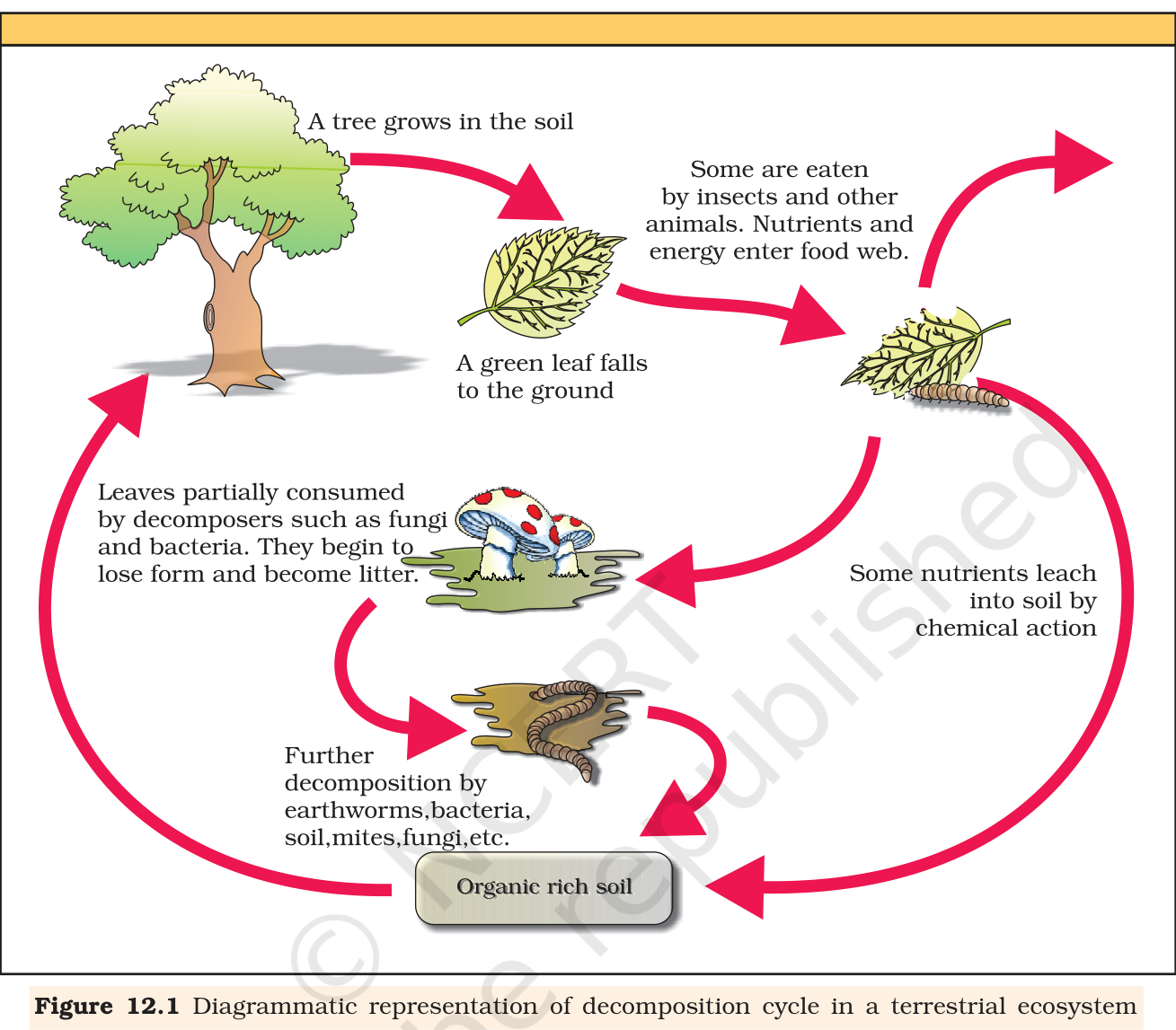
An ecosystem works as a unit through four processes. Productivity is the capture and conversion of solar energy into biomass. Decomposition breaks dead organic matter back into simpler substances. Energy flow carries that energy from one trophic level to the next. Nutrient cycling keeps the chemical elements moving between the living and non-living parts.
1.4 A pond as a model
A pond shows all four processes clearly. Its abiotic component is water with dissolved substances and the bottom soil. Sun and temperature govern how fast the pond works. Phytoplankton and algae, together with the plants that float, submerge or root at the margins, are its producers. The consumers are zooplankton and the free-swimming and bottom-dwelling animals. Fungi, bacteria and flagellates, especially in the bottom mud, are the decomposers.
The pond does what the biosphere does on a larger scale. Autotrophs use sunlight to turn inorganic material into organic matter. Heterotrophs eat the autotrophs. Dead matter is decomposed and mineralised so the inorganic nutrients return for reuse. These events repeat endlessly. Energy, however, moves only one way, towards higher trophic levels, and is eventually lost as heat.
1.5 Ecosystem services
The products of ecosystem processes are called ecosystem services. Forests purifying air and water is the standard example. The term matters in exams because it links this chapter to the economics of conservation.
1.6 Why the boundaries are blurred
The division into terrestrial and aquatic, or natural and man-made, is a convenience rather than a rule of nature. A wetland grades into a grassland, and a river carries terrestrial material into the sea, so an ecosystem's edges are not sharp walls. What makes the idea useful is that energy and matter can be followed through a defined unit. Once the boundary is drawn, the same four processes can be measured inside it. A crop field is a good example: it needs ploughing, sowing and harvesting, and much of its energy input comes from humans rather than from the sun directly. That is why a field is a man-made ecosystem and not a self-sustaining one.
1.7 Climate as a controller
A second controlling influence is climate. The same species composition will produce different amounts of biomass in a warm wet year and in a cold dry one, because temperature and moisture decide how long the growing season lasts. This is why productivity values are always reported for a stated period and a stated place. It is also why comparing a tropical forest with a temperate forest on a single number hides more than it shows. The comparison that matters is between ecosystems measured over the same length of time and in comparable conditions. A single season is rarely enough, because one good rainfall year can make a dry region look productive.
1.8 Inputs, transfers and outputs
Another way to see the four processes is as an input, a set of transfers and an output. Solar energy is the input, and productivity is the rate at which the system takes it in. Energy flow and nutrient cycling are the transfers inside the system, one carrying energy to consumers and the other returning elements to the producers. The output is the loss of energy as heat and the degradation of organic material back to inorganic form. Seeing the ecosystem this way explains why it needs a constant energy supply while matter keeps circulating: energy passes through once, matter goes round many times.