

Concepts: Energy flow and ecological pyramids
Ecosystem19 min readLesson 3 of 5
3.1 The source of energy
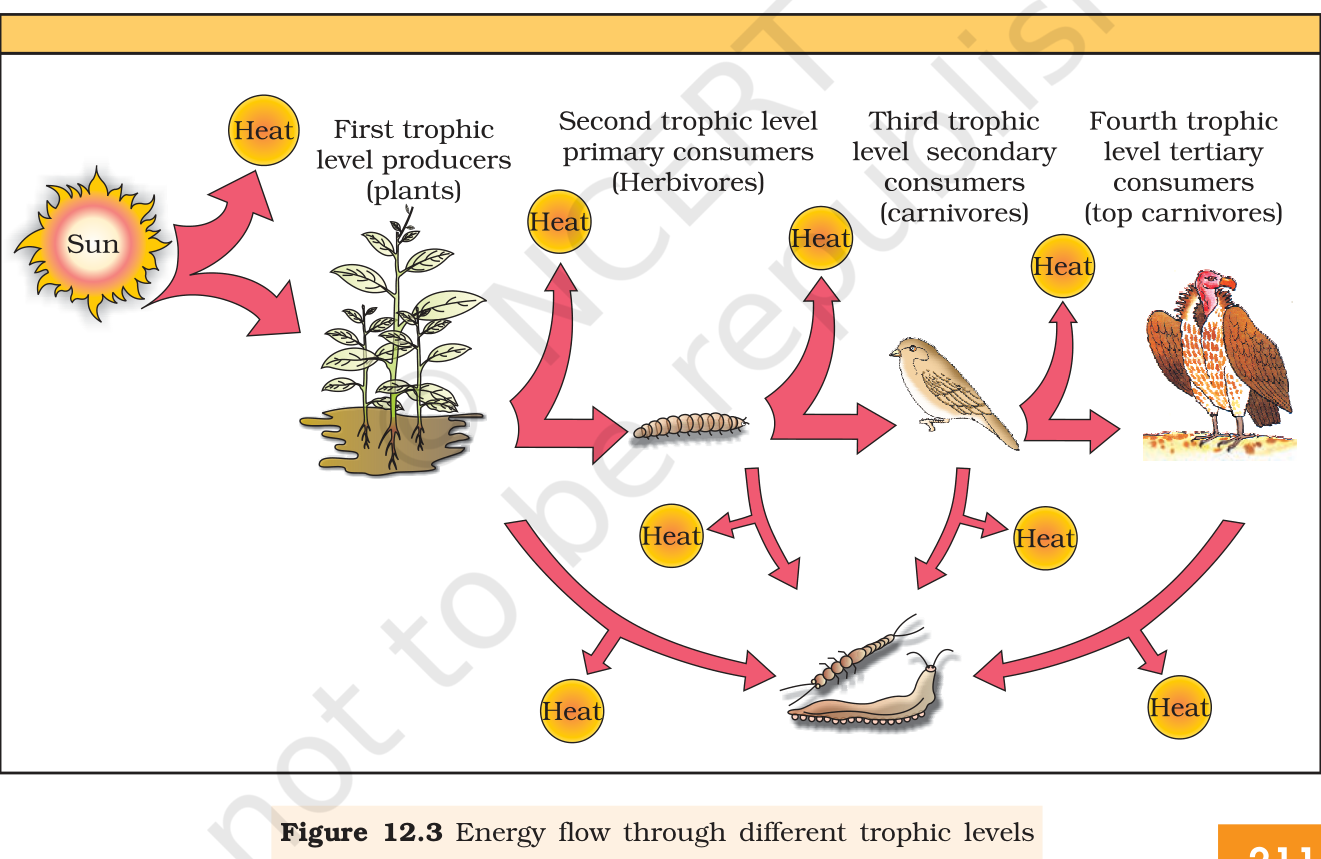
Away from the deep sea hydrothermal vents, the sun is the only energy source for ecosystems on earth. Less than half of the incoming solar radiation is photosynthetically active radiation, or PAR, the part plants can use. Plants capture only 2 to 10 per cent of that PAR, and this small fraction supports the entire living world. Following that energy through the ecosystem is the subject of this section.
Energy travels in one direction only: from the sun to producers, then to consumers. Every organism depends on producers for food, directly or indirectly, so energy never travels back from a consumer to the sun. The unidirectional path is consistent with the first law of thermodynamics, which says energy is neither created nor destroyed, only changed in form. Ecosystems are also subject to the second law: they need a continuous energy supply to build ordered molecules against the general tendency towards disorder.
3.2 Producers, consumers and food chains
Green plants are the producers. In a terrestrial ecosystem the main producers are herbaceous and woody plants; in an aquatic one they are phytoplankton, algae and higher plants. Animals are consumers, also called heterotrophs. Those that eat producers are primary consumers, and those that eat primary consumers are secondary consumers, and so on. Primary consumers are herbivores. The consumers that feed on herbivores are carnivores, more precisely primary carnivores.
A grazing food chain begins with a producer. Grass, eaten by a goat, eaten by a man, is the standard example. A detritus food chain begins with dead organic matter and is run by decomposers, mainly fungi and bacteria, also called saprotrophs. Decomposers release digestive enzymes that break dead and waste material into simple inorganic substances, which they then absorb.
In an aquatic ecosystem the grazing food chain is the main route for energy flow. In a terrestrial ecosystem a much larger share of energy travels through the detritus food chain. The two chains connect at points: some detritus feeders are eaten by grazing-chain animals, and omnivores such as cockroaches and crows eat from both. These links turn food chains into a food web.
3.3 Trophic levels and standing crop
An organism's trophic level is its position in the food chain, decided by its source of nutrition. Producers sit at the first level, herbivores at the second and carnivores at the third. Energy falls at each step. The standing crop is the mass of living material at a trophic level at a particular time, measured as biomass or as number per unit area. Biomass is expressed as fresh or dry weight, and dry weight is the more accurate measure because water content varies with conditions.
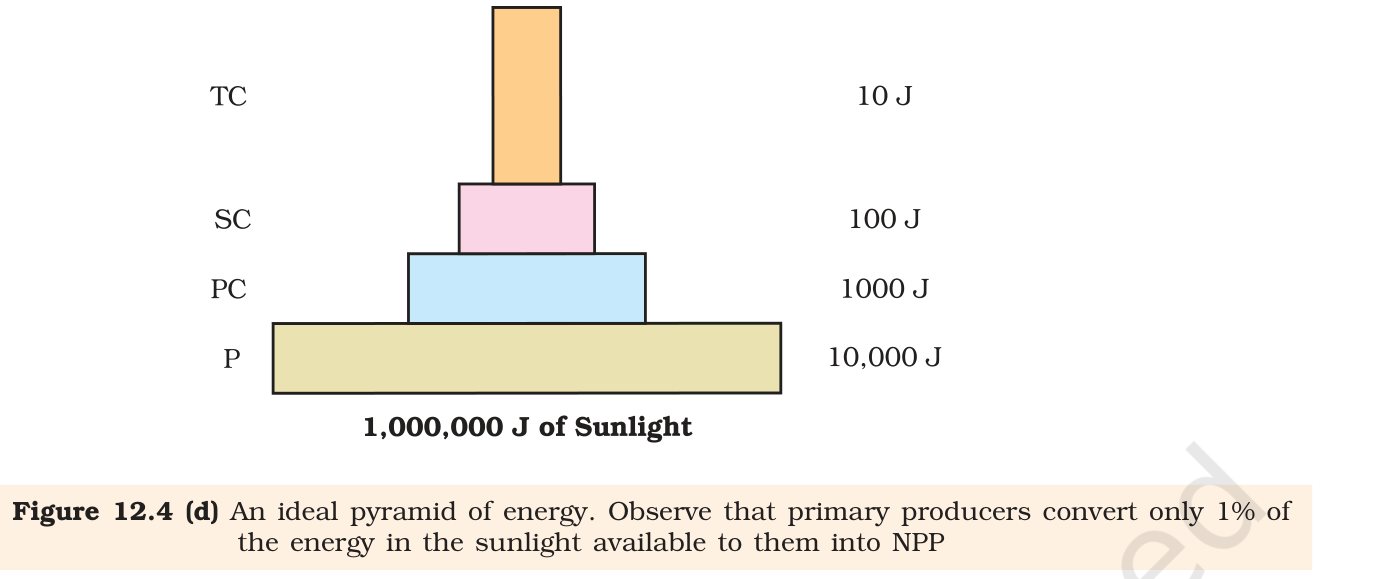
Energy transfer follows the ten per cent law: only about 10 per cent of the energy at one trophic level reaches the next. That is why grazing food chains have only a few levels. In practice a chain can hold a producer, a herbivore, a primary carnivore and a secondary carnivore, and no more.
3.4 Ecological pyramids
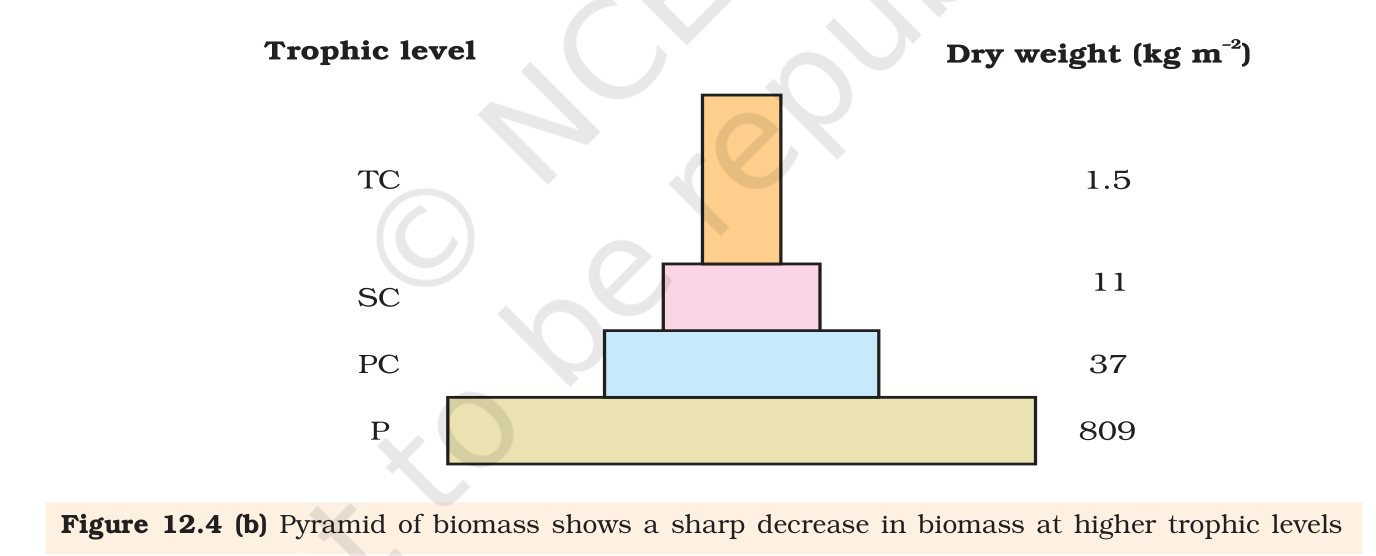
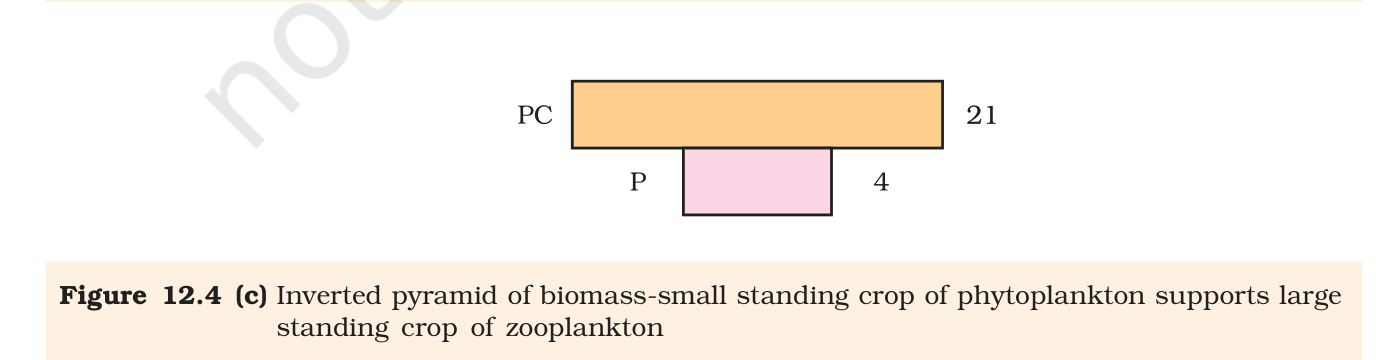
An ecological pyramid shows the relationship between trophic levels in terms of number, biomass or energy. Its base is the producer level and its apex is the top consumer. There are three kinds: the pyramid of number, the pyramid of biomass and the pyramid of energy (Figure 12.4).
In most ecosystems all three are upright, with producers more numerous and heavier than herbivores, and herbivores more numerous and heavier than carnivores; energy is also always greater at lower levels. There are exceptions. A single big tree supporting many insects, then small birds, then larger birds, gives an inverted pyramid of numbers. The pyramid of biomass in a sea is generally inverted because fish weigh far more than the phytoplankton under them; the phytoplankton turn over very fast, so a small standing crop can support a large one above it. The pyramid of energy is never inverted, because energy is lost as heat at every transfer.
Pyramids have limits, and those limits are often a full question on their own. The limits come from the same simplification that makes a pyramid easy to read: a single bar stands for a whole trophic level, which assumes a clean chain and a fixed place for every species. They do not allow for a species that occupies two or more trophic levels at once, they assume a simple food chain where nature has a web, and they give saprophytes no place at all.
Slideshow, slide 1 of 4. Use the left and right arrow keys to change slides and the space bar to play or pause.
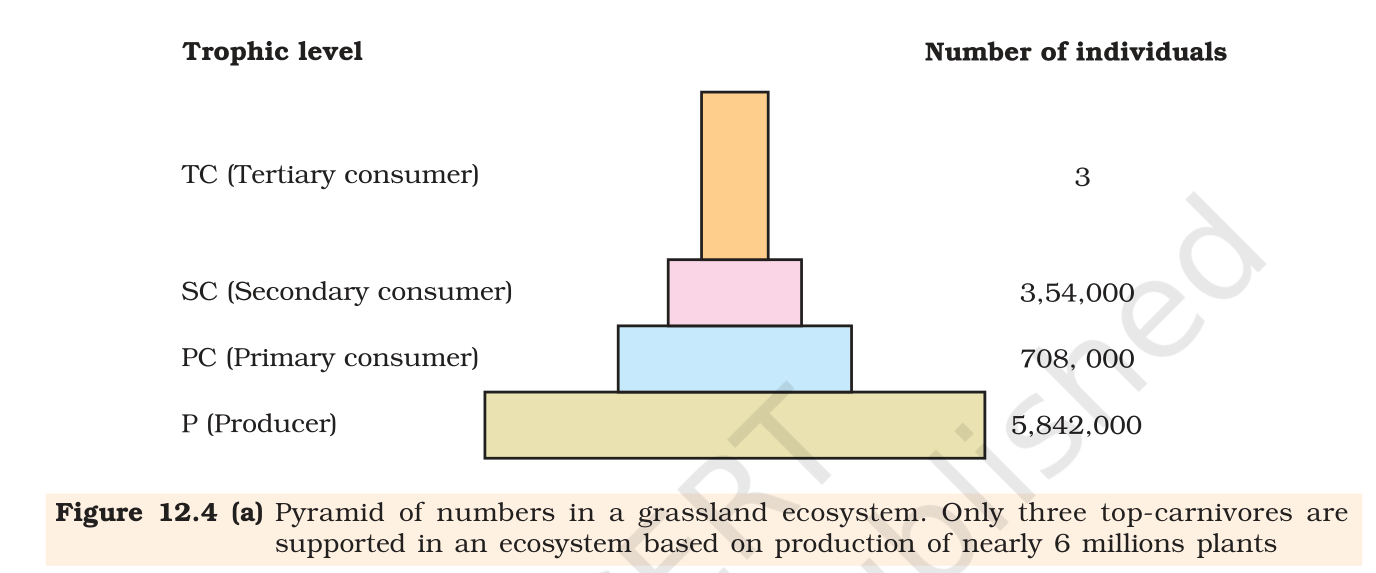
A pyramid of numbers for a grassland, with millions of grass plants at the base and only three top carnivores at the apex.