

Concepts: bonding theories, colour, magnetism and stability
Coordination Compounds22 min readLesson 3 of 6
3.1 Valence bond theory in practice
Valence bond theory treats the metal ligand bond as a coordinate bond in which the ligand donates a lone pair into an empty hybrid orbital of the metal. The hybridisation is chosen to match the observed geometry: sp3 for tetrahedral, dsp2 for square planar, d2sp3 for an inner orbital octahedron and sp3d2 for an outer orbital octahedron. The d orbital used in d2sp3 comes from the inner (n-1)d set, which is why the complex is called inner orbital. Whether a strong field ligand forces pairing decides whether the inner d orbital is available: a strong ligand pairs the electrons and frees a d orbital for hybridisation.
The theory explains geometry, magnetic behaviour and the difference between inner and outer orbital complexes. It cannot explain why different ligands give different colours, why the moment changes gradually with ligand strength, or the observed order of ligand strengths. Those gaps led to crystal field theory.
3.2 Crystal field theory
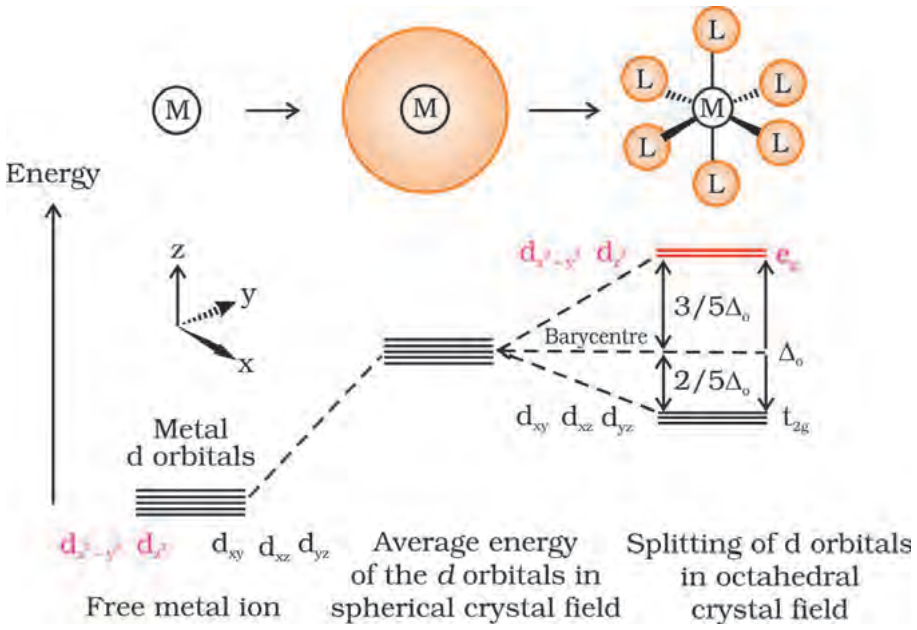
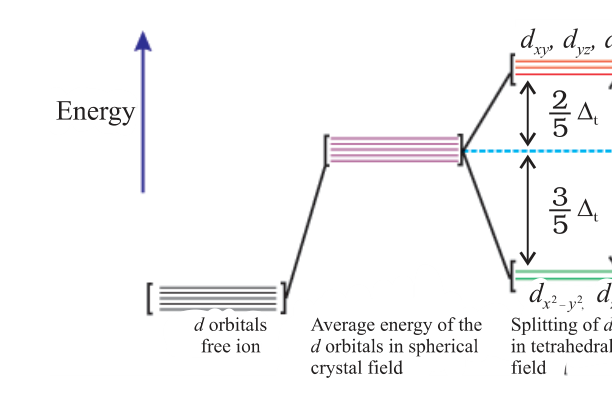
Crystal field theory treats the ligands as negative point charges that repel the metal d electrons. In an octahedral field the six ligands lie on the axes, so the d orbitals pointing along the axes, dz2 and dx2-y2, are raised in energy and form the eg set, while the dxy, dyz and dxz orbitals lie between the axes and form the lower t2g set. The energy gap between the sets is Δo, also called 10 Dq. In a tetrahedral field the splitting is inverted and smaller, with Δt equal to four ninths of Δo for the same ligands.
The size of Δo depends on the metal and on the ligand. The spectrochemical series arranges ligands from weak field to strong field as iodide, bromide, chloride, fluoride, water, ammonia, en, cyanide and carbon monoxide. For a given metal, a strong field ligand produces a large splitting. When Δo is larger than the pairing energy P, the electrons pair in the lower t2g set and the complex is low spin; when Δo is smaller than P, the fourth electron enters eg and the complex is high spin.
3.3 Colour and magnetism from the theory
Colour arises when a d electron is promoted across the gap by absorbing light of the corresponding energy. The colour observed is the complement of the light absorbed. Because Δo depends on the ligand, the same metal gives different colours with different ligands; [Ni(H2O)6]2+ is green while [Ni(CN)4]2- is colourless because the cyanide complex has a completely filled d subshell after pairing. The magnetic moment follows from the number of unpaired electrons. [Fe(CN)6]3- has one unpaired electron and a moment near 1.73 BM, while [FeF6]3- has five and a moment near 5.92 BM, so the ligand alone changes the magnetism of the same iron oxidation state.
The crystal field stabilisation energy is the energy gained by the electrons in the split d levels relative to the barycentre. Filling the lower t2g set stabilises the complex, so the CFSE is negative for an octahedral complex and is calculated as minus 0.4Δo times the number of t2g electrons plus 0.6Δo times the number of eg electrons. For a d3 ion the CFSE is minus 1.2Δo, and for a d5 high spin ion it is zero because two electrons sit in eg and three in t2g. The theory also predicts the tetragonal distortion of some complexes, which is why some copper(II) complexes are distorted octahedra.
3.4 Stability and applications
The stability of a complex is described by its formation constant, and a larger constant means the complex holds its ligands more strongly. The chelate effect raises stability when a polydentate ligand forms several rings with the metal, because the entropy change of releasing several monodentate ligands is favourable. EDTA binds calcium strongly enough to be used as a titrant and to remove scale from boilers, and the same chelating property explains why it is used in food fortification to keep iron available.
Coordination compounds are central to biology and medicine. Haemoglobin carries oxygen with an iron complex and chlorophyll captures light with a magnesium complex. Vitamin B12 contains cobalt. Cisplatin, a square planar platinum complex, is used in cancer chemotherapy. Silver thiosulphate is used to fix photographic images, and Wilkinson's catalyst is used in hydrogenation. Each case uses the same idea: a metal ion with the right ligands performs a job that neither the free metal nor the free ligand can do.
3.5 Worked CFSE examples
Example 1: d3 octahedral. Three electrons occupy t2g singly, so the CFSE is minus 1.2Δo. Example 2: d6 low spin. Six electrons occupy t2g as three pairs, so the CFSE is minus 2.4Δo. Example 3: d5 high spin. Three electrons in t2g and two in eg give a CFSE of zero. The calculations show why strong field ligands with their large Δo favour low spin complexes: the extra stabilisation from placing electrons in the lower set offsets the pairing energy. The same reasoning explains why [Fe(CN)6]3- is low spin while [FeF6]3- is high spin.
3.6 A note on limitations
Crystal field theory treats the ligand as a point negative charge, so it ignores covalency and cannot explain the order of the spectrochemical series in full. It also predicts that every d1 copper(II) complex should have the same splitting, which is not what experiment shows. The theory is still useful because it predicts colour and magnetism well, and the failure of the point charge model is the reason ligand field theory and molecular orbital theory were developed later.