

Concepts: Werner's theory, nomenclature and isomerism
Coordination Compounds22 min readLesson 2 of 6
2.1 Werner's theory
Alfred Werner explained coordination compounds by giving the metal two kinds of valence. The primary valence is the ordinary ionic valence, satisfied by negative ions, and it is ionisable. The secondary valence is the coordination number, satisfied by neutral molecules or ions that donate a lone pair, and it is not ionisable in solution. The geometry of the complex follows from the secondary valence: six gives an octahedron, four gives a tetrahedron or a square plane. The theory explained the number of chloride ions precipitated by silver nitrate from different cobalt ammine chlorides, which chemistry had not explained before.
The modern reading is that the primary valence corresponds to the oxidation state and the secondary valence to the number of donor atoms. The number of ions that can be precipitated now becomes a test of how many ligands are outside the coordination sphere. That single idea solves most questions about the structure of a complex from its conductivity or its precipitation data.
2.2 Terms and the effective atomic number
The central metal with its ligands forms the coordination entity or complex ion. The ligands are classified by the number of donor atoms as monodentate, bidentate or polydentate. Ethane-1,2-diamine (en) and oxalate are bidentate, while EDTA has six donor sites and is hexadentate. A chelate is a complex in which a polydentate ligand grips the metal at two or more points, and the chelate effect makes such complexes more stable than comparable monodentate ones.
The effective atomic number is the total number of electrons around the metal after coordination. Sidgwick noted that many stable complexes have an EAN equal to the next noble gas, which is 36 for the first row transition metals. The rule is a useful bookkeeping check but not a law, since many stable complexes do not reach a noble gas count. The calculation is (Z - x) + 2n, with Z the atomic number, x the oxidation state and n the coordination number.
Slideshow, slide 1 of 3. Use the left and right arrow keys to change slides and the space bar to play or pause.
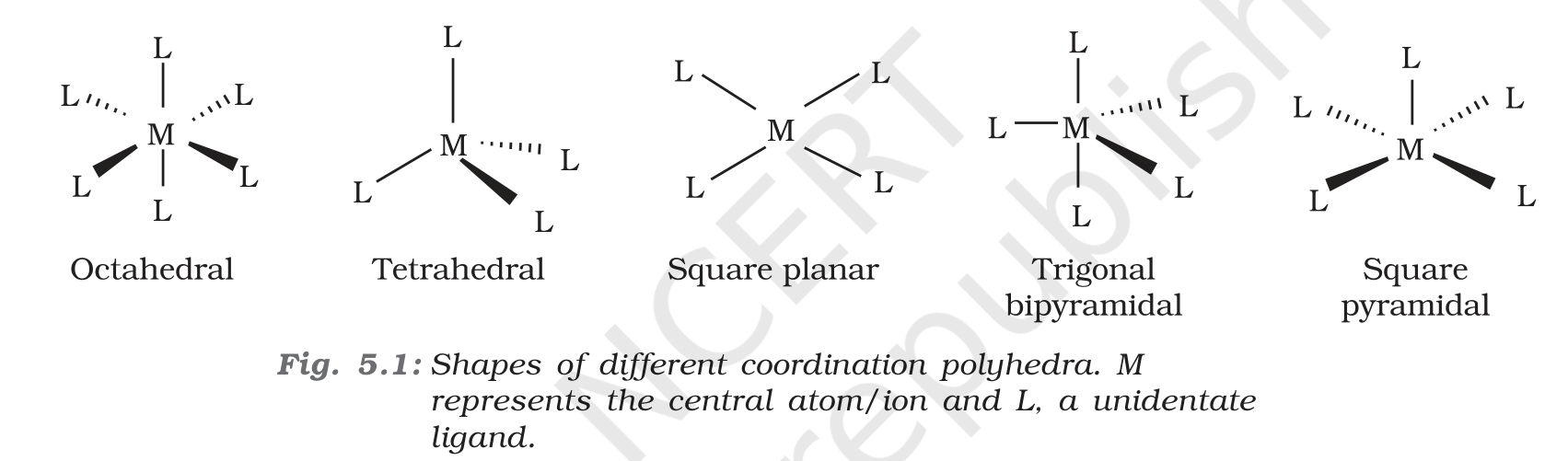
Shapes of different coordination polyhedra: octahedral, tetrahedral, square planar, trigonal bipyramidal and square pyramidal.
2.3 Nomenclature in practice
The rules are few but they must be applied in order. Name the cation first, then the anion. Inside the coordination entity, list the ligands alphabetically, ignoring any multiplying prefix. Use di, tri, tetra for simple ligands and bis, tris, tetrakis for names that already contain a prefix or for complicated ligands. Name the metal with its oxidation state in Roman numerals. Anionic complexes take the suffix ate on the metal name: ferrate, cuprate, cobaltate, nickelate.
A ligand that can attach through two different atoms is called ambidentate, and the atom through which it is attached is shown by the element symbol in italics after the ligand name. The nitrite ion can attach through nitrogen (nitrito-N) or through oxygen (nitrito-O). The thiocyanate ion can attach through S (thiocyanato-S) or through N (thiocyanato-N). When the coordination entity is neutral the metal name has no charge suffix, and when it is an ion the charge is not shown in the name because it follows from the oxidation state and the ligand charges.
2.4 Isomerism in coordination compounds
Structural isomerism includes ionisation isomerism, where the counter ion and a ligand exchange places as in [Co(NH3)5SO4]Cl and [Co(NH3)5Cl]SO4. Hydration isomerism is the same idea with water as the exchanged species. Linkage isomerism appears when an ambidentate ligand is attached through different donor atoms. Coordination isomerism occurs in compounds with both cation and anion complexes, where ligands are distributed differently between the two metal centres, as in [Co(NH3)6][Cr(CN)6] and [Cr(NH3)6][Co(CN)6].
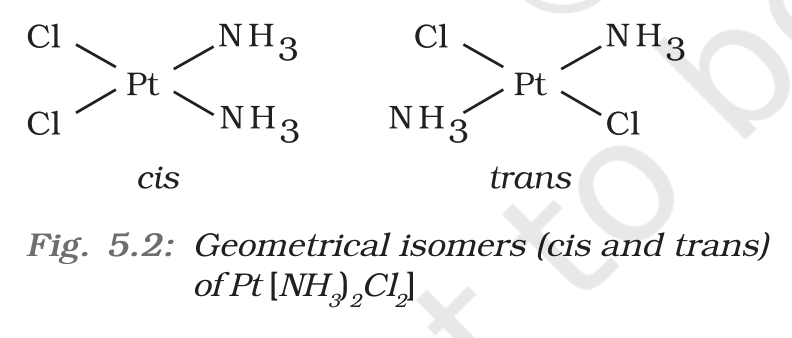
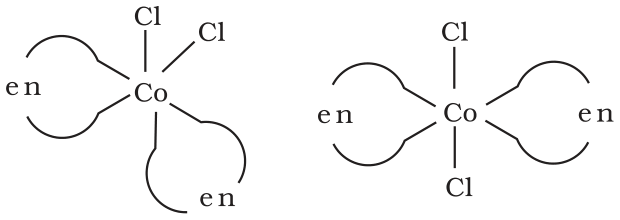
Stereoisomerism includes geometrical and optical isomerism. Square planar complexes of the type MA2B2 show cis and trans forms, and octahedral complexes of the type MA4B2, MA3B3 and M(AA)2B2 also show geometrical isomers. Optical isomerism appears when a complex and its mirror image are not superimposable, which happens for octahedral complexes with bidentate ligands, such as the two enantiomers of [Co(en)3]3+. The cis form of [PtCl2(en)2]2+ is optically active while the trans form is not, because the trans form has a plane of symmetry.
2.5 Worked naming examples
Example 1: [Co(NH3)4Cl2]Cl. The complex cation has four ammonia ligands and two chlorides, and cobalt is +3, so it is tetraamminedichloridocobalt(III) chloride. Example 2: K2[PtCl6]. The complex is an anion, so platinum becomes platinate, and the six chlorides give hexachloridoplatinate(IV), with two potassium ions as counter cations. Example 3: [Ni(CO)4]. Carbon monoxide is a neutral ligand and nickel is in the zero oxidation state, so the name is tetracarbonylnickel(0).
2.6 Common mistakes
Writing the metal before the ligands, using the old prefix names for ligands, or leaving out the Roman numeral are the usual errors. A second group of mistakes concerns charge: the number of counter ions must be chosen so that the whole formula is neutral. In isomerism questions, students often list geometrical isomers but forget optical isomerism, or claim that a trans square planar complex is optically active when it has a mirror plane. The cis form of a square planar complex can be optically active only in special cases; the standard example of optical isomerism in this chapter is the tris-chelate octahedral complex.
The safest way to learn nomenclature is to name ten complexes aloud, writing the ligand list in alphabetical order each time. After ten examples the order of the rules becomes automatic and the Roman numeral becomes the last thing that has to be checked.