

Concepts: position, configurations and periodic trends
The d- and f-Block Elements20 min readLesson 2 of 6
2.1 Where the blocks sit
The d block lies between the s block and the p block, and the f block is placed at the bottom of the periodic table as the inner transition series. The first row of transition metals runs across the fourth period from scandium to zinc. Because the (n-1)d electrons are shielded from the nucleus by the outer ns electrons, these elements behave more like a family than the main group elements do: neighbours are similar in size, ionisation energy and chemistry.
2.2 Electronic configurations
The general configuration of the first row is 3d1 to 3d10 in the ground state with 4s electrons, and the filling order is after the 4s subshell. Two cases break the rule. Chromium prefers 3d5 4s1 because a half filled d subshell is stable, and copper prefers 3d10 4s1 because a completely filled d subshell is stable. In their ions the 4s electrons are lost first, so chromium(II) is 3d4 and copper(II) is 3d9, which is why both form coloured salts.
2.3 Atomic and ionic radii
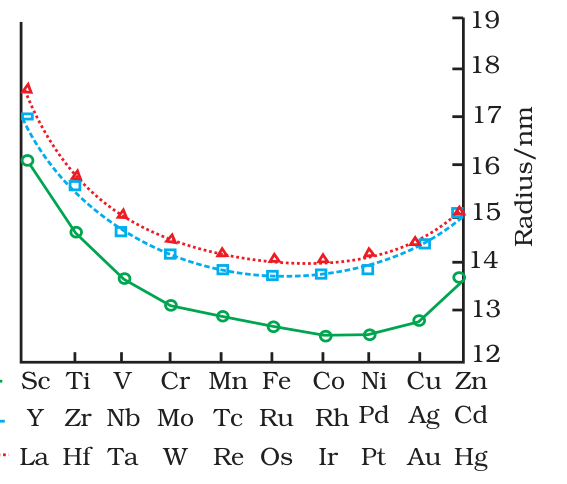
Across a series the atomic radius falls at first, reaches a minimum near the middle and then rises slightly. The fall is caused by increasing nuclear charge pulling the outer electrons in while the added d electrons shield the outermost electrons poorly. The later rise is small and is not a dramatic effect. Ionic radius follows the same pattern, with ions of higher oxidation state being smaller. For the lanthanoids the radius falls steadily from lanthanum to lutetium; this lanthanoid contraction is caused by the poor shielding by 4f electrons and it is why the second and third transition rows have almost the same size.
2.4 Melting point, density and ionisation enthalpy
Transition metals have high melting points and high densities because both the ns and the (n-1)d electrons enter the metallic bonding. Melting point rises to a maximum near the middle of the series, where the largest number of unpaired d electrons can contribute to bonding, and then falls toward copper and zinc. Zinc has the lowest enthalpy of atomisation in the row because its d subshell is full and takes no part in bonding. Density rises across the series as the atoms become smaller and the mass increases. Ionisation enthalpy rises slowly because the increasing nuclear charge is largely offset by the extra d electrons being removed from a similar shell, so the 3d series does not show the sharp jumps seen in the p block.
Slideshow, slide 1 of 4. Use the left and right arrow keys to change slides and the space bar to play or pause.
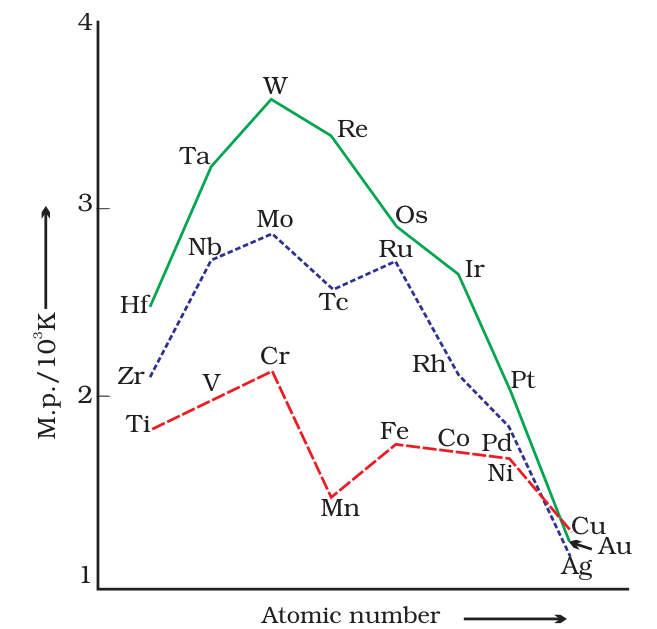
Trends in melting points of the first, second and third transition series, showing a maximum near the middle of each series.
2.5 Oxidation states
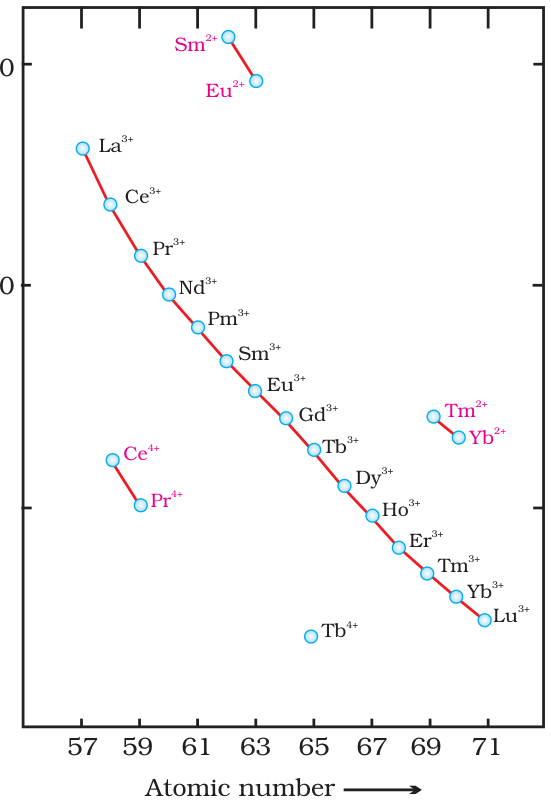
Transition metals show a variety of oxidation states because the ns and (n-1)d electrons have comparable energies and can both be used for bonding. Across the first row the maximum oxidation state rises to +7 at manganese, and the highest states occur in oxides and oxoanions rather than in simple salts. In the lanthanoids the +3 state dominates, and in the actinoids the range is wider because the 5f, 6d and 7s orbitals lie close in energy. The non-transition elements show fewer states, and their states differ by two, whereas transition metals commonly show states differing by one.
2.6 Two worked reasoning steps
Example 1: why Zn is not a transition element. The zinc atom is 3d10 4s2 and the Zn2+ ion is 3d10. In both the d subshell is complete, so there is no partially filled d subshell and zinc does not count as a transition element even though it sits inside the d block. Example 2: why copper is one. Copper is 3d10 4s1, but in the Cu2+ ion the configuration is 3d9, with one hole in the d subshell, so copper does count.
2.7 A comparison of the three rows
The three transition series differ in the subshell that is filled and in the shielding around the nucleus. The 3d row is the smallest and has no lanthanoid contraction ahead of it, while the 4d and 5d rows lie after the lanthanoids and therefore start with nearly the same radii. That is why the 5d metals are denser and why their chemistry resembles that of the 4d metals so closely. The table below summarises the general trend.
| Property | Across a series | Reason |
|---|---|---|
| atomic radius | falls, then rises slightly | poor d shielding, then d-d shielding |
| melting point | rises to a middle maximum, then falls | number of unpaired d electrons available for bonding |
| density | rises | smaller size with larger mass |
| ionisation enthalpy | rises slowly | nuclear charge offset by d shielding |
| oxidation states | variety of states | ns and (n-1)d electrons close in energy |
2.8 Worked example and common mistakes
Example: magnetic moment. Find the spin only moment of Fe3+. Iron is 3d6 4s2, so Fe3+ is 3d5. There are five unpaired electrons, so the moment is the square root of 5 times 7, which is 5.92 BM. A common mistake is to count the total d electrons instead of the unpaired ones, which gives the wrong value for a paired configuration. Another mistake is to use the formula for a d9 ion as if all nine electrons were unpaired; only the single hole counts, so Cu2+ has one unpaired electron and 1.73 BM. Write the configuration, mark the unpaired electrons, then substitute n. In a question about the most stable ion in water, compare configurations such as d3, d5 and d10, because a half filled or completely filled subshell is the usual reason for stability.
A useful check on any trend answer is to name the competing effects first, then say which one wins across the series. That structure earns the reasoning marks even when the final sentence is short.