

Concepts: reactivity, colour, magnetic behaviour and the f block
The d- and f-Block Elements22 min readLesson 3 of 6
3.1 How reactive are the transition metals
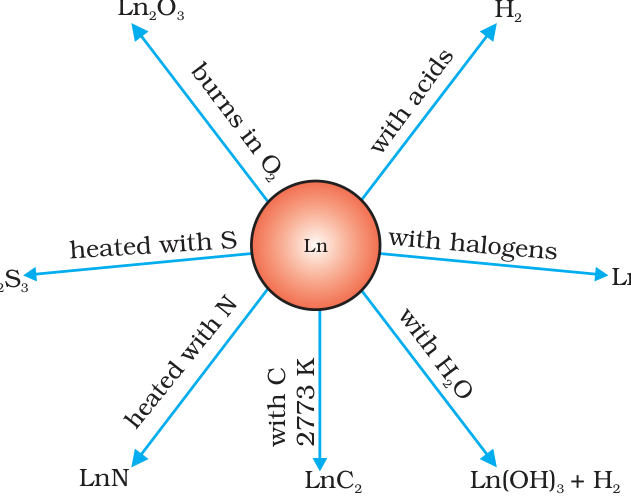
Most transition metals are moderately reactive metals. They displace hydrogen from dilute acids only when their standard potential is below that of the hydrogen couple, so zinc and iron do so while copper and silver do not. The metal surfaces often carry a thin oxide film that slows further reaction, which is why titanium and chromium look unreactive although they are thermodynamically able to react. The highest oxidation states appear in oxides and oxoanions, where the small, highly charged metal ion is stabilised by a strongly basic oxide ion.
3.2 Colour and electronic transitions
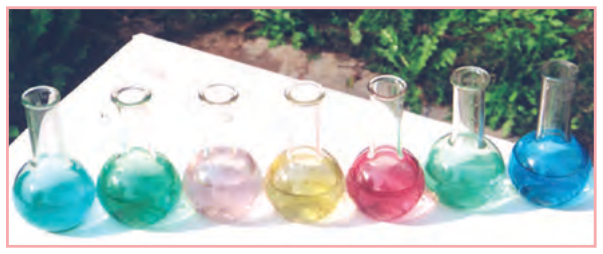
A transition metal complex is coloured when a partly filled d subshell allows an electron to move from the lower set of d orbitals to the higher set by absorbing light of a visible wavelength. What the eye sees is the complement of the wavelength removed. The size of the gap changes with the metal, its oxidation state and the ligands, so one metal can appear in different colours with different ligands. An ion with a d0 or d10 configuration has no such transition and is colourless, unless a charge transfer band supplies the colour. Permanganate is the standard example of colour from charge transfer rather than from d-d absorption.
3.3 Magnetic behaviour
Unpaired electrons make a substance paramagnetic, while a completely paired configuration is diamagnetic. Count the unpaired electrons, call that count n, and put it into the spin only expression for the moment in Bohr magnetons. For first row transition ions this expression matches experiment closely, since the ligand field largely quenches the orbital part of the moment. A measured moment close to 1.73 BM points to one unpaired electron, near 2.83 BM to two, near 3.87 BM to three, 4.90 BM to four and 5.92 BM to five. The comparison between a measured and a spin only value is a standard way to infer the electronic configuration, especially for deciding between high spin and low spin complexes.
3.4 Catalysis and interstitial compounds
Transition metals are good catalysts because they can change oxidation state easily, adsorb reactants on their surface and form intermediate compounds that decompose to products. Iron in ammonia synthesis, nickel in hydrogenation and platinum in oxidation are common examples. The metals also form interstitial compounds when small atoms such as hydrogen, boron, carbon or nitrogen occupy the voids in the metal lattice. These compounds are often non-stoichiometric, are harder and higher melting than the parent metal, and retain metallic conductivity. Alloys such as steel and brass form because atoms of similar size can replace one another in the lattice.
3.5 Permanganate and dichromate
Potassium permanganate and potassium dichromate are the two important oxidising agents of the chapter. Acidified permanganate oxidises iron(II) to iron(III), oxalate to carbon dioxide and iodide to iodine, and it is decolourised in each case. Acidified dichromate oxidises iodide to iodine and iron(II) to iron(III). The chromate and dichromate ions interconvert with pH: in acid the orange dichromate dominates, while in alkali the yellow chromate is formed. Permanganate heated on its own gives potassium manganate, and in strong alkali it can be reduced to manganate as well.
3.6 The lanthanoids and actinoids
The lanthanoids fill the 4f subshell and the actinoids fill the 5f subshell. Lanthanoids are electropositive, form mainly ionic compounds and are almost always +3, with Ce4+ and Eu2+ as the common exceptions. Their radii fall steadily across the series, the lanthanoid contraction, and the colour and magnetic moment arise from f electrons. The actinoids resemble the lanthanoids but show a wider range of oxidation states because the 5f, 6d and 7s orbitals are close in energy, and all of them are radioactive. The chemistry of the early actinoids is dominated by the +6 and +5 states in oxoanions, while the later members settle at +3. The actinoid contraction is larger than the lanthanoid contraction because 5f electrons shield the nucleus less effectively than 4f electrons.
3.7 Worked examples with the two oxidising agents
Example 1: permanganate with iron(II). Balance the half reactions in acid. Permanganate gains five electrons and iron(II) loses one, so five iron ions are needed per permanganate ion. The equation is MnO4- plus 5Fe2+ plus 8H+ giving Mn2+ plus 5Fe3+ plus 4H2O. The permanganate colour disappears at the end point, which is why no indicator is needed.
Example 2: dichromate with iodide. Dichromate gains six electrons and each iodide loses one, so one dichromate ion oxidises six iodide ions. The equation is Cr2O7(2-) plus 14H+ plus 6I- giving 2Cr3+ plus 3I2 plus 7H2O, and the solution turns green from the Cr3+ formed.
3.8 Common mistakes
Writing the permanganate reduction as if it gave MnO2 in acidic medium is a common slip; the product depends on the medium, and acidic conditions give Mn2+. Mixing the chromate and dichromate formulas, or forgetting the hydrogen ions in the balanced equation, costs marks in the equation question. In colour questions, saying that an ion is coloured because it has unpaired electrons is not enough, because the colour needs a partly filled d subshell and a d-d transition, unless charge transfer is responsible.
Example 3: colour and configuration. A d0 ion such as Ti4+ and a d10 ion such as Zn2+ are both colourless, because neither can have a d-d transition. An ion with a partly filled d subshell, such as Cu2+ with d9, is coloured. Stating the d count and then the transition makes the reason complete in one line.