

Carbohydrates: classification, structure and reactions
Biomolecules20 min readLesson 2 of 5
2.1 What carbohydrates are
A carbohydrate is a polyhydroxy aldehyde or ketone, or a compound that gives one on hydrolysis. The name comes from the old ratio of carbon and water in glucose, and the formula Cn(H2O)m still fits the simple sugars. They are made by plants during photosynthesis and are the main energy store of animals.
Classification follows the number of units. Monosaccharides cannot be hydrolysed into smaller sugars and include glucose, fructose, ribose and deoxyribose. Disaccharides contain two units and include sucrose, maltose and lactose. Polysaccharides contain many units and include starch, cellulose and glycogen. A further split matters for the tests: a sugar that reduces Tollens or Fehling reagent is a reducing sugar, and sucrose, with both anomeric carbons used in the linkage, is not.
2.2 The structure of glucose
The formula C6H12O6 fits an aldohexose. Evidence comes in a chain. Glucose reduces Tollens reagent and reacts with HCN, so it has an aldehyde group. Acetylation gives a penta-acetate and methylation gives a penta-methyl derivative, which shows five hydroxyl groups. Oxidation with nitric acid gives saccharic acid, which shows that carbon 1 and carbon 6 are both oxidisable ends of a six carbon chain. Prolonged bromine water oxidation gives gluconic acid and confirms the aldehyde. Glucose is optically active, and its two enantiomers are the D and L forms; ordinary sugar is the D form.
The straight chain does not answer everything, because glucose does not show some of the reactions expected of a free aldehyde, such as a normal bisulphite addition. The explanation is that the aldehyde group closes with the hydroxyl on carbon 5 to form a six membered ring, a cyclic hemiacetal, which leaves a new chiral centre at carbon 1. The two arrangements at that new centre are called anomers, and alpha and beta glucose are the two anomers. The six membered ring is the pyranose form and the five membered form from fructose is the furanose form.
2.3 Reactions of glucose and fructose
Glucose reacts with hydrogen cyanide to give a cyanohydrin, which confirms the aldehyde group and extends the chain by one carbon. With hydroxylamine it gives an oxime, and with phenylhydrazine it gives an osazone. Bromine water oxidises it to gluconic acid, and nitric acid oxidises both ends to saccharic acid. Acetic anhydride gives the penta-acetate, and methyl iodide with silver oxide gives the methylated ether.
Fructose is a ketohexose and behaves differently in two useful ways. It does not react with bromine water, because a ketone is not oxidised by it, so bromine water separates glucose from fructose. It does react with Tollens and Fehling reagent, because fructose tautomerises in dilute alkali to a mixture that includes glucose and mannose, and those reduce the reagent. Fructose with hydrogen cyanide gives a cyanohydrin, and the ring form is a furanose.
2.4 Disaccharides and polysaccharides
Two monosaccharide units join through a glycosidic linkage: the anomeric carbon of one sugar bonds to a hydroxyl of the other with loss of water. Sucrose is made from one molecule of glucose and one of fructose, and both anomeric carbons take part, so it has no free reducing end and does not reduce Tollens reagent. Maltose is two glucose units with one free anomeric carbon, so it does reduce. Lactose is glucose plus galactose and reduces as well.
Starch and cellulose are both polymers of glucose, but the linkage differs. Starch is a mixture of amylose, a straight chain, and amylopectin, a branched chain, and the human body digests it. Cellulose has beta linkages, which gives a straight rigid chain that packs into fibres; human digestive enzymes cannot break beta linkages, so cellulose passes through as dietary fibre. Glycogen, the animal storage carbohydrate, is like amylopectin but more branched.
Slideshow, slide 1 of 3. Use the left and right arrow keys to change slides and the space bar to play or pause.
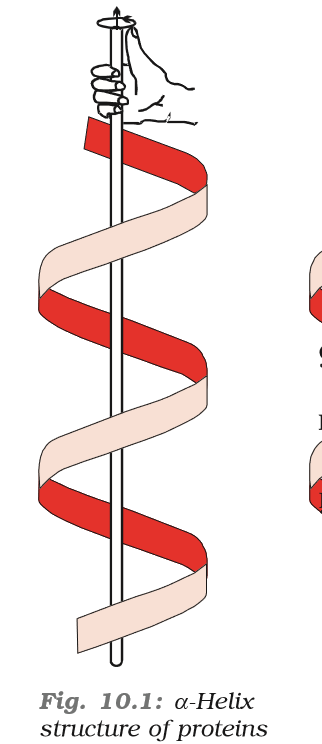
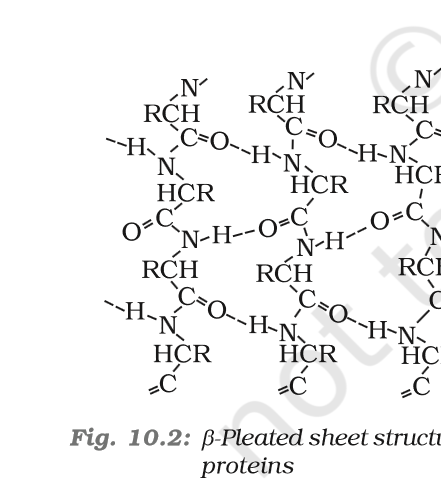
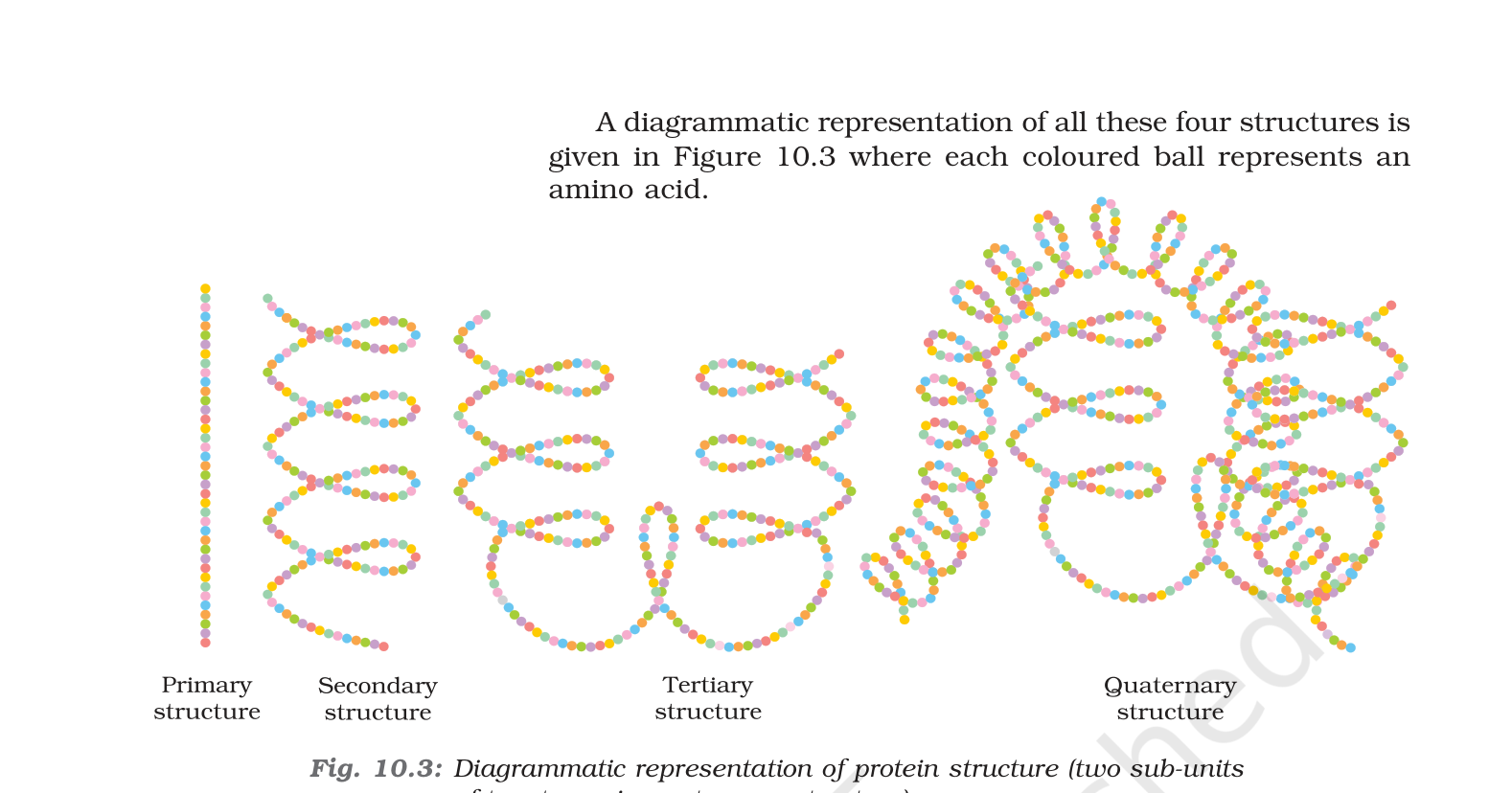
Alpha helix structure of a protein showing the coiled backbone held by hydrogen bonds between the NH and CO groups of the same chain.
2.5 Why the reducing end matters
The reducing behaviour of a sugar is decided by whether it has a free anomeric carbon that can open back to the aldehyde or ketone form in solution. Sucrose has both anomeric carbons locked in the glycosidic linkage, so it cannot open and cannot reduce. Maltose and lactose keep one anomeric carbon free, so they do reduce. This distinction explains the everyday observation that sucrose does not give a silver mirror while honey, which contains some invert sugar, does.
2.6 Exercise practice
10.1 and 10.2 structure questions. The number of chiral centres in glucose follows from its open chain: carbons 2, 3, 4 and 5 are stereocentres, and carbon 1 becomes one only in the ring form. Fructose has three in the open chain. A chain of n stereocentres can give at most 2 to the power n stereoisomers, so glucose can have up to sixteen including ring forms, which is why sugar chemistry has so many isomers.
10.3 and 10.4 tests. Tollens and Fehling identify a reducing sugar. Bromine water separates glucose from fructose. Iodine solution gives a blue colour with starch. Seliwanoff's test is not part of the NCERT list, so stick to the textbook tests in an exam.
10.5 sucrose hydrolysis. Boiling sucrose with dilute acid hydrolyses it to glucose and fructose; the mixture is called invert sugar because the sign of optical rotation changes from positive to negative as fructose has the larger laevorotation.
10.6 starch and cellulose. Both are glucose polymers, but starch has alpha linkages that human amylase can break and cellulose has beta linkages that it cannot. That single difference in linkage is the reason a potato is food while cotton is not.