

Proteins, enzymes, vitamins and nucleic acids with exercise practice
Biomolecules26 min readLesson 3 of 5
3.1 Amino acids and proteins
An amino acid has an amino group and a carboxyl group on the same carbon, the alpha carbon. Because both groups are present, the molecule exists as a zwitterion: the carboxyl group loses a proton to the amino group, so the molecule carries a positive charge on nitrogen and a negative charge on oxygen, and it is neutral overall only at a particular pH called the isoelectric point. Amino acids behave like salts, which is why they dissolve in water and have high melting points.
Two amino acids join when the carboxyl group of one and the amino group of the other lose water, forming a peptide bond. A dipeptide has two residues and one peptide bond, a tripeptide has three residues and two bonds, and a polypeptide has many. The sequence of residues is the primary structure. Hydrogen bonds between the NH and CO of the backbone coil the chain into an alpha helix or lay two chains side by side in a beta pleated sheet, and these are the secondary structures. Folding of the whole chain into a three dimensional shape by disulphide bridges, hydrophobic interactions and salt bridges gives the tertiary structure, and the assembly of several folded chains gives the quaternary structure, as in haemoglobin with its four subunits.
3.2 Enzymes
Enzymes are proteins that catalyse reactions in living systems. They are highly specific: an enzyme usually acts on one substrate and catalyses one reaction, which is why the body needs so many different enzymes. They are also efficient, speeding a reaction by a large factor under mild conditions of temperature, pH and pressure, where an industrial catalyst would need harsh conditions.
The active site is the part of the enzyme where the substrate binds. The lock and key model treats the site as a rigid shape that only the right substrate fits; the induced fit model allows the site to change shape slightly as the substrate binds. Enzymes can be denatured by heat, extremes of pH, and reagents such as heavy metal ions, because these break the hydrogen bonds and other weak interactions that hold the active shape. A denatured enzyme loses its activity and the loss is usually permanent.
3.3 Vitamins
Vitamins are organic compounds needed in small amounts for normal growth and health, and most cannot be made by the body. They are grouped by solubility. The fat soluble vitamins are A, D, E and K, stored in the liver and fatty tissue, so a deficiency takes time to appear but an excess can accumulate. The water soluble vitamins are B and C, and they are excreted in urine, so they must be taken regularly and an excess is usually harmless.
Vitamin A is needed for vision and its deficiency causes night blindness and xerophthalmia. Vitamin B1 deficiency causes beri beri, B2 ariboflavinosis, B12 pernicious anaemia. Vitamin C deficiency causes scurvy, with bleeding gums and slow wound healing. Vitamin D is needed for calcium and phosphate absorption and its deficiency causes rickets in children and osteomalacia in adults. Vitamin E deficiency causes muscle weakness and sterility, and vitamin K deficiency lengthens clotting time.
3.4 Nucleic acids
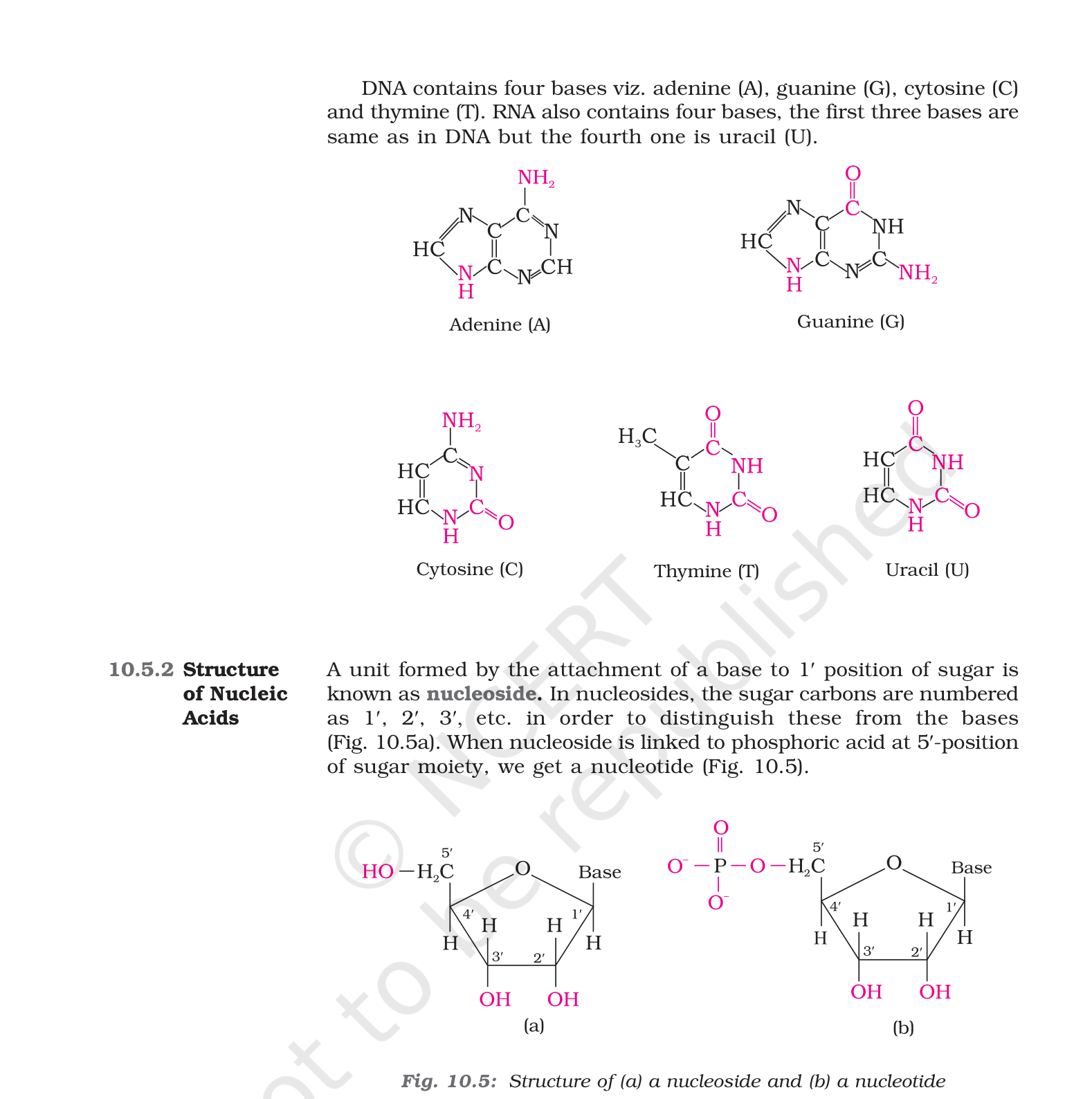
A nucleoside is a nitrogenous base joined to a sugar, and a nucleotide is a nucleoside plus a phosphate group. The sugar is 2-deoxyribose in DNA and ribose in RNA. The bases are of two kinds: purines, adenine and guanine, with two rings, and pyrimidines, cytosine, thymine and uracil, with one ring. DNA uses adenine, guanine, cytosine and thymine; RNA uses adenine, guanine, cytosine and uracil in place of thymine.
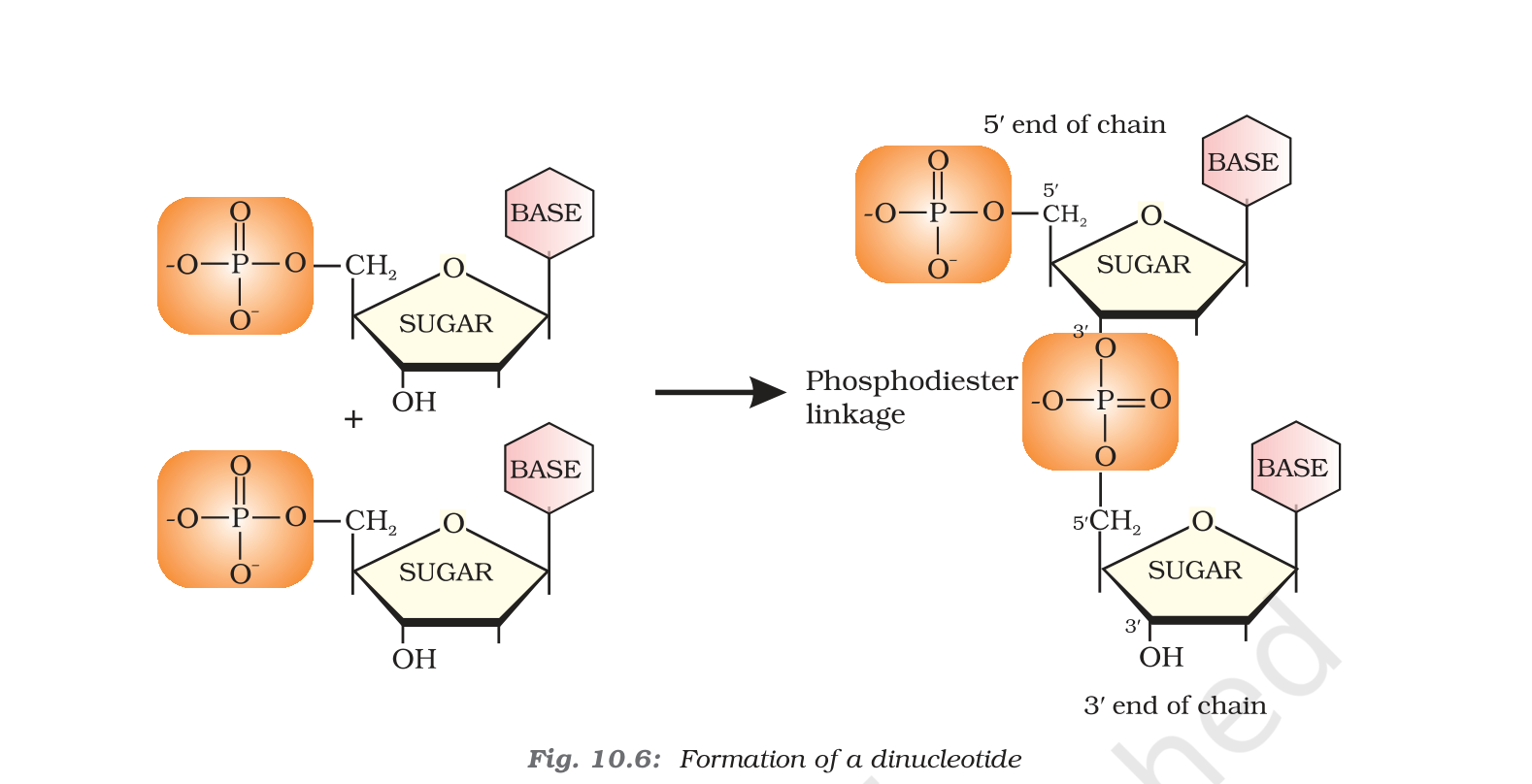
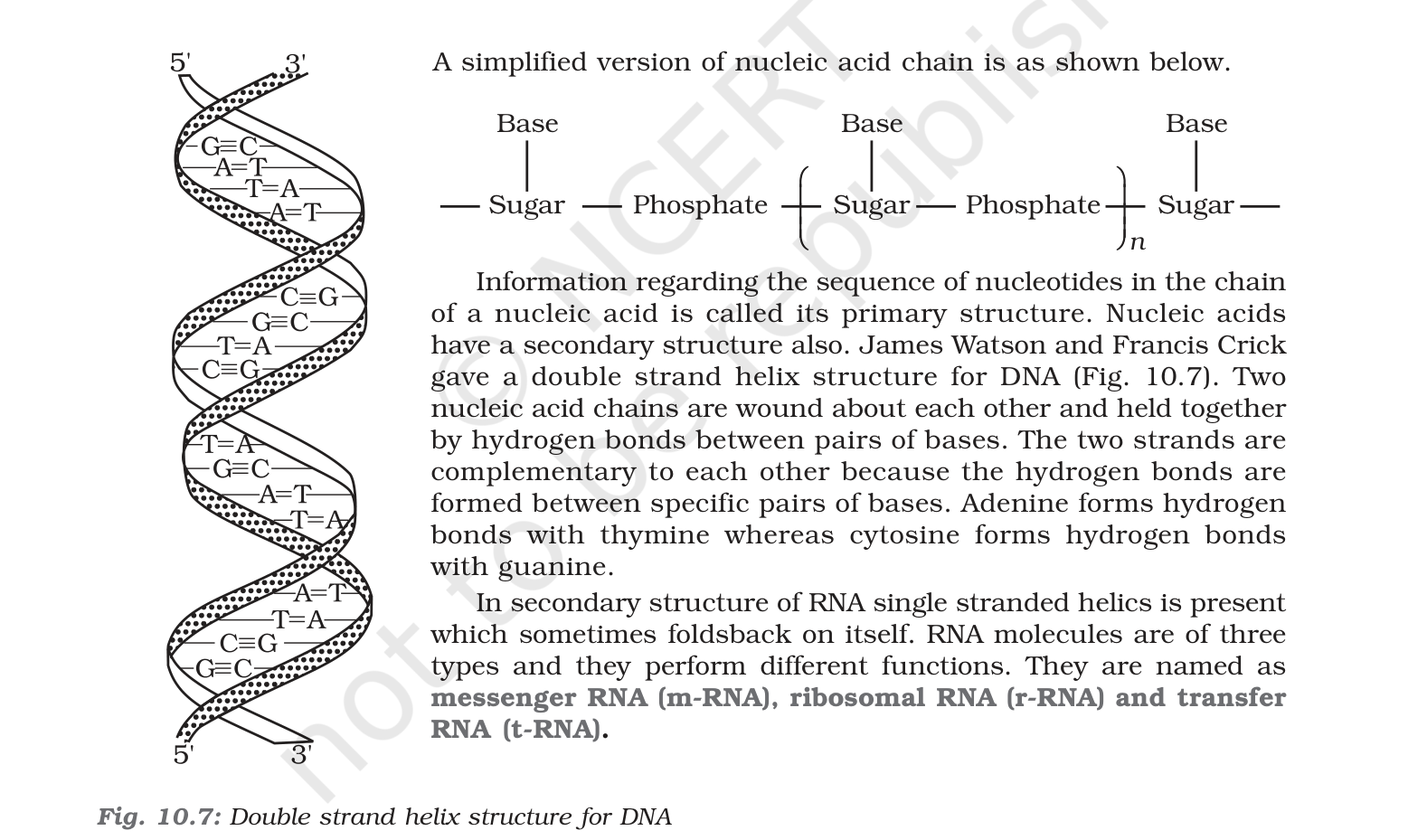
Nucleotides join through phosphodiester bonds, with the phosphate of one nucleotide linking the sugar of the previous one to the sugar of the next. The chain has a backbone of sugar and phosphate with the bases sticking out, and the two strands of DNA are held together by hydrogen bonds between the bases. Adenine pairs with thymine using two hydrogen bonds and guanine pairs with cytosine using three. Because the pairing only works when the strands are antiparallel, the two chains run in opposite directions and wind into the right handed double helix, with the bases inside and the sugar phosphate backbone outside.
RNA is mostly single stranded in the cell and comes in three main forms: messenger RNA carries the code from DNA to the ribosome, transfer RNA brings amino acids to the ribosome, and ribosomal RNA is part of the ribosome itself. The base sequence is the genetic information, and a change in it is a mutation.
3.5 Exercise practice
10.7 to 10.9 classification. A reducing sugar is one with a free anomeric carbon. Glucose and fructose are reducing; sucrose is not; starch and cellulose are not sugars at all. The polysaccharide in the list sucrose, glucose, starch and fructose is starch. Amino acids behave like salts because they form zwitterions, and penta-acetate of glucose does not react with hydroxylamine because the ring form is locked by the acetate groups and the aldehyde group is not free.
10.10 and 10.11 tests. Tollens or Fehling identifies a reducing sugar. Bromine water oxidises glucose to gluconic acid and leaves fructose unchanged, so it separates the two. Nitric acid on glucose gives saccharic acid, which is evidence for oxidisable ends at both ends of the chain. Prolonged heating of glucose with a strong acid converts it to 5-hydroxymethylfurfural, which is why sugar solutions darken on strong heating.
10.12 enzymes and proteins. Enzymes are specific and efficient, and their activity depends on the active site shape, so heat and pH change the rate. Hydrolysis of a protein gives amino acids; the number of peptide bonds in a chain of n amino acids is n minus one, which is why a tetrapeptide has three peptide bonds. Denaturation breaks secondary and tertiary structure but not the primary sequence of peptide bonds.
10.13 to 10.15 vitamins. Water soluble vitamins must be taken regularly because they are excreted in urine and not stored. Deficiencies map onto diseases: A to night blindness, B1 to beri beri, C to scurvy, D to rickets, K to increased clotting time. Fat soluble vitamins are A, D, E and K.
10.16 to 10.18 nucleic acids. DNA and RNA differ in the sugar, and in the base thymine versus uracil, and RNA is mostly single stranded. The two strands of DNA are held by hydrogen bonds between the base pairs, and adenine pairs with thymine through two bonds while guanine pairs with cytosine through three. A dinucleotide forms when two nucleotides link through a phosphodiester bond with loss of water.