

Concepts: classification, structure, properties and basicity
Amines20 min readLesson 2 of 5
2.1 Classification and naming
An amine is ammonia with one or more hydrogens replaced by organic groups. A primary amine has one group on nitrogen, RNH2; a secondary amine has two; a tertiary amine has three; and a quaternary ammonium salt has four, with a positive charge on nitrogen and an anion alongside.
The groups decide the first part of the name. For a primary amine, name the alkyl group and add amine: CH3NH2 is methanamine, CH3CH2NH2 is ethanamine. When the amine group is a substituent on a longer chain, it is amino, as in 2-aminoethanol. Secondary and tertiary amines are named as N-substituted derivatives of a primary amine, so CH3NHCH3 is N-methylmethanamine and (CH3)3N is N,N-dimethylmethanamine. Aromatic amines keep the common name aniline, and its derivatives use benzenamine in IUPAC naming.
2.2 Structure of the nitrogen atom
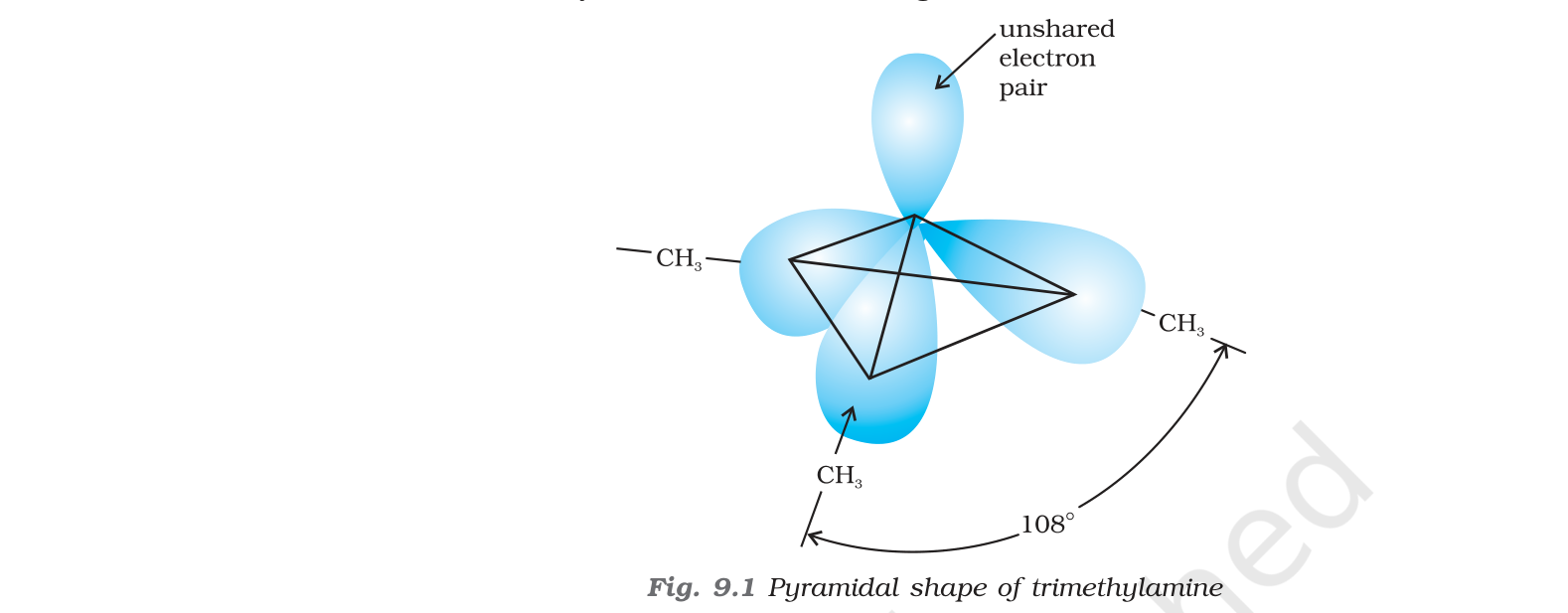
In ammonia and amines the nitrogen is sp3 hybridised with three bond pairs and one lone pair, so the shape is pyramidal rather than planar. The textbook figure shows the pyramid for trimethylamine, with the nitrogen lone pair occupying the apex and the three methyl groups forming the base. Electronegativity matters as well: nitrogen is more electronegative than phosphorus or arsenic, so the lone pair is held tightly and an amine is a weaker donor than a phosphine.
A surprising consequence of that pyramidal shape is invertibility. The nitrogen can turn inside out through a planar transition state, so the two enantiomers of a chiral amine interconvert rapidly and are not separable at room temperature. That is why chirality at nitrogen is seldom discussed even when the three groups differ.
2.3 Physical properties
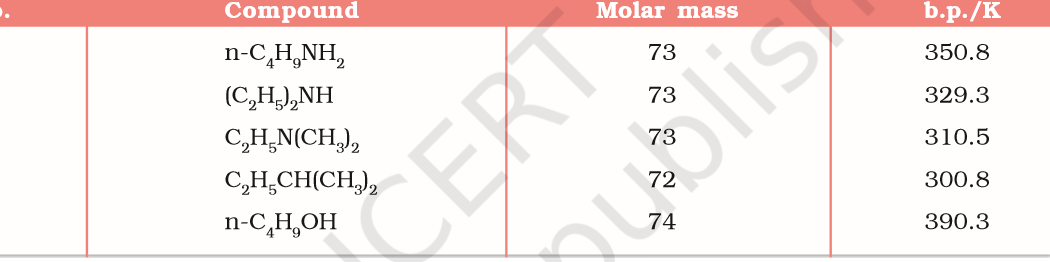
Primary and secondary amines can donate a hydrogen bond because they have hydrogens on nitrogen, but nitrogen is less electronegative than oxygen, so the hydrogen bond is weaker than the one in an alcohol. Their boiling points lie between those of comparatively sized alcohols and alkanes: ethanamine boils at 290 K, ethanol at 351 K and ethane at 184 K.
The three families differ among themselves. Primary and secondary amines hydrogen bond intermolecularly, while a tertiary amine has no hydrogen on nitrogen and dissolves less readily. The textbook figure shows the intermolecular hydrogen bonding of a primary amine, where the NH group of one molecule attaches to the lone pair of another. Solubility in water also falls as the carbon count grows, and the lower amines mix freely with water.
2.4 Basicity
An amine is basic because its nitrogen lone pair accepts a proton. The strength depends on three competing things: how available the lone pair is, how stable the ammonium ion is in the solvent, and how crowded the nitrogen is.
An aromatic amine is much weaker than an aliphatic one. In aniline the nitrogen lone pair is conjugated with the ring, which spreads the electron density into the ring and makes the pair less available for protonation. The same delocalisation stabilises the free amine relative to the ammonium ion, so aniline is a weaker base than ammonia. An electron withdrawing group such as nitro reduces basicity further, while an electron releasing group such as methyl increases it. In substituted anilines the methyl group makes the amine a little stronger than aniline, and a nitro or halo group makes it weaker.
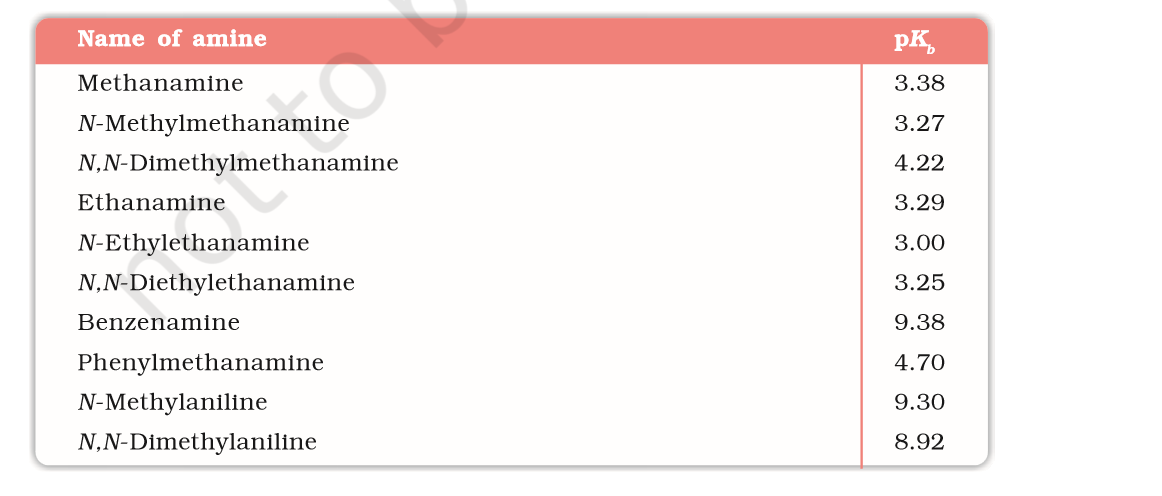
For the simple alkylamines the pattern is not a single line. In the gas phase, where solvation plays no part, tertiary is the strongest base, followed by secondary, primary and ammonia. In water the solvent changes the ranking: the ammonium ion is stabilised by hydrogen bonds from water, and a primary or secondary ion has more hydrogens on nitrogen to use for that. Steric crowding in the tertiary ammonium ion also limits the number of good hydrogen bonds. The net result is secondary above primary above tertiary in aqueous solution, which is why the pKb values of the methylamines are about 3.27 for secondary, 3.38 for primary and 4.22 for tertiary.
2.5 Preparation
Ammonolysis of a haloalkane gives a mixture of amine families rather than one product. The alkyl halide reacts with ammonia to give the primary amine, which then competes with the remaining ammonia for the halide and becomes secondary, then tertiary, and finally a quaternary salt. Using a large excess of ammonia favours the primary amine.
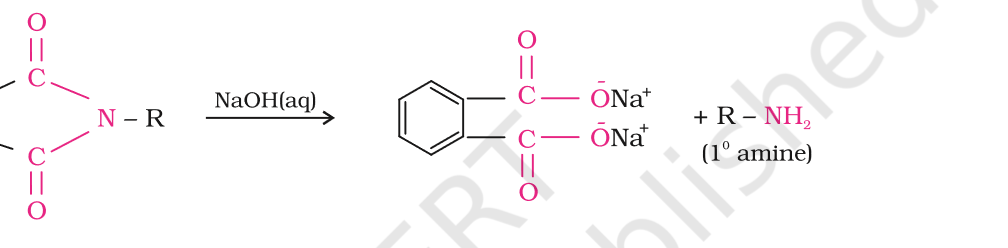
Nitriles reduce cleanly to primary amines with lithium aluminium hydride, with hydrogen and nickel, or with sodium and alcohol. Amides reduce to primary amines with lithium aluminium hydride. The Hofmann bromamide reaction treats an amide with bromine and concentrated sodium hydroxide and gives a primary amine with one carbon fewer, which makes it a reliable way to step down a chain. The Gabriel phthalimide synthesis converts phthalimide to its potassium salt with KOH, attacks that salt with an alkyl halide, and then hydrolyses the product to give a pure primary amine; it cannot be used for aromatic amines because aryl halides do not react. Aromatic primary amines come from reducing nitro compounds with hydrogen over nickel, or with tin or iron and hydrochloric acid.
Slideshow, slide 1 of 3. Use the left and right arrow keys to change slides and the space bar to play or pause.
Section 9.5.3: Hofmann bromamide degradation, an amide with bromine and sodium hydroxide giving a primary amine with one carbon less.
- Can I rank aliphatic and aromatic amines by basic strength in water and give the reason?
- Can I choose between Hofmann, Gabriel and nitrile reduction for a given primary amine?