

Reactions, identification and diazonium chemistry with exercise practice
Amines26 min readLesson 3 of 5
3.1 Reactions of the amine group
Acylation uses an acid chloride or anhydride to replace a hydrogen on nitrogen by an acyl group, so ethanamine with ethanoyl chloride gives N-ethylethanamide, and the amide is less reactive than the amine. This is the basis of the protection step used before electrophilic substitution of aniline.
Alkylation goes the other way: the amine attacks a haloalkane and gains a carbon group. Because it can happen again on the product, the quaternary salt is usually the final product when excess halide is present.
The Hinsberg test separates the three classes with benzenesulphonyl chloride. A primary amine gives a sulphonamide that still has a hydrogen on nitrogen, so it dissolves in alkali as its salt. A secondary amine gives a sulphonamide with no hydrogen on nitrogen, so it does not dissolve in alkali. A tertiary amine has no hydrogen to replace, so it does not react and simply stays in solution. The carbylamine test is simpler but less pleasant: a primary amine with chloroform and alcoholic KOH gives an isocyanide with a strongly unpleasant smell, while secondary and tertiary amines give nothing.
3.2 Reaction with nitrous acid
Nitrous acid is generated in place from sodium nitrite and hydrochloric acid, and the three classes behave differently, which makes the reaction an identification test. A primary aliphatic amine gives an unstable diazonium salt that decomposes at once and releases nitrogen gas, so bubbles appear and an alcohol forms. A primary aromatic amine gives a diazonium salt that is stable if the mixture is kept cold, between 273 and 278 K, and that salt is the starting point for the rest of the chapter. A secondary amine gives an N-nitroso amine, a yellow oily liquid, with no gas. A tertiary aliphatic amine dissolves to give a salt, while a tertiary aromatic amine such as N,N-dimethylaniline gives a green colour in the ring.
3.3 Benzene diazonium chloride
The diazonium salt is made by treating aniline with sodium nitrite and hydrochloric acid at 273 to 278 K. Its two useful reactions are the replacement of the diazonium group and the coupling reaction.
In replacement reactions the diazonium group leaves and something else takes its place. Copper(I) chloride or bromide with the salt gives chlorobenzene or bromobenzene, the Sandmeyer reaction. Copper powder is an alternative, and that route is the Gattermann reaction. Potassium iodide gives iodobenzene without a copper catalyst. Warming with water or dilute acid gives phenol. Hypophosphorous acid or phosphinic acid removes the group altogether and gives benzene. Reaction with fluoroboric acid followed by heating gives fluorobenzene, the Balz Schiemann reaction.
In coupling reactions the diazonium salt keeps the nitrogen and joins two aromatic rings. With phenol in mild alkali it couples at the para position to give p-hydroxyazobenzene, an orange dye; with aniline it couples to give p-aminoazobenzene, a yellow dye. Both are azo dyes, and the coupling needs an activated ring such as phenol or aniline rather than a plain benzene ring.
3.4 Electrophilic substitution of aniline
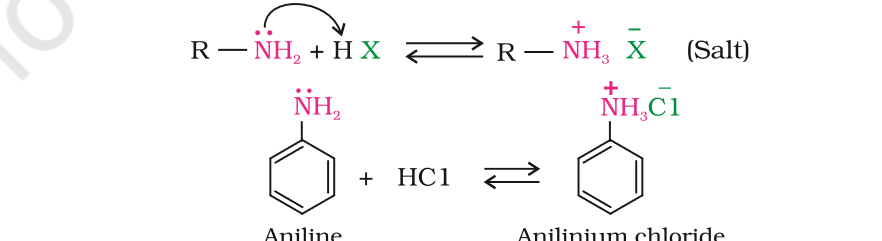
The NH2 group activates the ring strongly and directs new groups to ortho and para positions, but it is a problem for reactions that use a Lewis acid. Aniline reacts with bromine water to give 2,4,6-tribromoaniline directly, with no catalyst. For mono substitution the ring has to be tamed: acetylate the amine first, because an amide group is less activating, and then brominate; hydrolysis of the amide returns the amine. Nitration of aniline is messy because the acid protonates the amine to give a deactivated anilinium ion and some of it oxidises, so a mixture of meta and ortho and para products appears.
3.5 Exercise practice
9.1 and 9.2 naming. Primary amines in the exercise are named as alkanamines with N substituents for the secondary and tertiary cases. Aniline derivatives take the common name aniline with the substituent locants. 9.4 basic strength orders. For the methylamines in aqueous solution, dimethylamine is stronger than methylamine, which is stronger than trimethylamine; in the gas phase the order is reversed. Aromatic amines come well below aliphatic ones, and the pKb table in the figure settles the exact numbers.
9.5 conversions. Ethanoic acid to methanamine uses the amide then the Hofmann bromamide reaction. Hexanenitrile to 1-aminopentane is a nitrile reduction followed by the one carbon loss route through the amide. Methanol to ethanoic acid goes through a Grignard reagent and carbon dioxide. Ethanamine to methanamine uses the Hofmann route with one carbon less. Nitromethane to dimethylamine goes through reduction to methylamine and then alkylation.
9.6 identification. Use the Hinsberg test, and confirm with the carbylamine test for the primary amine and the nitrous acid behaviour for all three.
9.8 conversions. Aniline to p-bromoaniline needs protection: acetylate, brominate, then hydrolyse. Aniline to 2,4,6-tribromofluorobenzene uses the diazonium salt and Balz Schiemann for fluorine, with the bromines already on the ring. Benzyl chloride to 2-phenylethanamine goes through the nitrile with KCN and then reduction. Chlorobenzene to p-chloroaniline is nitration then reduction. Aniline to p-bromoaniline, aniline to benzyl alcohol and benzamide to toluene all run through the diazonium salt or the amine group in a similar way.
Exam
For identification questions, work from the test to the class: Hinsberg splits primary, secondary and tertiary; carbylamine confirms only primary; nitrous acid separates aromatic primary from aliphatic primary by the stability of the salt. Then write the equation.