

Concepts: structure, naming, preparation and reactivity
Aldehydes, Ketones and Carboxylic Acids20 min readLesson 2 of 6
2.1 The carbonyl group
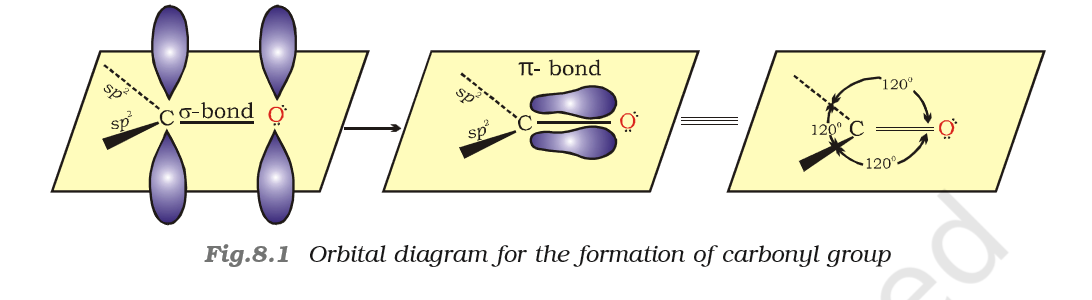
An aldehyde has a carbonyl carbon joined to at least one hydrogen, and a ketone has the carbonyl carbon joined to two carbon groups. The carbonyl carbon is sp2 hybridised, so the three groups around it lie in one plane at about 120 degrees, and the carbon oxygen double bond is polar with the carbon end positive. That positive carbon is the reason the whole chapter exists: nucleophiles go there.
The other two double bonds in the family round it out. In a carboxylic acid, the carbonyl is attached to an OH group, and the lone pair on that oxygen is conjugated with the carbonyl, which changes both its structure and its reactivity.
2.2 Naming
For aldehydes, the suffix is al and the chain is numbered from the carbon of the CHO group, which is always C1. Propanal, 3-methylbutanal and 2-methylpropanal are simple examples; benzene derivatives keep the common names benzaldehyde and phenylacetaldehyde. Ketones take the suffix one, and the carbonyl carbon gets the lowest possible locant, so CH3COCH2CH3 is butan-2-one. Aromatic ketones such as acetophenone and benzophenone keep their common names, and mixed compounds are named as phenyl ketones.
Carboxylic acids take the suffix oic acid, with the carboxyl carbon as C1: methanoic acid, ethanoic acid, propanoic acid, 2-methylpropanoic acid. Cyclic and aromatic cases keep common names such as benzoic acid. Acid derivatives have their own names worth keeping in one place: acid chlorides such as ethanoyl chloride, esters such as ethyl ethanoate, amides such as ethanamide, and acid anhydrides such as ethanoic anhydride.
2.3 The common names worth knowing
The chapter's exercise asks for common names as well, so a small list is useful. HCHO is formaldehyde, CH3CHO acetaldehyde, CH3COCH3 acetone, C6H5CHO benzaldehyde, CH3COOH acetic acid, HCOOH formic acid, and C6H5COOH benzoic acid. The common names of the aromatic ketones are acetophenone for methyl phenyl ketone and benzophenone for diphenyl ketone.
2.4 Preparation
Aldehydes and ketones come from several standard routes. A primary alcohol can be oxidised to an aldehyde with PCC or with chromium trioxide in an anhydrous medium, and a secondary alcohol oxidises to a ketone. Passing the vapour of a primary or secondary alcohol over hot copper at 573 K dehydrogenates it to the carbonyl compound. Acid chlorides reduce to aldehydes by the Rosenmund reaction, which uses hydrogen over palladium on barium sulphate poisoned with quinoline, so the aldehyde is not reduced further.
Alkynes hydrolyse to carbonyl compounds: ethyne with dilute sulphuric acid and mercury(II) sulphate gives acetaldehyde, and propyne gives propanone. Alkene ozonolysis is a diagnostic and preparative route, since the alkene is cleaved at the double bond and each carbon becomes a carbonyl carbon. Aryl and alkyl ketones can also be made by Friedel Crafts acylation with an acid chloride and aluminium chloride, and by the reaction of a nitrile with a Grignard reagent followed by hydrolysis.
2.5 Physical properties
Carbonyl compounds are polar, so dipole dipole attractions raise their boiling points above those of comparable alkanes or ethers. They are still far below alcohols and carboxylic acids, because they cannot donate a hydrogen bond; an alcohol has an OH to donate, a carboxylic acid has an even stronger hydrogen bond because of its two oxygen atoms. Branched carbonyl compounds boil lower than straight chain isomers for the usual reason: less surface contact.
The small aldehydes and ketones dissolve well in water through hydrogen bonding to the carbonyl oxygen, and solubility falls as the hydrocarbon part grows. Aldehydes and ketones have a mild smell, and the smaller ones are used as solvents and flavouring agents.
2.6 Reactivity order
Aldehydes are more reactive than ketones towards nucleophilic addition. Two effects explain it: a ketone has two alkyl groups crowding the carbonyl carbon, so an incoming nucleophile is blocked, and those same two groups release electron density towards the carbon, which reduces its positive character. An aromatic aldehyde is slower than an aliphatic one because the ring is conjugated with the carbonyl and spreads the positive charge, and the ring is also bulky. Methanal is the most reactive of the family because it has two hydrogen atoms and no crowding at all. A useful check while reading a carbonyl structure is to count the groups on the carbonyl carbon. Two hydrogens means methanal, one hydrogen leaves an aldehyde and two carbon groups give a ketone, and the same count explains the reactivity order above. When a structure carries an OH on the carbonyl carbon it is a carboxylic acid, which is a different chapter of behaviour because the oxygen lone pair is conjugated with the carbonyl.
- Can I explain why aldehydes are more reactive than ketones towards nucleophiles?
- Can I name an aldehyde, ketone and acid from a structure and back again?
- Do I know the reagents for the four standard preparation routes?