

Reactions and mechanisms of carbonyl compounds
Aldehydes, Ketones and Carboxylic Acids24 min readLesson 3 of 6
3.1 Nucleophilic addition, one step at a time
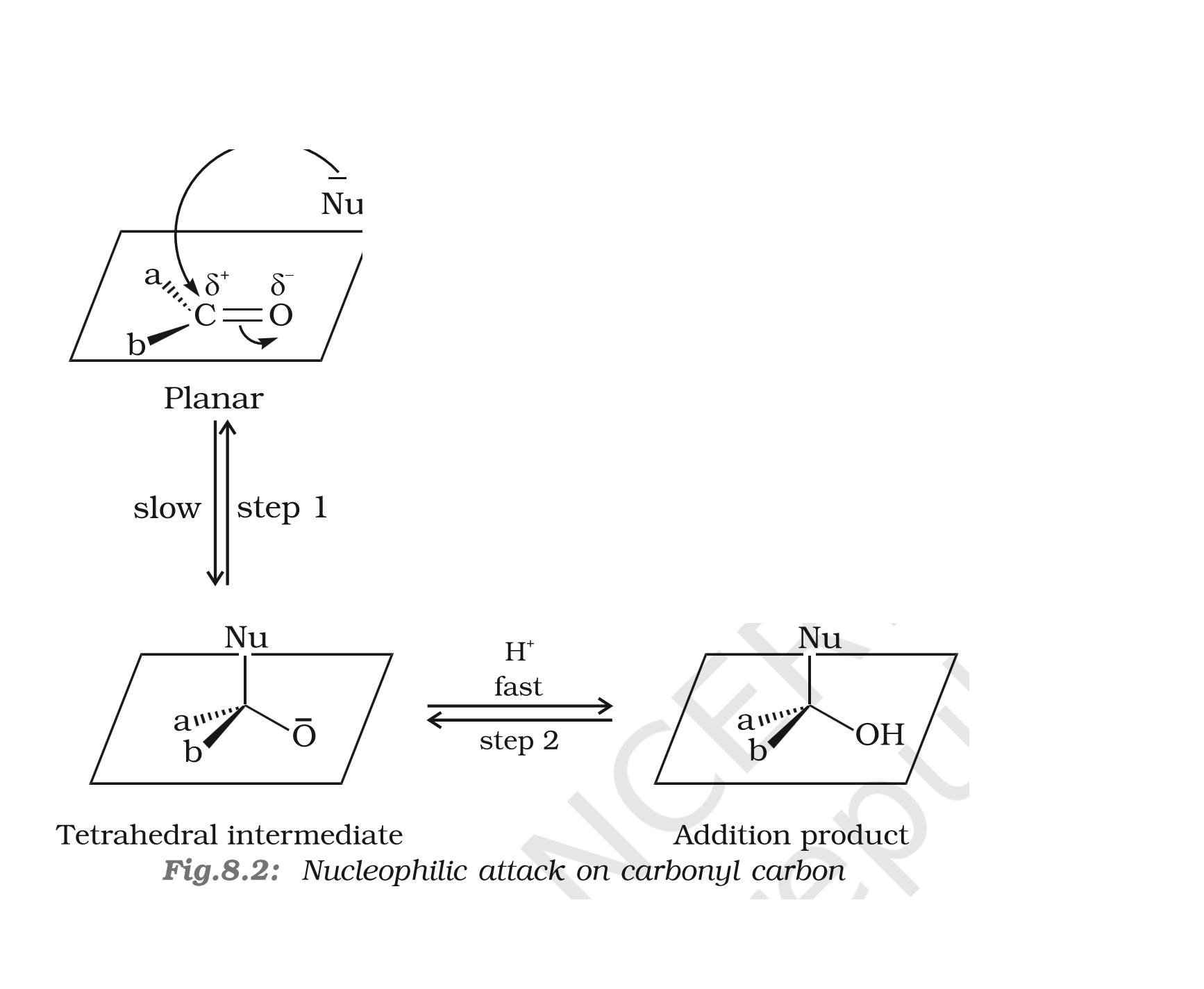
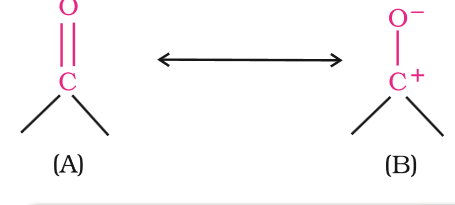
The carbonyl carbon carries partial positive charge and the oxygen partial negative charge, so a nucleophile attacks the carbon. In the first step the nucleophile donates its pair to the carbon and the pi electrons of the carbon oxygen bond move onto oxygen, which gives a tetrahedral alkoxide intermediate. In the second step a proton is picked up from the medium, and the product is the addition compound. The two steps matter for two reasons. The carbon changes from sp2 to sp3, which is why the product is tetrahedral. The oxygen ends up with negative charge, which is why the reaction needs a proton source afterwards and why the whole process is easier when the carbonyl carbon is more positive.
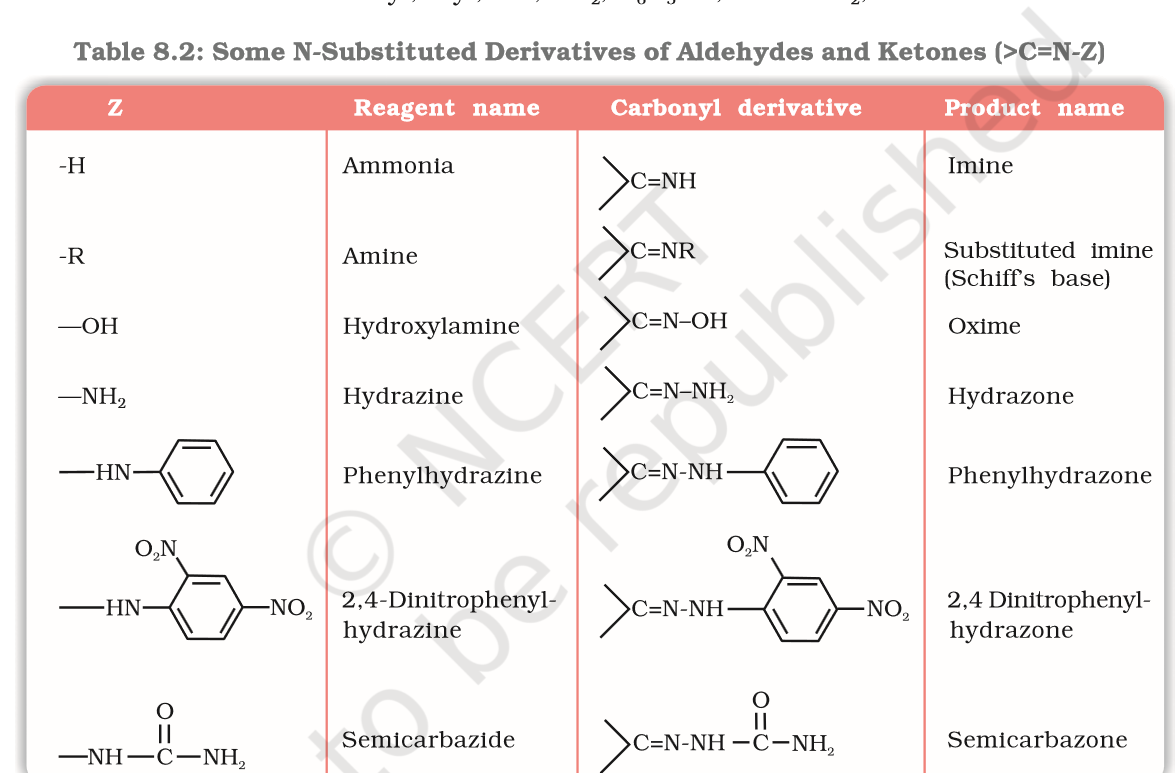
The same mechanism explains a whole family of products. Hydrogen cyanide adds to give a cyanohydrin, which is a useful synthetic intermediate because the nitrile can later be hydrolysed or reduced. Sodium bisulphite adds to give a crystalline bisulphite adduct, which is used to purify aldehydes. An alcohol adds to give a hemiacetal, and a second alcohol molecule with dry HCl gives an acetal. Ammonia and its derivatives add and then lose water to give imines, oximes, hydrazones and semicarbazones; these are the standard tests and derivatives for identifying a carbonyl compound. A Grignard reagent adds and the adduct is hydrolysed to an alcohol, and the class of alcohol tells you which carbonyl you started with.
Slideshow, slide 1 of 3. Use the left and right arrow keys to change slides and the space bar to play or pause.
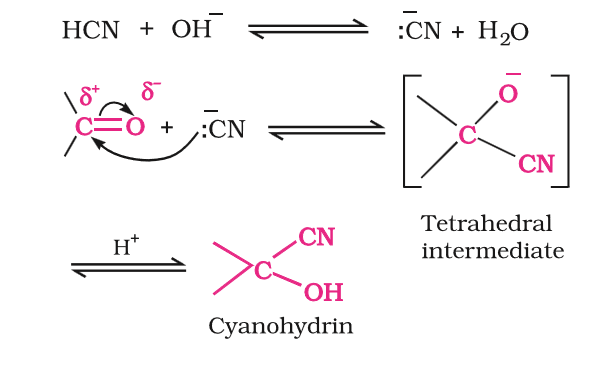
Section 8.4.1(iii)(a): hydrogen cyanide with base gives cyanide ion, which adds to a carbonyl compound and then picks up a proton to give a cyanohydrin.
3.2 Reactions that depend on the alpha hydrogen
A hydrogen on the carbon next to the carbonyl is acidic, because the negative charge left after its removal is delocalised onto the carbonyl oxygen. That single fact produces the aldol reaction and the haloform reaction.
In the aldol reaction, dilute sodium hydroxide removes an alpha hydrogen from one molecule to give an enolate, which attacks the carbonyl carbon of a second molecule. The product is a beta hydroxy aldehyde or ketone, which on heating loses water and gives an alpha, beta unsaturated carbonyl compound. Methanal has no alpha hydrogen and benzaldehyde has none either, so neither can undergo aldol condensation.
The haloform reaction takes a methyl ketone, or acetaldehyde, through successive halogenation of the methyl group and then cleavage by base. The products are a carboxylate salt and a haloform such as iodoform. Iodine with sodium hydroxide gives the yellow precipitate of iodoform, which is the standard test for a methyl group next to a carbonyl.
3.3 Cannizzaro and the reductions
An aldehyde with no alpha hydrogen reacts with concentrated sodium hydroxide, and two molecules of it react with each other. One is oxidised to a carboxylate salt and the other is reduced to an alcohol; this is the Cannizzaro reaction. Benzaldehyde gives benzyl alcohol and sodium benzoate, and methanal gives methanol and sodium methanoate.
The carbonyl group can be removed completely. Clemmensen reduction with zinc amalgam and concentrated hydrochloric acid, and Wolff Kishner reduction with hydrazine and potassium hydroxide in ethylene glycol, both replace the C=O by CH2, so a ketone becomes the corresponding alkane. Reduction with sodium borohydride or lithium aluminium hydride stops at the alcohol instead, and catalytic hydrogenation does the same.
3.4 Oxidation and tests
Aldehydes are easy to oxidise and ketones are not, which is the basis of the tests. Tollens reagent is ammoniacal silver nitrate: an aldehyde reduces it to metallic silver, giving a silver mirror. Fehling solution is a copper(II) complex, which an aliphatic aldehyde reduces to a red precipitate of copper(I) oxide; aromatic aldehydes and ketones do not react. Acidified permanganate is a stronger oxidant and takes a primary alcohol or an aldehyde to the acid. Ketones resist all three under ordinary conditions and need strong oxidants and heat, which break carbon carbon bonds and give a mixture of acids.
3.5 Carboxylic acids
The acidity of a carboxylic acid comes from the carboxylate ion, where the negative charge is shared equally by two oxygen atoms through resonance. That is much more stable than an alkoxide with the charge on one oxygen, which is why ethanoic acid at pKa 4.76 beats ethanol at 15.9. Electron withdrawing groups stabilise the anion further and raise acidity, and electron releasing groups do the opposite, so trichloroethanoic acid is a strong acid while propanoic acid is weaker than ethanoic acid.
Acids react with metals, carbonates and bicarbonates to give salts and carbon dioxide, with alcohols to give esters, with ammonia to give amides, and with phosphorus pentachloride to give acid chlorides. The HVZ reaction puts a halogen on the alpha carbon using red phosphorus and halogen, and that halo acid can then be converted into an amino acid or a hydroxy acid. Heating a sodium carboxylate with soda lime decarboxylates it and gives an alkane with one carbon less. Reducing an acid with lithium aluminium hydride gives a primary alcohol.
Exam
When a question asks why one carbonyl compound is more reactive, answer with the two named effects: steric hindrance at the carbonyl carbon and the inductive release or withdrawal of electron density by the attached groups. Add the solvent or hydrogen bonding point only if it changes the order.