

Concepts: area, cofactors, adjoint and inverse: Determinants
Determinants26 min readLesson 3 of 6
3.1 Area of a triangle
Three points in the plane form a triangle whose area comes from a 3 by 3 determinant. Write the coordinates in the first two columns and a column of ones in the third, take the determinant, and halve the absolute value. The absolute value matters because swapping two vertices changes the sign but not the area.
If the area comes out as zero, the three points lie on a straight line. Collinearity questions are therefore determinant questions in disguise, and the answer is the value that forces the determinant to zero.
3.2 Minors and cofactors
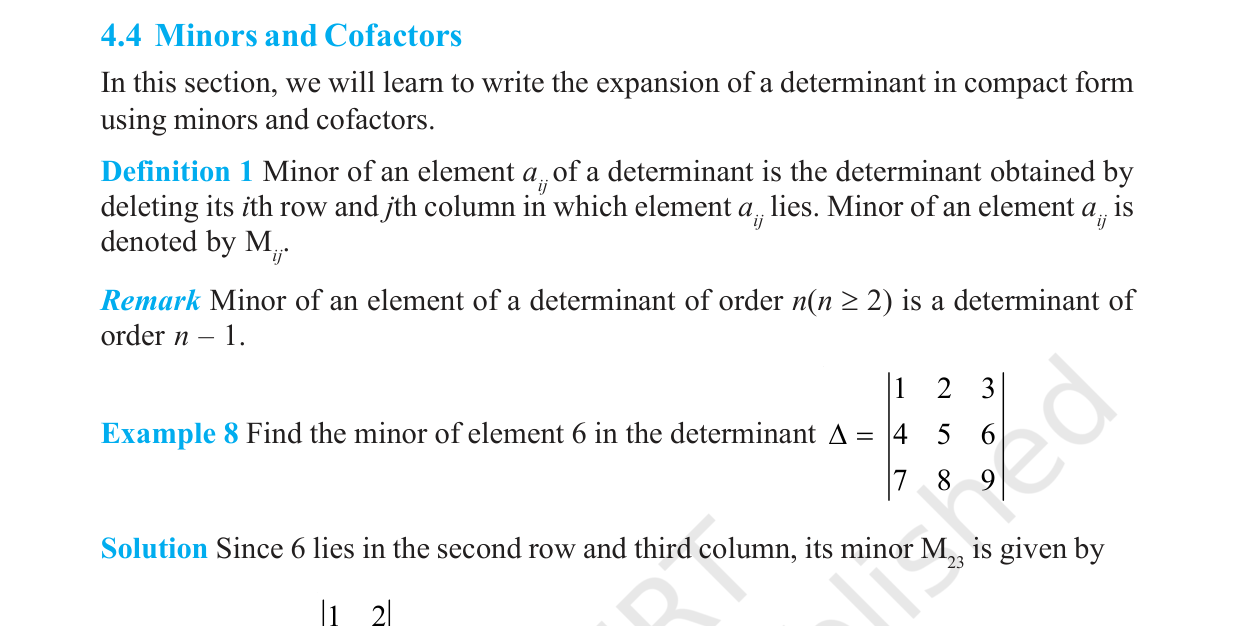
For any entry of a square matrix, the minor is the determinant left after deleting the row and column of that entry. The cofactor is the minor multiplied by a sign that depends on the position. Checkerboard the signs starting with plus in the top left corner.
For a 3 by 3 matrix, each cofactor is a 2 by 2 determinant with a sign. Writing them as a matrix gives the cofactor matrix, which becomes the adjoint after a transpose.
3.3 Adjoint and inverse
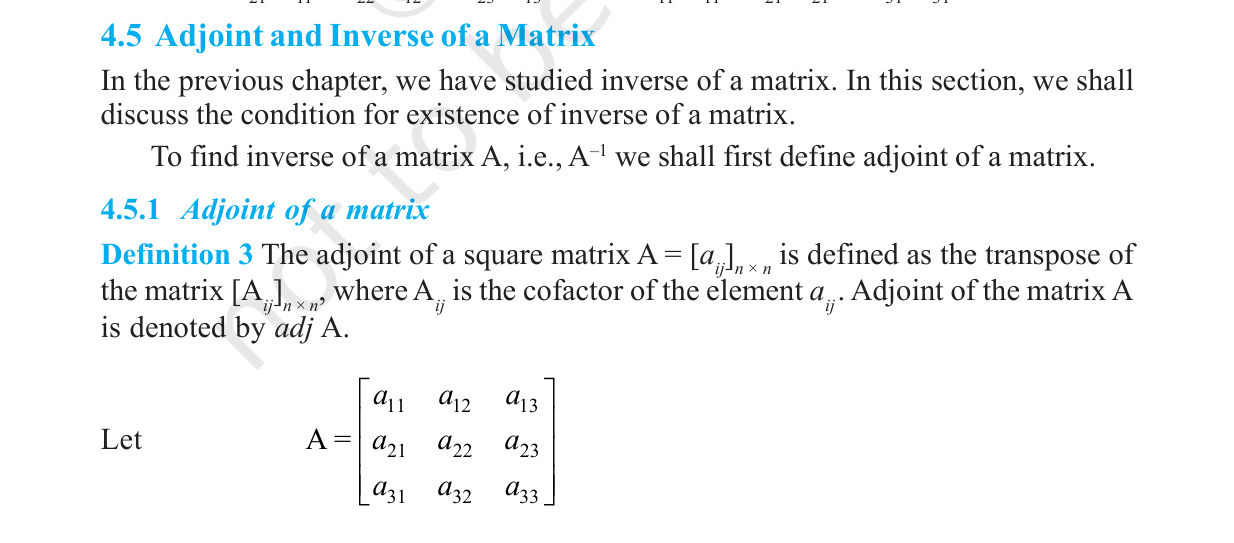
The adjoint of a square matrix is the transpose of its cofactor matrix. Its main use is the inverse formula: the inverse equals the adjoint divided by the determinant, provided the determinant is not zero. When the determinant is zero, the matrix has no inverse and is called singular.
Two adjoint identities are worth memorising. The product of a matrix with its adjoint gives the determinant times the identity, and the determinant of the adjoint of an n by n matrix equals the determinant raised to the power n minus 1.
3.3.1 Exercise coverage
Exercise 4.3 is the area and collinearity set, Exercise 4.4 is minors and cofactors, and Exercise 4.5 is the adjoint and inverse set. The worked recipes on this page map one to one with those exercise sections. A question about finding the inverse of a 2 by 2 matrix uses the shortcut formula directly, while a 3 by 3 inverse question needs the cofactor matrix and its transpose.
3.4 Worked inverse example
Find the inverse of A = [[2, 3], [1, 2]]. The determinant is 2 times 2 minus 3 times 1, which is 1, so the inverse exists. For a 2 by 2 matrix, swap the diagonal entries, change the signs of the off-diagonal entries and divide by the determinant. The result is [[2, minus 3], [minus 1, 2]]. Multiply A with this matrix to confirm the identity matrix.
For a 3 by 3 matrix, the working is longer but the pattern is fixed. Compute the cofactor of each of the nine entries, arrange them in the cofactor matrix, take the transpose to obtain the adjoint, divide every entry by the determinant. A final multiplication by the determinant of A returns the identity, which is the natural check.
3.5 Worked area example
Find the area of the triangle with vertices (1, 2), (3, 4) and (5, 6). The determinant has rows [1, 2, 1], [3, 4, 1] and [5, 6, 1]. Expanding gives 1(4 minus 6) minus 2(3 minus 5) plus 1(18 minus 20), which is minus 2 plus 4 minus 2, equal to zero. The area is zero, so the points are collinear. This is why collinearity answers often say the determinant vanishes instead of computing an area.
Warning
Do not divide by the determinant until you have shown it is not zero. Also keep the checkerboard sign pattern separate from the minor, because mixing the two is the most common cofactor error.
3.5.1 Worked adjoint and inverse
For the 3 by 3 matrix with rows [2, minus 1, 1], [minus 1, 2, minus 1] and [1, minus 1, 2], the determinant is 4. Each cofactor is a 2 by 2 determinant with an alternating sign, and the adjoint is the transpose of the cofactor matrix. Dividing every entry of the adjoint by 4 gives the inverse, and a check multiplication produces the identity matrix.
3.5.2 Worked area through determinants
For vertices (1, 1), (4, 2), (3, 5), place the coordinates in rows with a third column of ones. The determinant evaluates to 1(2 minus 5) minus 1(4 minus 3) plus 1(20 minus 6), which is minus 3 minus 1 plus 14, equal to 10. The area is half of 10, which is 5 square units. Sign and halving are the two places where marks are lost.
3.6 A full adjoint and inverse example
Take A with rows [1, 2, 3], [0, 1, 4] and [5, 6, 0]. Expanding gives 1(0 minus 24) minus 2(0 minus 20) plus 3(0 minus 5), which is minus 24 plus 40 minus 15, equal to 1. The inverse exists. Each cofactor is a 2 by 2 determinant with an alternating sign; arranging the nine cofactors and transposing gives the adjoint, and dividing by 1 leaves the adjoint itself as the inverse. A quick multiplication recovers the identity matrix.
3.7 Area with a sign change
For vertices listed in the order (0, 0), (3, 0), (0, 4), the determinant is 12 and the area is 6. If the same three vertices are listed as (0, 0), (0, 4), (3, 0), the determinant becomes minus 12, but the absolute value again gives area 6. The order affects the sign, never the area.