

Concepts: determinants and their properties: Determinants
Determinants24 min readLesson 2 of 6
2.1 From a matrix to a number
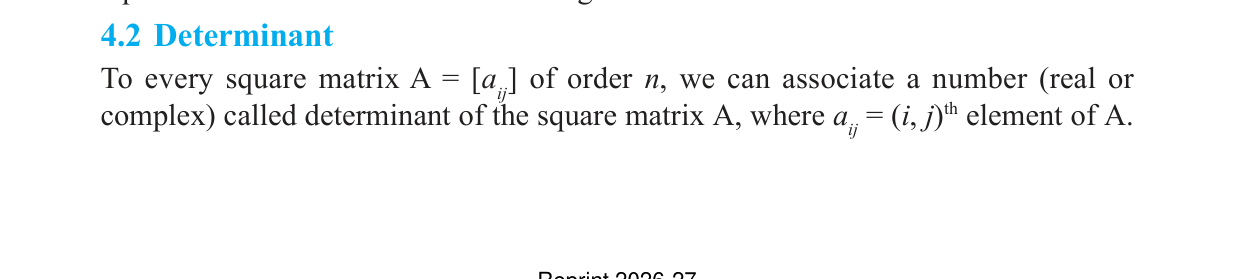
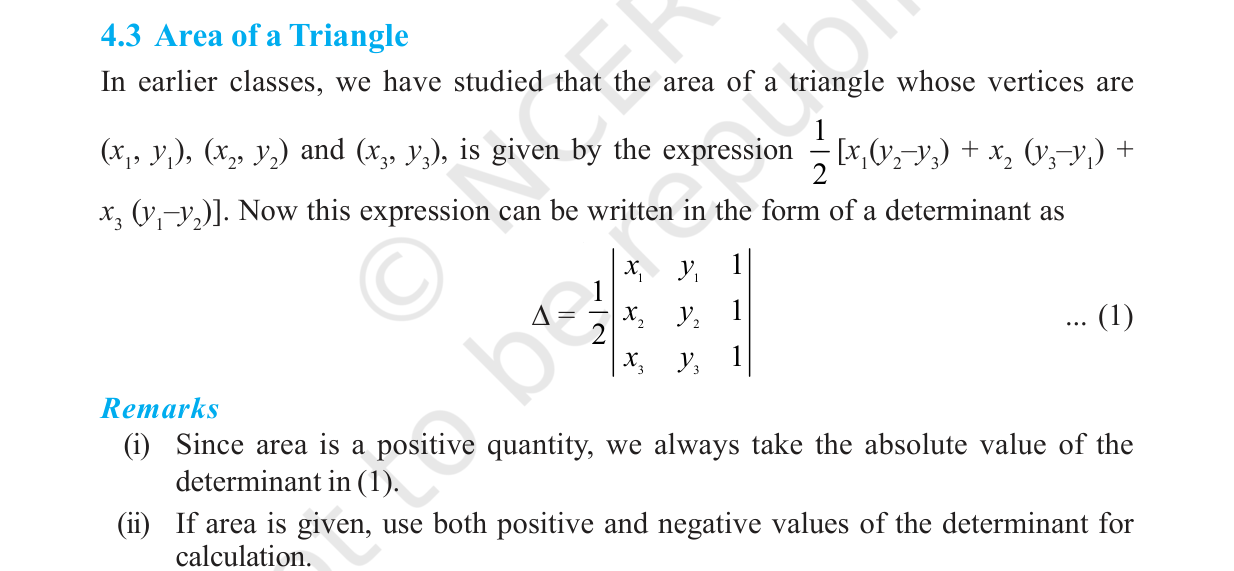
A determinant is defined only for a square matrix, and it collapses the whole array into one number. That number decides whether a system of equations has a unique solution, whether a matrix can be inverted, and whether three points lie on a line.
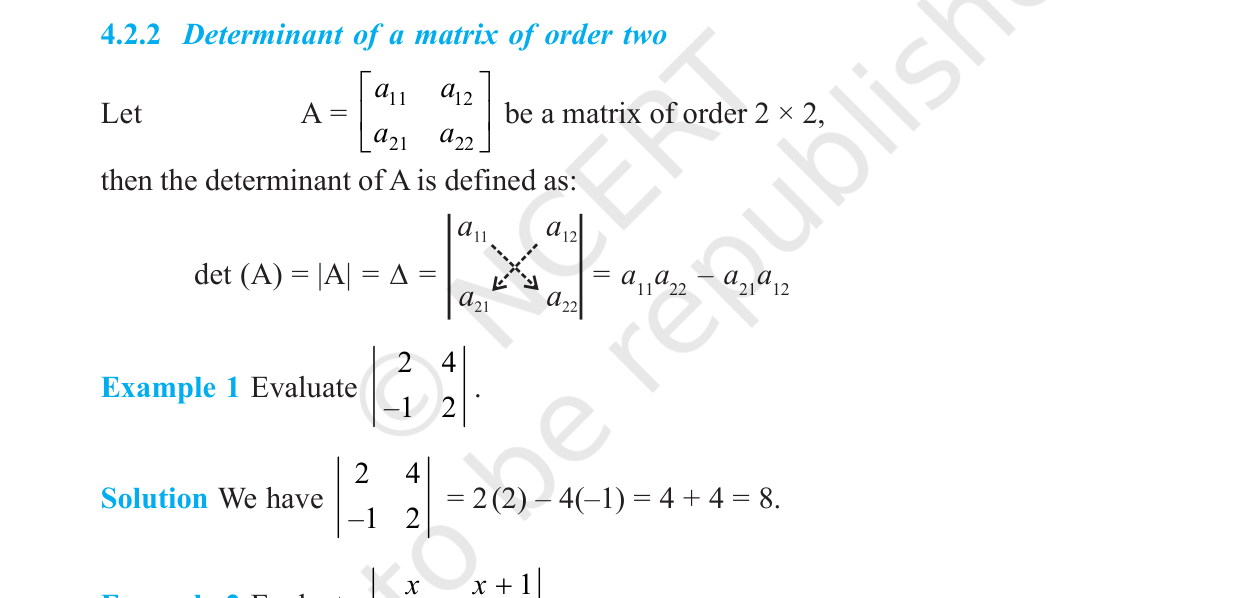
For a 2 by 2 matrix, write the entries as a, b in the first row and c, d in the second. The determinant is ad minus bc. Students should know this formula by heart because many questions start there and add one property.
For a 3 by 3 matrix, the chapter gives the expansion rule along the first row. Each entry multiplies the 2 by 2 determinant left after deleting its row and column, and the signs alternate plus, minus, plus. The same expansion works along any row or column, and choosing the row with the most zeros makes the arithmetic short.
2.1.1 Properties that save work
Determinant questions are designed so that a property reduces the calculation. If two rows are interchanged, the sign changes. If a row is multiplied by k, the whole determinant is multiplied by k. If a row is replaced by itself plus k times another row, the value is unchanged.
A determinant with a row of zeros is zero, and a determinant with two identical rows is zero. Using these rules before expanding is faster than computing six 2 by 2 determinants.
2.1.2 Exercise map for determinants
Exercise 4.1 asks for determinant values and simple unknown entries. Exercise 4.2 handles determinants of higher order and property based evaluations. The right habit is to scan for a zero row or a common factor before expanding, then apply the property that makes the calculation smallest. When a question says show that a determinant is zero, apply a row operation that produces two equal rows and quote the property.
Slideshow, slide 1 of 3. Use the left and right arrow keys to change slides and the space bar to play or pause.
Determinant definition and notation
Exam
When a determinant question looks heavy, stop and look for a row operation. One well chosen subtraction often produces a zero row and ends the calculation in two lines.
2.1.3 Worked determinant calculations
A 2 by 2 determinant is one multiplication pair minus another. For [[4, 7], [2, 3]] the value is 4 times 3 minus 7 times 2, which is 12 minus 14, equal to minus 2. The sign of the answer matters because it carries orientation information.
A 3 by 3 determinant is best computed by choosing a row with a zero. For rows [1, 2, 3], [0, 4, 5] and [0, 0, 6], expanding along the first column leaves 1 times the 2 by 2 determinant of 4, 5 and 0, 6, which is 24. The other terms vanish because of the zeros, so the determinant is 24.
2.1.4 Property based proofs
A standard exercise asks to show that a determinant is zero. If the first and third rows are identical, swapping them changes the sign while the matrix stays the same, so the value must be zero. This one-line proof is accepted in board papers.
Another exercise asks to factor a determinant. If every entry of one row has a common factor k, take k outside as a multiplier before expanding. Repeating row by row turns a heavy calculation into a product of small factors.
2.1.5 Exercise 4.1 and 4.2 practice
Exercise 4.1 asks for determinant values and for unknowns that force a given value. Setting the determinant expression equal to the given number and solving is enough. Exercise 4.2 mixes higher order determinants with property based evaluation; the safest order is to look for zeros, then factor, then expand.
2.2 A full 3 by 3 expansion
Evaluate the determinant with rows [1, 2, 3], [4, 5, 6] and [7, 8, 10]. Expanding along the first row gives 1 times (5 times 10 minus 6 times 8) minus 2 times (4 times 10 minus 6 times 7) plus 3 times (4 times 8 minus 5 times 7). The three 2 by 2 values are 2, minus 2 and minus 3, so the determinant is 2 plus 4 minus 9, which is minus 3. Writing the three minors separately keeps the arithmetic visible.
2.3 A property based proof
Show that the determinant with rows [a, b, c], [a, b, c] and [x, y, z] is zero. Subtracting the second row from the first gives a zero row, and a determinant with a zero row vanishes. In the exam, state the row operation and the property separately, because that is two marking points.
2.4 Another property based result
Show that multiplying every entry of a 3 by 3 determinant by k multiplies the value by k cubed. Taking the factor k out of each of the three rows one at a time gives k times k times k times the original determinant. The same reasoning explains the rule for |kA| in matrix questions. The triangular matrix shortcut means one product of diagonal entries, which is faster than a full expansion when the zeros line up.