

Concepts: continuity and its tests: Continuity and Differentiability
Continuity and Differentiability24 min readLesson 2 of 6
2.1 The three value test for continuity
Continuity at a point is a statement about three numbers: the limit from the left, the limit from the right, and the value of the function at the point. When all three agree, the graph has no break or hole there. When any one differs, the function is discontinuous at that point.
The test extends to intervals. A function is continuous on an open interval when it is continuous at every point of the interval. On a closed interval, continuity at the endpoints is understood in the one-sided sense. Most of the functions in this chapter are continuous where they are defined.
2.1.1 Reading a graph for continuity
A graph tells the story quickly. A curve drawn without lifting the pen is continuous on that stretch. A jump, a hole or a vertical asymptote marks a discontinuity. The greatest integer function is the classic example of jumps: its graph is a staircase, and at every integer the left limit and the right limit differ by one.
2.1.2 Algebra of continuous functions
Sums, differences, products and quotients of continuous functions are continuous wherever the quotient denominator is not zero. Compositions of continuous functions are continuous. These rules let us decide continuity of a complicated expression without checking limits at every point.
2.1.3 Testing a piecewise function
A piecewise function is the standard exam shape. For a function defined differently on the two sides of a point, compute the left limit using the left piece and the right limit using the right piece. If the two limits agree, the limit exists; comparing it with the value at the point then decides continuity.
For a function with an unknown constant, equating the two limits gives an equation for the constant. Writing the left limit, right limit and value in three separate lines is the expected presentation, and it keeps the method marks visible.
2.1.4 Exercise 5.1 coverage
Exercise 5.1 is built on this test. Some items give a piecewise rule and ask for the constant that makes it continuous. Others ask for all points of discontinuity of a given function. The method is identical: test the candidate points, compute the two one-sided limits, compare, and conclude. For the greatest integer function, the candidates are the integers, and for rational functions they are the points where the denominator vanishes.
Slideshow, slide 1 of 3. Use the left and right arrow keys to change slides and the space bar to play or pause.
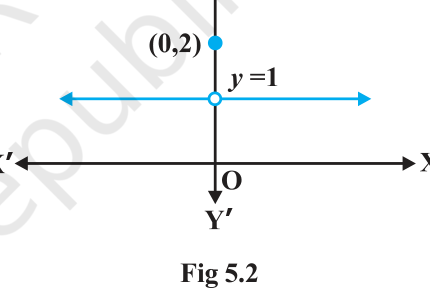
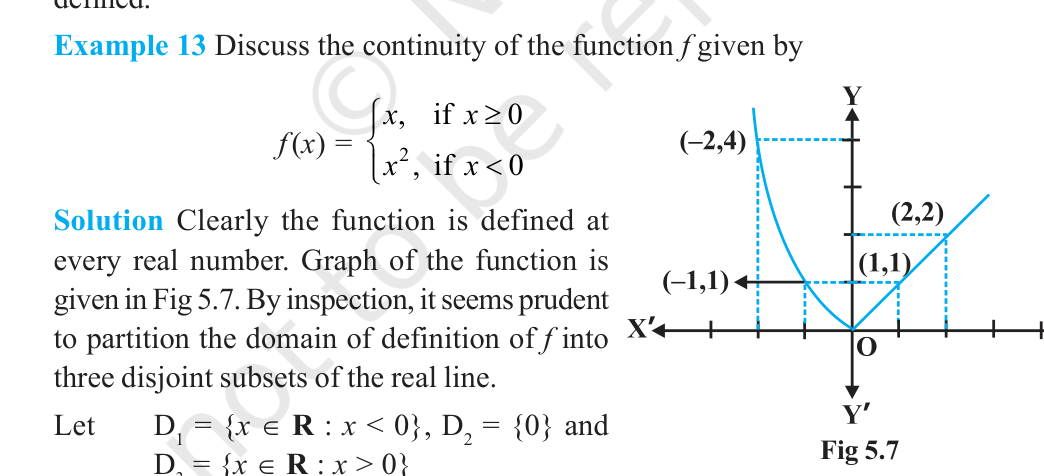
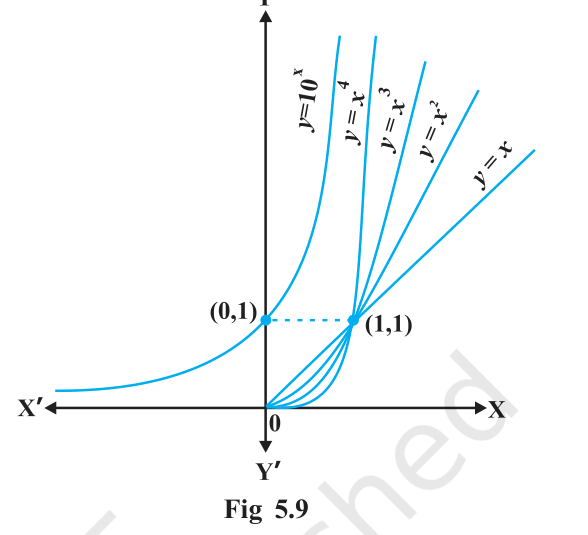
A continuous curve without a break
Warning
A function can be continuous at a point yet not differentiable there. The absolute value function is the standard counterexample, and saying this sentence earns the reasoning mark in assertion questions.
2.2 Limits and continuity worked together
Continuity questions become simple once limits are under control. For a polynomial, substitution gives the limit directly. For a rational function, substitute unless the denominator vanishes; if it vanishes, factor and cancel. For a square root expression with the zero over zero form, multiply by the conjugate first.
A one-sided limit uses values from one side only. The left limit of the greatest integer function at an integer n is n minus 1, while the right limit is n. For the absolute value function at zero both sides give zero but the slopes differ, which is where continuity and differentiability separate.
2.3 Composite and implicit continuity
A composition of continuous functions is continuous: if the inner function is continuous at a point and the outer is continuous at the inner value, the composite is continuous there. This explains why sine of a polynomial is continuous everywhere.
The same idea shows why a rational function is continuous on its domain. Numerator and denominator are polynomials, and the quotient is continuous wherever the denominator is non-zero. Listing the excluded points is often the full answer for a points of discontinuity question.
2.4 Exercise 5.1 worked line
Let f(x) equal x squared for x less than 2 and equal kx plus 1 for x at least 2. The left limit at 2 is 4 and the right value is 2k plus 1. Equating gives k equal to 3 by 2. Writing the left limit, the right limit and the value on separate lines is exactly the required shape.
2.5 Continuous extensions and interval questions
Some functions are undefined at a single point but approach the same value from both sides. For example, (x squared minus 1) over (x minus 1) is undefined at 1 but its limit is 2, so defining the value as 2 at that point makes it continuous. Such a repair is called a continuous extension.
Continuity on a closed interval also needs one-sided continuity at the endpoints. For a function given on [0, 2] by a polynomial rule, the value at 0 is the right limit and the value at 2 is the left limit. Writing both shows the examiner that the endpoints were handled.
2.6 Continuity of a composition at a point
If g is continuous at c and f is continuous at g(c), the composition f of g is continuous at c. This rule explains why a trigonometric function of a polynomial is continuous everywhere, and why a logarithm of a positive polynomial is continuous wherever the polynomial stays positive. Applying it needs only the two continuity facts, not a limit computation.