

Concepts: differentiability and standard derivatives: Continuity and Differentiability
Continuity and Differentiability25 min readLesson 3 of 6
3.1 Differentiability and why it is stronger
Differentiability at a point means the curve has a well-defined slope there. The left derivative and the right derivative must both exist and be equal; a corner or a vertical tangent breaks differentiability even when the function is continuous.
The relationship between the two concepts is one way. Differentiable implies continuous, so a function that is discontinuous cannot be differentiable. The converse fails, and the absolute value function shows why: it is continuous at zero but has a sharp corner, so the left slope is minus one and the right slope is plus one.
3.1.1 Derivatives of the standard functions
The derivative formulas for powers, sine, cosine, tangent, exponentials and logarithms are the base layer. On top of them sit the inverse trigonometric derivatives, which appear in Exercise 5.2 and in later integration work. The chain rule then multiplies by the derivative of the inner function.
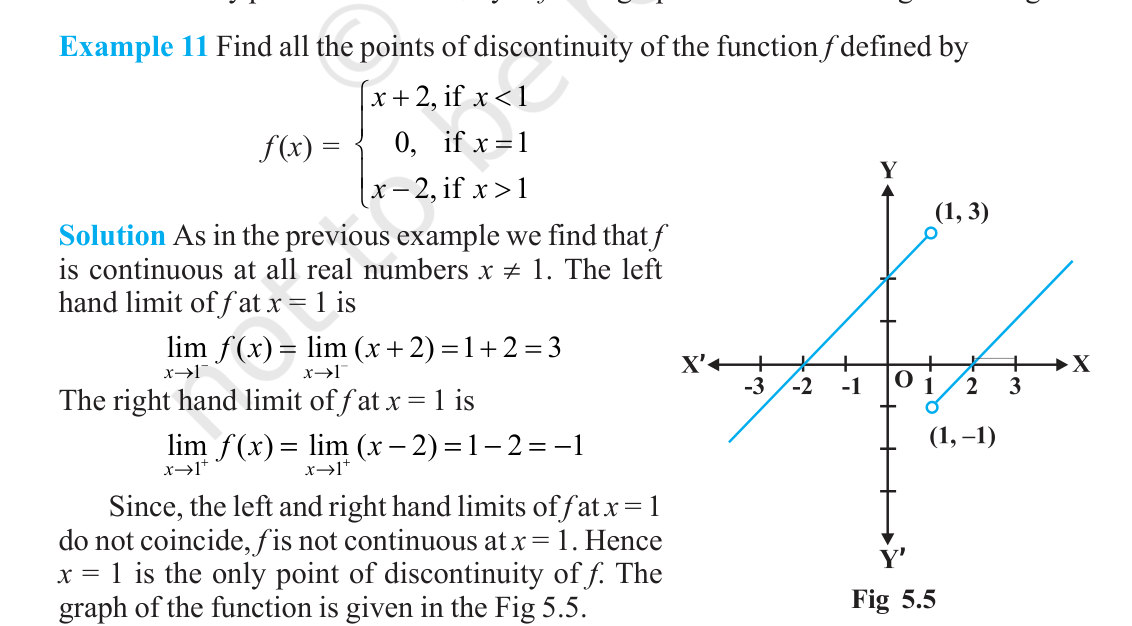
A common exam question asks for differentiability of a piecewise function at the joint. Compute the left derivative from the left piece and the right derivative from the right piece, then compare. If they differ, the function is continuous but not differentiable at that point.
3.1.2 Exponential and logarithmic functions
Exponential functions have the striking property that their derivative is proportional to the function itself. The natural exponential has the simplest rule, and the logarithm is its inverse. The chapter uses these functions to build the logarithmic differentiation technique on the next page.
3.1.3 Exercise 5.2 to 5.4 coverage
Exercise 5.2 is direct differentiation using the formulas. Exercise 5.3 is the inverse trigonometric derivatives, where the inner function is the only trap. Exercise 5.4 mixes exponentials and logarithms. In every case, identify the outer function, differentiate it, then multiply by the derivative of the inner function.
Slideshow, slide 1 of 3. Use the left and right arrow keys to change slides and the space bar to play or pause.
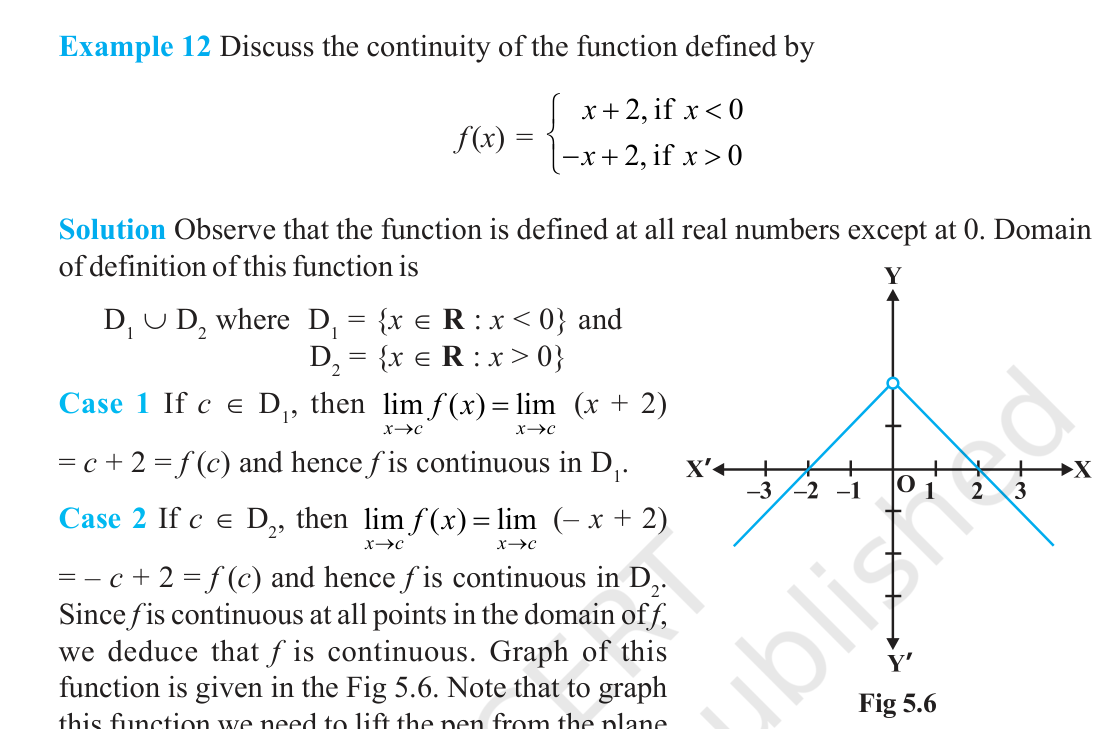
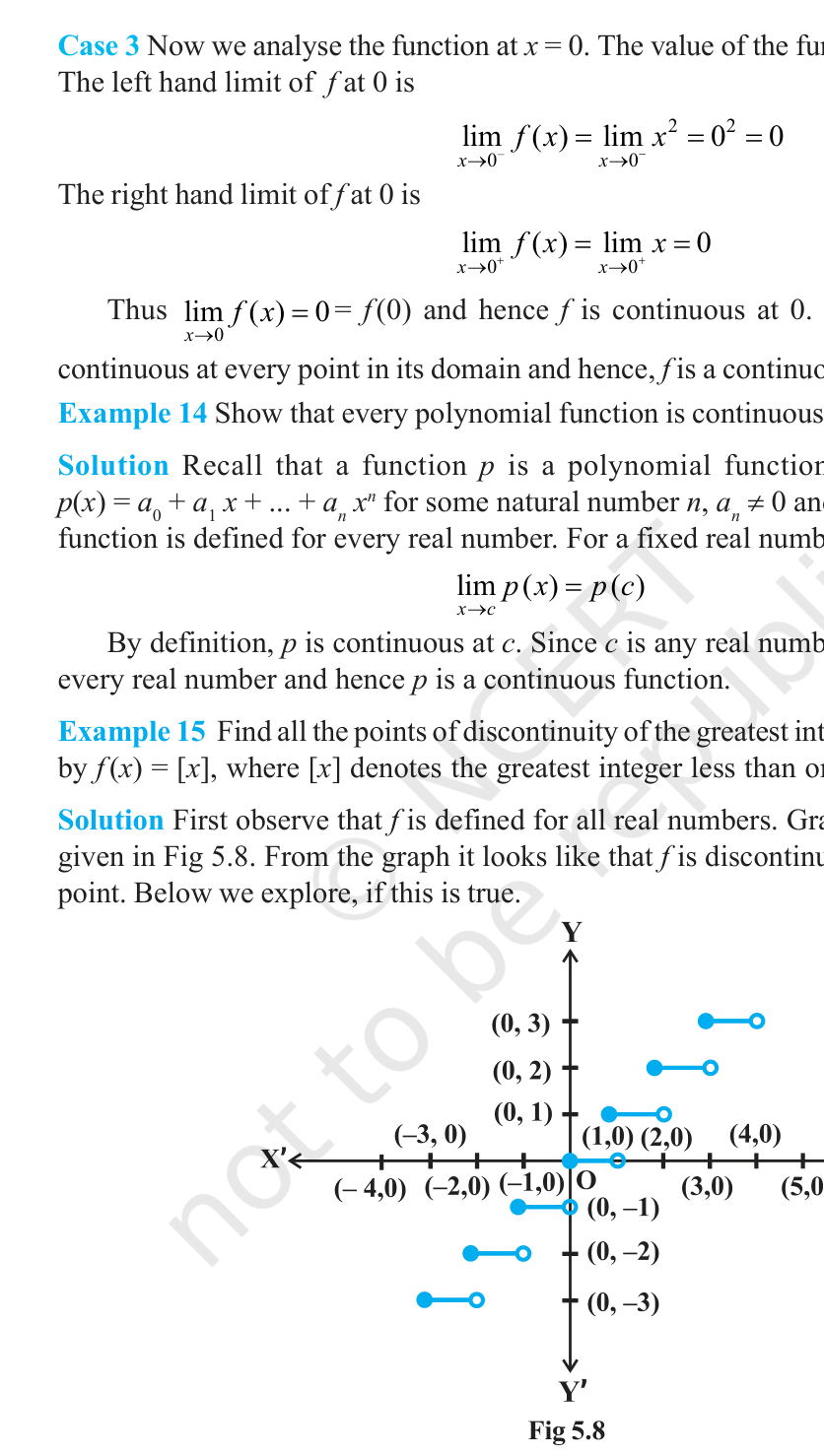
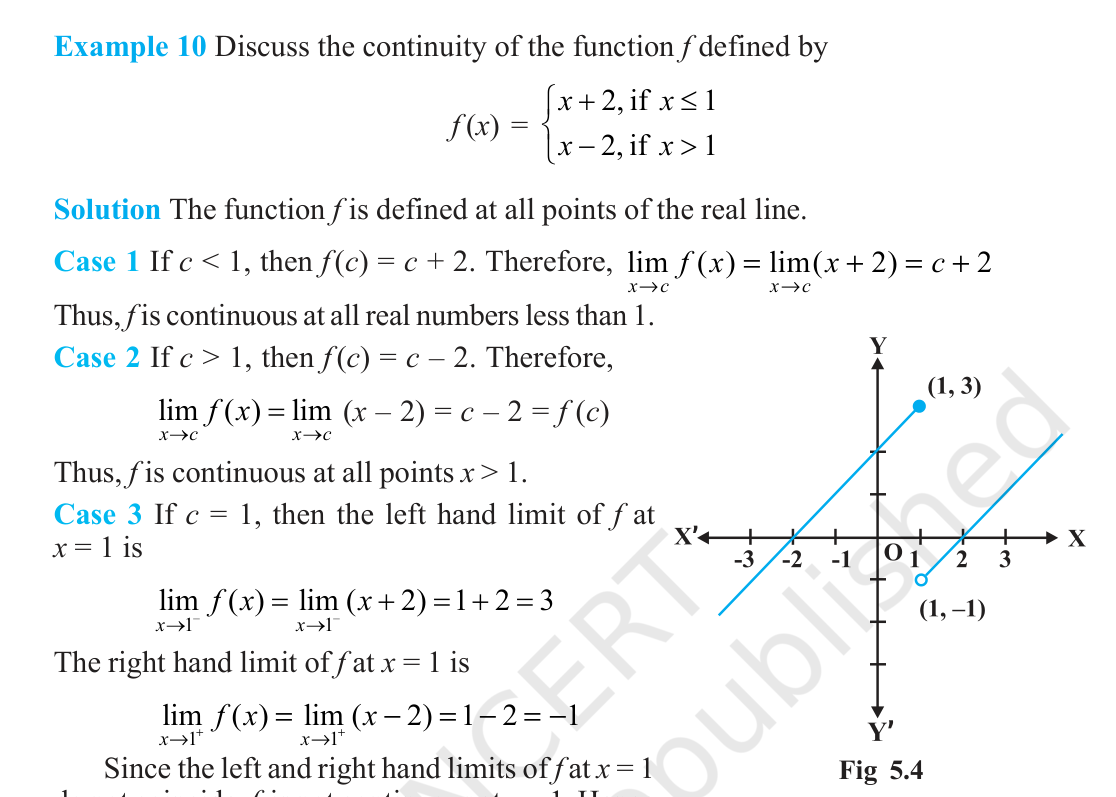
Piecewise graph used to discuss differentiability at the joint
Exam
When a question asks whether a function is differentiable at a point, write both one-sided derivatives. A conclusion without the two limits loses the method mark.
3.2 The chain rule as the main tool
The derivative of f of g of x is f prime at g of x times g prime at x. Name the outer and inner functions before differentiating. For sin of x squared the outer is sine and the inner is the square, so the derivative is cosine of x squared times 2x.
For a product use the product rule, and for a quotient use the quotient rule. Both are combinations of the base derivatives and both appear in Exercise 5.2. Writing the expression as a product is sometimes faster than applying the quotient rule directly.
3.3 Inverse trigonometric derivatives in practice
The derivative of sin inverse x has a square root in the denominator, so the chain rule adds the derivative of the inner argument. For sin inverse of 2x the derivative is 2 divided by the square root of one minus 4x squared. The domain restriction inside the square root is part of the answer and writing it earns a mark.
3.4 Exponential and logarithmic derivatives
The derivative of e to the power f of x is e to the power f of x times f prime of x. The derivative of log of f of x is f prime of x divided by f of x. These two rules cover every exponential and logarithm question in the chapter, including the composite expressions of Exercise 5.4.
3.5 Two more derivative worked lines
Differentiate x squared times sin x using the product rule: 2x sin x plus x squared cos x. Differentiate sin x over x using the quotient rule: (x cos x minus sin x) over x squared. Writing the two rules separately before simplifying keeps sign errors away.
For a composite of three functions, differentiate from the outside in. The derivative of e to the power sin of x squared is e to the power sin of x squared times cos of x squared times 2x. Each factor belongs to one layer.
3.6 Differentiability at a joint
A piecewise function with two polynomial pieces can be checked at the joint in four lines. First the left derivative from the left piece, then the right derivative from the right piece, then the equality test. If the function values also match, the function is both continuous and differentiable there. If the derivatives differ, the function is continuous but not differentiable, and the corner is the reason.
3.7 More inverse trigonometric practice
Differentiate cos inverse of x squared. The outer derivative is minus one over the square root of one minus x to the fourth, and the chain multiplies by 2x, giving minus 2x over that square root. For tan inverse of sin x, the derivative is cos x over one plus sin squared x. Naming the outer and inner parts makes both answers immediate.
3.8 Differentiability and the derivative as a local slope
The derivative at a point is the limit of the difference quotient. Geometrically it is the slope of the tangent there. A curve can be continuous at a point and still fail to have a tangent, as the absolute value function shows at zero. Vertical tangents also fail the differentiability test because the limit of the difference quotient is infinite.
For a function given by a formula, differentiability on an open interval follows from the standard derivative rules and the continuity of the derivative. For a piecewise function the joint is the only place to inspect, and the left and right derivatives decide the answer.