

Concepts: increasing and decreasing functions: Application of Derivatives
Application of Derivatives24 min readLesson 3 of 6
3.1 Monotonicity from the sign of the derivative
A function is strictly increasing on an interval when its derivative is positive throughout the interior of that interval. It is strictly decreasing when the derivative is negative throughout. If the derivative is zero at isolated points but has one sign around them, the function can still be monotonic on the whole interval.
To find the intervals, start from the derivative, factor it and locate the points where it is zero. These critical points divide the real line into pieces. Pick a convenient test value in each piece, evaluate the sign of the derivative, and record the conclusion for that piece.
For a trigonometric function on a restricted interval, solve the derivative equation inside the interval and test the pieces in the same way. Endpoints are handled by the domain statement of the question.
3.2 Worked intervals
Take f(x) equal to x cubed minus 3x. The derivative is 3x squared minus 3, which factors as 3(x minus 1)(x plus 1). The critical points are 1 and minus 1. On the interval from minus infinity to minus 1 the derivative is positive, so the function rises. Between minus 1 and 1 it falls, and beyond 1 it rises again. Writing the intervals with their signs is the complete answer.
Take f(x) equal to x plus 1 over x on positive reals. The derivative is 1 minus 1 over x squared, which is negative between 0 and 1 and positive after 1. So the function falls on (0, 1) and rises on (1, infinity), with a local minimum at 1. This is a standard half-mark-each question.
3.3 Exercise 6.2 coverage
Exercise 6.2 asks for intervals of increase and decrease, for the values of a parameter making a function monotonic, and for proofs such as showing that a given function is increasing on its domain. The derivative test covers all of them once the critical points are found correctly.
Slideshow, slide 1 of 3. Use the left and right arrow keys to change slides and the space bar to play or pause.
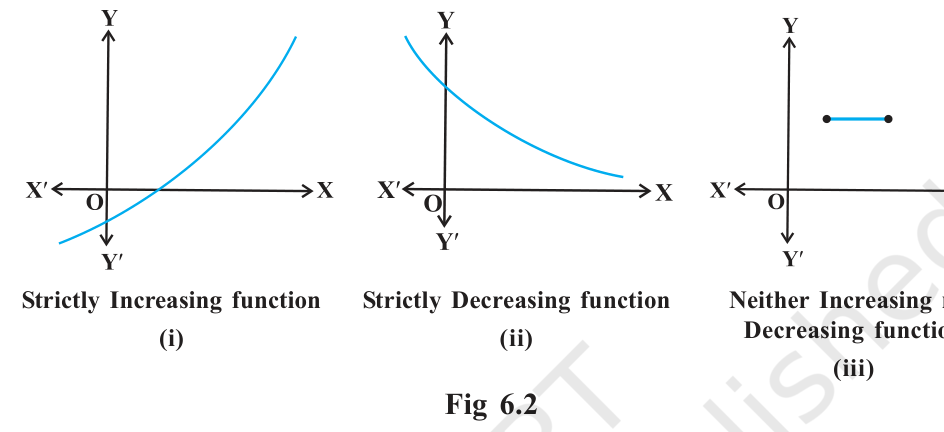
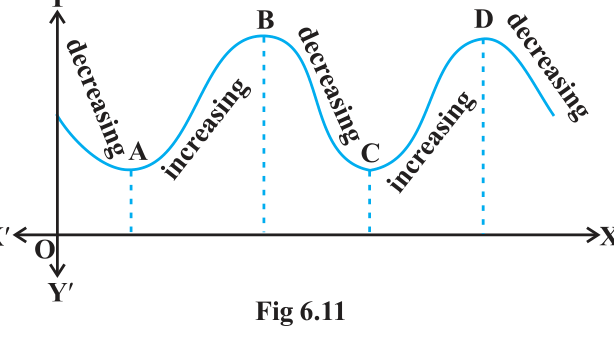
Graphs of strictly increasing and strictly decreasing functions
3.4 Parameters and monotonicity
A frequent variant asks for the values of k for which f(x) = x cubed + kx + 3 is increasing on the whole real line. The derivative is 3x squared plus k, and for this to be positive for every x the constant k must be non-negative. The reasoning is that a square is always non-negative, so the smallest value of the derivative is k. This kind of question combines the derivative test with a simple inequality.
When the derivative is a quadratic with a parameter, the discriminant decides whether it stays positive. A discriminant below zero with a positive leading coefficient makes the quadratic positive everywhere, which gives the range of the parameter.
3.5 Presentation of the answer
Write the derivative, factor it, list the critical points in increasing order, make a small sign table, and then state the intervals. The sign table is accepted as a valid method and protects the marks even if the final statement has a typo.
Exam
If the derivative has the same sign on both sides of a critical point, that point is neither a local maximum nor a local minimum. Say so instead of forcing a classification.
3.6 A trigonometric monotonicity example
Show that f(x) = sin x plus cos x is decreasing on the interval from pi by 4 to 5 pi by 4. The derivative is cos x minus sin x, which is negative when sin x exceeds cos x, and on the stated interval that inequality holds. The interval is exactly where the sum lies between plus root 2 and minus root 2, so the function falls from the first value to the second.
3.7 A logarithmic monotonicity example
Show that f(x) = x plus log x is increasing for x positive. The derivative is 1 plus 1 over x, which is positive for every positive x. The conclusion follows immediately, and the domain statement is part of the answer.
3.8 Proofs of monotonicity
A proof that a function is increasing on its domain usually reduces to showing that the derivative is positive everywhere. For x plus sine x, the derivative is one plus cosine x, which is non-negative and zero only at isolated points, so the function is increasing on the whole real line. For a function with a parameter, the condition that the derivative stay non-negative turns into an inequality on the parameter.
Writing the derivative, simplifying it, and then stating the sign argument in one sentence is enough for a three mark proof.
3.9 One more interval question
Find where f(x) = 2x cubed minus 9x squared plus 12x is increasing. The derivative is 6x squared minus 18x plus 12, which factors as 6(x minus 1)(x minus 2). The sign is positive outside the points 1 and 2, so the function increases on the intervals from minus infinity to 1 and from 2 to infinity, and decreases between 1 and 2. Writing the sign table before the intervals keeps the answer complete.