

Maxima, minima and optimisation: Application of Derivatives
Application of Derivatives26 min readLesson 4 of 6
4.1 Local and absolute extrema
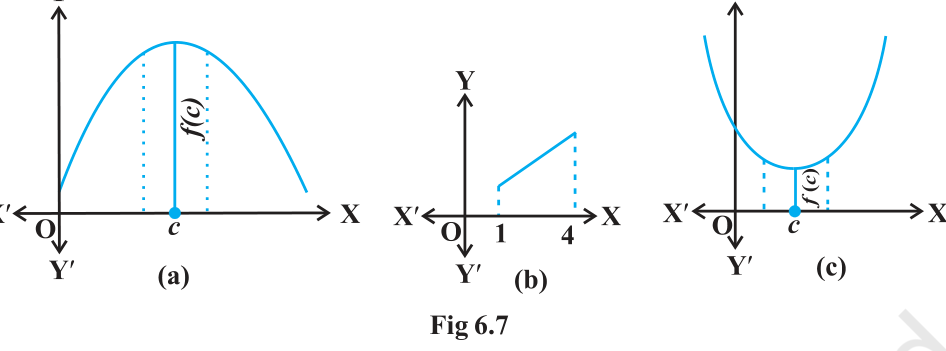
A local maximum is a point where the function is higher than at nearby points, and a local minimum is lower than at nearby points. The first derivative test reads the sign change, and the second derivative test reads the sign of the second derivative. For a closed interval, the absolute maximum and minimum are found by comparing the values at all critical points with the endpoint values.
The steps are fixed. Differentiate, solve the derivative equation, keep only the critical points inside the interval, evaluate the function at those points and at both endpoints, then pick the largest and smallest values. Writing the table of values makes the conclusion unavoidable.
4.2 Optimisation word problems
A word problem hides the function. Read the question, name the quantity to be optimised, express it in one variable using the given constraint, write the domain, differentiate, and test the critical point. The classic shapes are a rectangle with a fixed perimeter and maximum area, a box with a fixed volume and minimum surface, a cylinder with a fixed volume and minimum material, and two positive numbers with a fixed product and minimum sum of squares.
For the positive numbers problem with product 9, let the numbers be x and 9 over x. The sum of squares is x squared plus 81 over x squared. Differentiating and setting to zero gives x to the fourth equal to 81, so x equals 3. Both numbers are 3, and the second derivative test confirms a minimum.
4.3 Exercise 6.3 coverage
Exercise 6.3 is the extrema set. It asks for local maxima and minima of polynomials, absolute extrema on intervals, and the standard optimisation word problems. A representative item on a closed interval asks for both the absolute values; a representative word problem asks for the maximum area or minimum cost. The method is identical in both cases.
4.4 Worked extrema on a closed interval
Find the absolute maximum and minimum of f(x) = 12 x to the power four thirds minus 6 x to the power one third on the interval from 0 to 1. The derivative is 16 x to the power one third minus 2 x to the power minus two thirds, which factors as 2 x to the power minus two thirds times (8x minus 1). The critical point inside the interval is x equal to 1 by 8. Evaluating gives 0 at x equal to 0, minus 9 by 4 at x equal to 1 by 8, and 6 at x equal to 1. So the absolute maximum is 6 and the absolute minimum is minus 9 by 4.
4.5 Worked local extrema
Find the local maximum and minimum of f(x) = 4x squared plus 1 over x for x not zero. The derivative is 8x minus 1 over x squared, which is zero when x cubed equals 1 by 8, so x equals 1 by 2. The second derivative is 8 plus 2 over x cubed, which is positive at 1 by 2, so this point is a local minimum. The function has no local maximum because it tends to infinity on both ends.
4.6 Presentation habits
Write the derivative, the critical points, the second derivative or sign table, and then the conclusion with the values. For word problems, define the variable and the constraint in the first line. That single line is often the difference between full marks and half marks.
Exam
For a closed interval question, the endpoints are compulsory. Many students find the critical point and stop, missing the endpoint comparison and one mark.
4.7 A second optimisation worked problem
A closed cylinder has a fixed volume. Find the ratio of height to radius for the least surface area. The volume gives h in terms of r, the surface area becomes a function of r alone, and differentiating sets 4 pi r equal to 2V over r squared. Substituting the volume relation gives h equal to 2r, so the height equals the diameter at the minimum. The second derivative is positive, confirming a minimum.
4.8 Optimisation exam checklist
Name the variable and the constraint, write the function, state the domain, differentiate and factor, test the critical point, and give the final answer with units. Each of these lines is a visible step, and the marking scheme rewards them separately.
4.9 More optimisation practice
A rectangular pen against a wall with a fixed length of fencing has maximum area when the two equal sides are half the fixed third side. The constraint removes one variable, and the derivative test finishes the problem in two lines. A cylindrical can with a fixed volume uses the least material when the height equals the diameter, a result worth remembering for objective questions.
For an open box built from a square sheet with corners cut out, the volume is a cubic in the cut size. Differentiating gives a quadratic, and the valid root inside the domain is the answer. The domain statement rules out the negative roots and any cut larger than half the sheet.