

Concepts: matrix types, equality and notation: Matrices
Matrices24 min readLesson 2 of 6
2.1 What a matrix stores
A matrix is a compact way to write a collection of numbers that belongs together. The NCERT chapter opens with a bookseller who records the number of notebooks and pens bought by two students. The information sits in two rows and two columns, and reading a row gives one student's shopping list while reading the column gives one item's total across students.
The same arrangement appears in marks tables, stock statements and price lists. For a matrix with m rows and n columns, the position of each entry is fixed by its row number and column number, which is why two matrices can be compared entry by entry.
2.1.1 Order and entries
The order is written first by rows, then by columns. A matrix with 3 rows and 2 columns is a 3 by 2 matrix, and it has 6 entries. If a matrix has 36 entries, the possible orders are the factor pairs of 36: 1 by 36, 2 by 18, 3 by 12, 4 by 9, 6 by 6, and their reverses, which gives nine possible orders.
A matrix whose entries are defined by a formula is a standard board question. If a matrix of order 3 by 3 has entries aij = i minus 3j, then each entry is computed from its own row and column. For example, a11 = 1 minus 3 = minus 2, a12 = 1 minus 6 = minus 5, and a31 = 3 minus 3 = 0. Working entry by entry is faster than trying to remember the whole matrix.
2.1.2 Types of matrices
The names follow the shape. A row matrix is something like [1 2 3] with a single row. A column matrix is a vertical list. A rectangular matrix is not square. A square matrix has equal numbers of rows and columns.
Inside squares, a diagonal matrix keeps entries only on the main diagonal and puts zero everywhere else. A scalar matrix goes one step further and makes the diagonal entries equal. The identity matrix is the scalar matrix with ones. The zero matrix has every entry zero and behaves as the additive identity.
2.1.3 Equality of matrices
Two matrices are equal when their orders match and every corresponding entry matches. This single condition turns one matrix equation into several ordinary equations. For two matrices of order 2 by 2, equality gives four equations, which is why a question asking for a missing value usually supplies just enough entries to solve it.
Slideshow, slide 1 of 3. Use the left and right arrow keys to change slides and the space bar to play or pause.
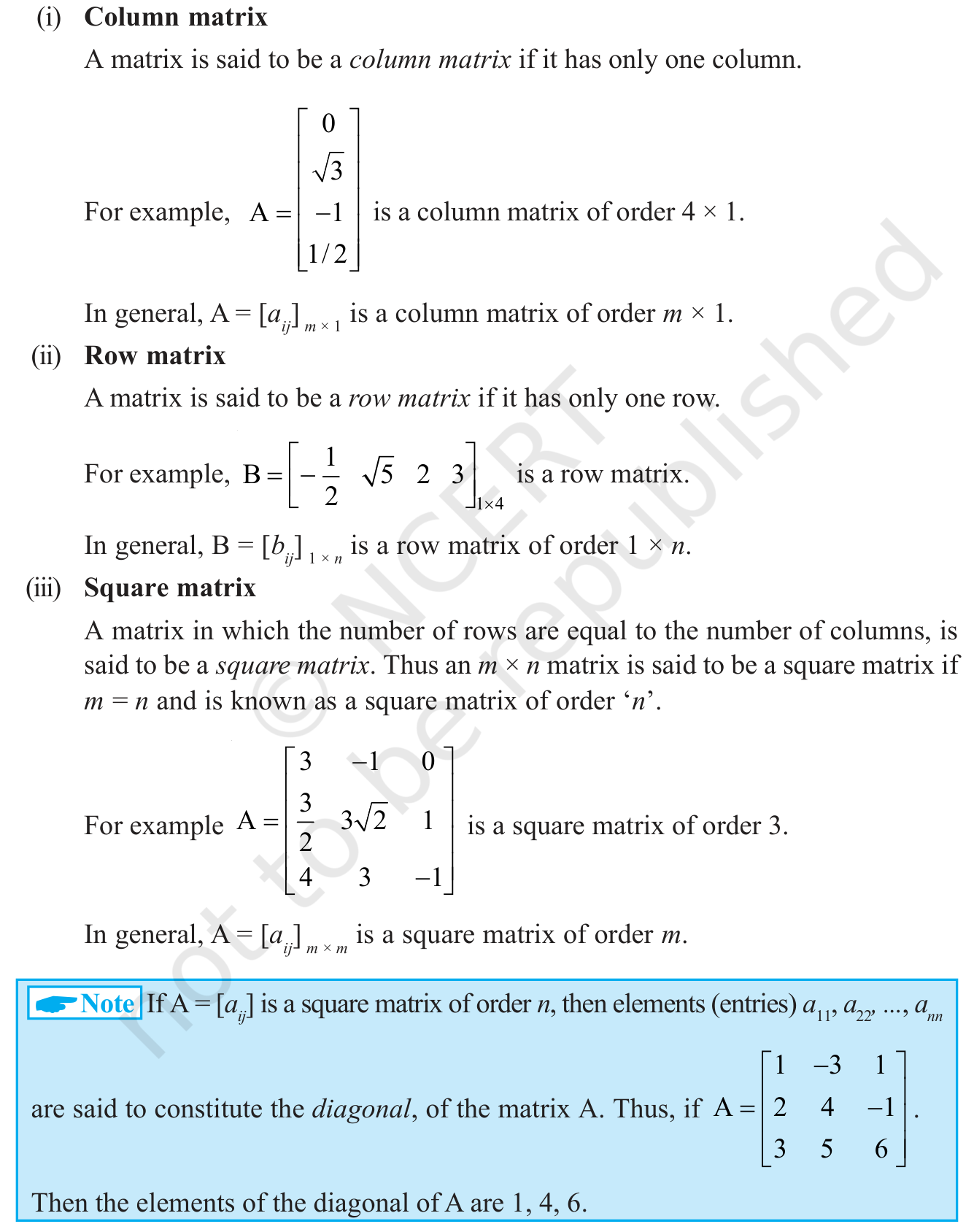
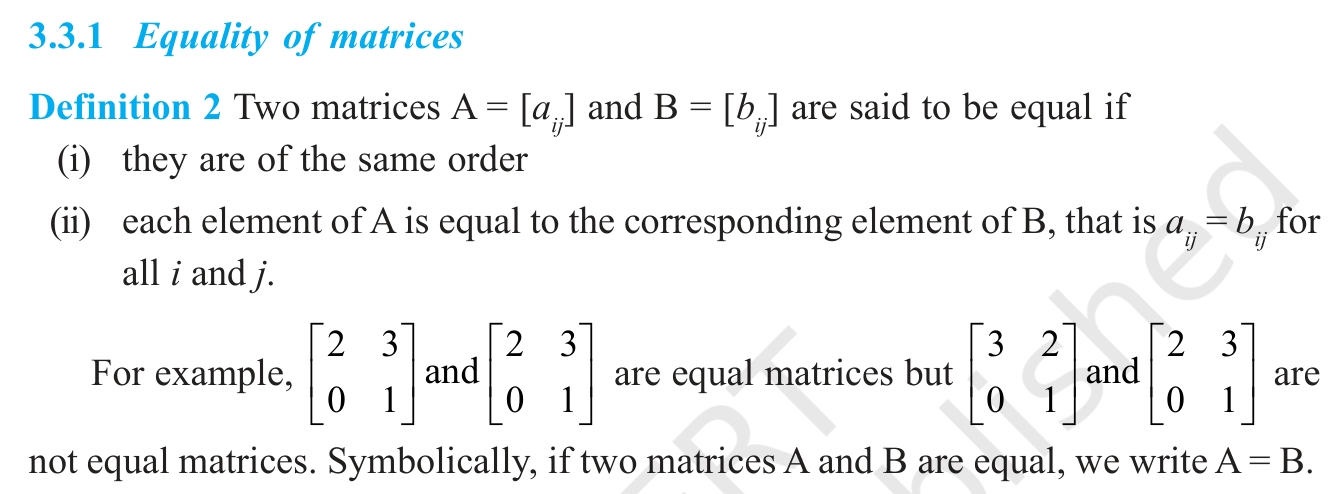
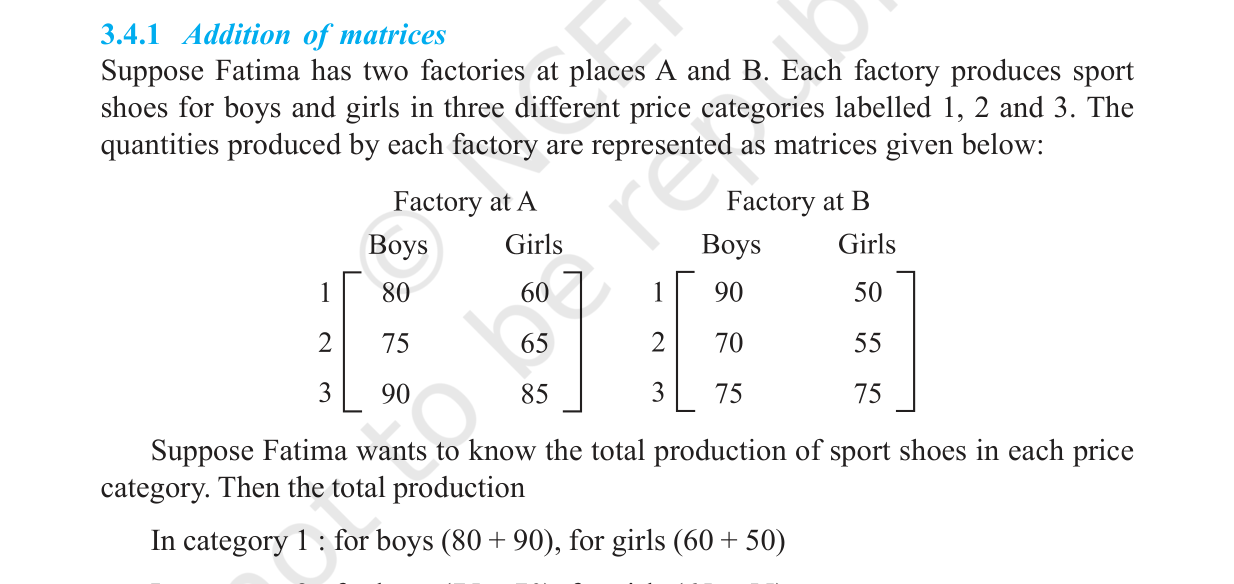
Matrix types as printed in the chapter
Exam
A matrix question that looks long usually reduces to comparing entries. Write the matching entries in separate lines rather than in one paragraph, and the marks follow the lines.