

Concepts: operations, transpose and invertible matrices: Matrices
Matrices26 min readLesson 3 of 6
3.1 Operations that keep the shape
Addition of two matrices is entrywise and needs identical orders. If A and B are both 2 by 3, then A + B is formed by adding matching entries, and the order stays 2 by 3. Scalar multiplication multiplies every entry by the scalar, so the order does not change at all. The zero matrix is the identity for addition, and the matrix with every entry negated gives the additive inverse.
These operations obey the familiar laws: addition is commutative and associative, and scalar multiplication distributes over addition. None of that requires the matrix to be square.
3.2 Multiplication and its order rule
For the product AB, the number of columns of A must equal the number of rows of B. If A is m by n and B is n by p, the product is m by p. Write the two orders side by side and cancel the inner numbers; if they match, the outer numbers give the order of the product.
The entry in row i and column j of AB is the dot product of row i of A and column j of B. This is why the product is not commutative in general: AB and BA may not even be defined together, and when both are defined they can differ. A useful identity is A I = I A = A for square matrices, where the identity has the matching order.
Multiplication is associative and distributes over addition. Powers of a square matrix are defined by repeated multiplication, and A squared means A times A, not the entrywise square.
3.3 Transpose, symmetric and skew symmetric matrices
The transpose interchanges rows and columns. It gives a matrix of order n by m from one of order m by n. Transposing twice returns the original, transposing a sum transposes each part, and transposing a product reverses the order.
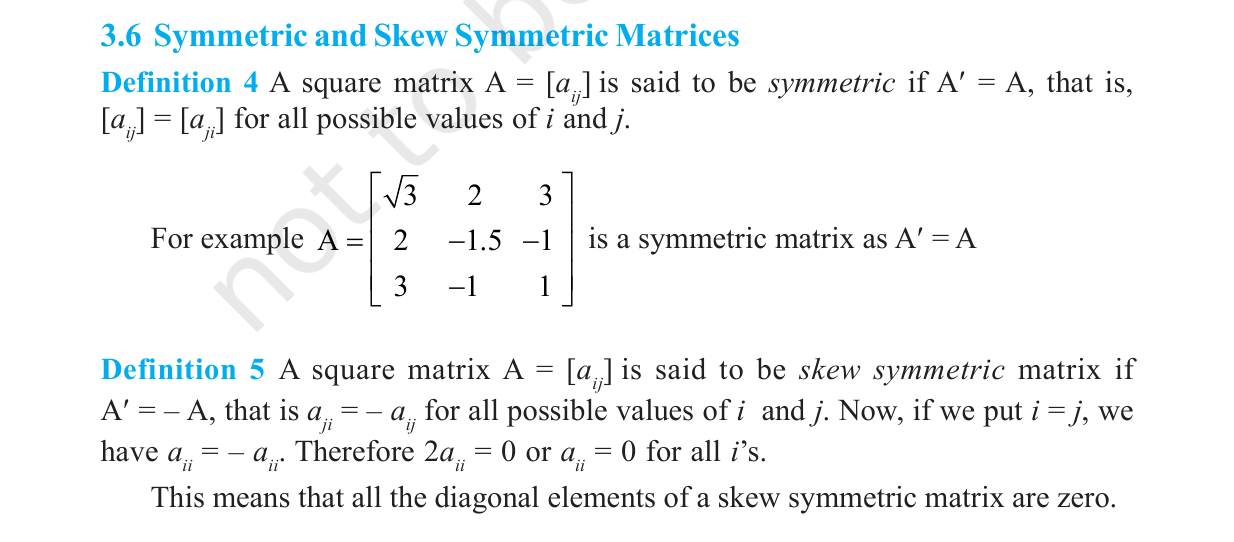
A square matrix is symmetric when it matches its own transpose and skew symmetric when it equals the negative of its transpose. Every square matrix can be written as the sum of a symmetric matrix and a skew symmetric matrix. The symmetric part is half of A plus its transpose, and the skew part is half of A minus its transpose. To check a result, add the two parts and see whether the original matrix returns.
3.4 Invertible matrices
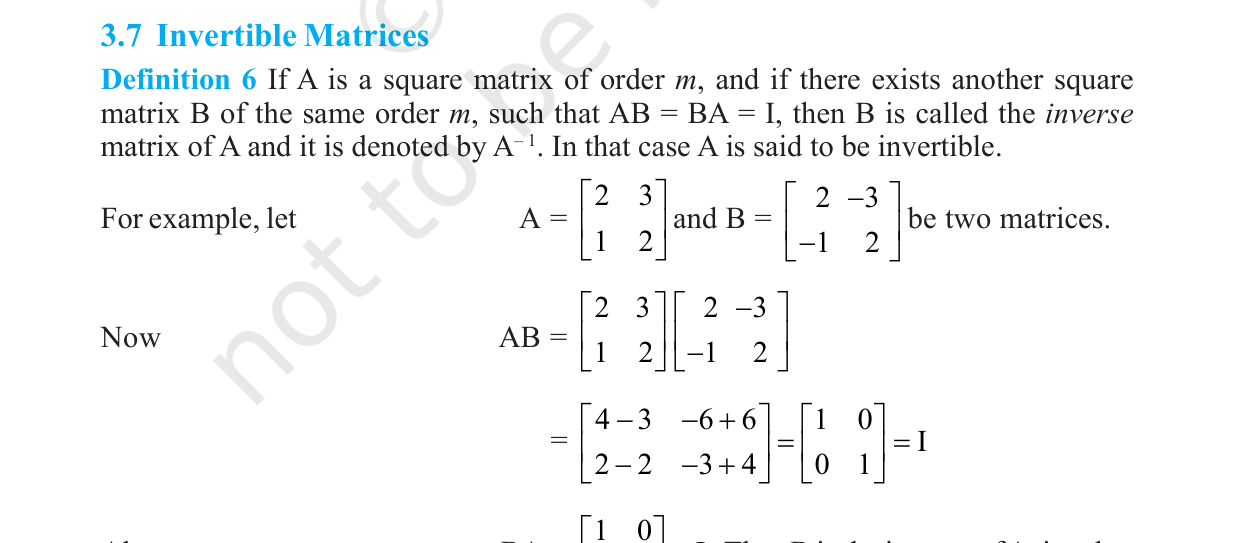
A square matrix A is invertible if there is a matrix B of the same order with AB = BA = I. In that case B is the inverse of A. This chapter uses the inverse through its algebraic rules rather than through the adjoint: the inverse of a product reverses the order, the inverse of a transpose is the transpose of the inverse, and the inverse of a scalar multiple is the scalar reciprocal times the inverse.
Not every matrix is invertible. The chapter introduces the idea through the determinant in the next chapter, but for now the working rule is that a matrix with an inverse is called non-singular.
3.5 Worked practice from the exercises
Exercise 3.1 asks for orders, entries and equality checks. A typical item gives a matrix with entries defined by a formula and asks for one entry, which is direct substitution. Exercise 3.2 covers addition, scalar multiplication and simple products. Exercise 3.3 covers matrix products and their order rule, and Exercise 3.4 asks for transposes and symmetry checks.
One representative worked item: if A = [[1, 2], [3, 4]] and B = [[5, 6], [7, 8]], then AB = [[1 times 5 + 2 times 7, 1 times 6 + 2 times 8], [3 times 5 + 4 times 7, 3 times 6 + 4 times 8]] = [[19, 22], [43, 50]]. Reversing the order, BA = [[23, 34], [31, 46]], which is different, so multiplication does not commute here.
A second worked item: for A = [[2, 3], [4, 5]], the symmetric part is half of A + A', which is [[2, 3.5], [3.5, 5]], and the skew part is half of A minus A', which is [[0, minus 0.5], [0.5, 0]]. Adding the two parts returns A, which checks the construction.
3.5.1 More worked operations
Matrix multiplication rewards careful bookkeeping. For A = [[1, 2], [3, 4]] and B = [[0, 1], [1, 0]], the product AB swaps the two columns of A, giving [[2, 1], [4, 3]], while BA swaps the two rows of A, giving [[3, 4], [1, 2]]. The two results are different, which is the shortest demonstration that matrix multiplication is not commutative.
Scalar multiplication and addition combine in the usual distributive way. If A and B are 2 by 2, then 2(A + B) equals 2A + 2B, and the entries confirm it one by one. Such a question usually asks for a missing entry or for a value of a variable after matching entries.
Transpose questions often come with a symmetry check. For A = [[1, 2], [4, 5]], the transpose is [[1, 4], [2, 5]], which is different, so A is not symmetric. The symmetric part is [[1, 3], [3, 5]] and the skew part is [[0, minus 1], [1, 0]]. Adding the two parts returns the original matrix, which is the check to write in the exam.
3.5.2 Invertibility shortcuts
The identity AI = IA = A is the workhorse for inverse questions in this chapter. If AB = I is given, then B is the inverse of A, and a quick multiplication verifies it. For a 2 by 2 matrix A = [[a, b], [c, d]], the inverse exists when ad minus bc is not zero, and the formula is one over that number times [[d, minus b], [minus c, a]]. The next chapter proves why the number ad minus bc decides everything.
Warning
A common error is to compute AB as an entrywise product. Matrix multiplication uses row times column, so write the intermediate sums. Another is to cancel matrices from both sides of an equation; that step is valid only when the matrix being cancelled is invertible.