

Concepts: Angle between two lines
Three Dimensional Geometry18 min readLesson 3 of 7
3.1 The angle is in the direction vectors
Two lines in space may meet or may not, but their angle is defined through their directions. Take the direction vector of each line, and the angle between those two vectors is the angle between the lines. The point of intersection is irrelevant to the angle, which is why the formula uses only the direction ratios.
The cosine formula is the dot product divided by the product of the lengths. It is the same formula that measures the angle between two vectors; only the interpretation changes, and that is why the dot product chapter comes first in the book. When the answer has to be acute, the modulus is taken before the division, and when the question names a directed angle, the sign of the dot product decides whether the reported angle is acute or obtuse. A line has two opposite senses, so swapping a direction vector for its negative changes the angle to its supplement. When the question asks for the acute angle, take the modulus of the dot product before dividing; when the lines are directed, keep the sign.
Two special cases carry most of the marks. If the dot product is zero, the lines are perpendicular; if the cross product is zero, or the direction ratios are proportional, the lines are parallel. A common question gives one family of lines with a parameter and asks for the value that makes a pair perpendicular or parallel, which turns the test into a short equation.
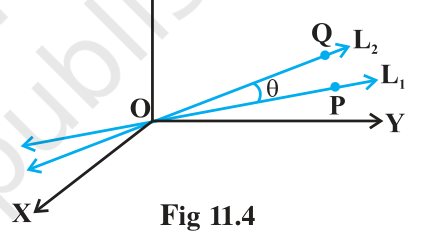
A frequent variant gives each line by two points and asks for the angle. The direction is the difference of the position vectors, and the same cosine formula follows. Keeping the points in the order named by the question matters, because reversing one direction changes the answer to its supplement.
Another variant gives one family of lines containing a parameter and asks for the value at which a second line is parallel to it. Set the direction ratios proportional and solve; the resulting equations usually pair up to give a single value of the parameter. For the perpendicular version, set the dot product to zero instead. The two tests are worth learning side by side because examiners alternate between them.
When one line is in vector form and the other is in cartesian form, convert both to direction triples before substituting. The conversion is mechanical: the coefficient vector of the parameter for the vector form, and the denominators for the cartesian form. After that, the cosine formula, the dot product test and the parallelism test all look the same. This is why the chapter's worked examples and exercises keep alternating between the two forms: the examiner wants to see that the direction, not the notation, is what carries the geometry.
3.2 Worked examples
Example 1. Two lines carry the directions (2, -1, 1) and (3, 5, 2). Their dot product is 3, and the lengths are root 6 and root 38, so the cosine of the angle is 3 divided by root 228 and the angle is the inverse cosine of that.
Example 2. Two lines have direction ratios (2, 3, 4) and (5, 2, 1). Their dot product is 20, so the cosine of the angle between them is 20 divided by the product of the lengths root 29 and root 30.
Example 3. Find the value of p for which the lines (1 - x)/2 = (y - 1)/3 = z/1 and (2x - 3)/(2p) = (y)/1 = (z - 4)/7 are perpendicular. The first line has direction ratios (-2, 3, 1) and the second has (p, 1, 7). The dot product -2p + 3 + 7 must be zero, so p equals 5. (Note how the sign of the first line is handled before comparing.)
Example 4. Show that the line through (1, -1, 2) and (3, 4, -2) is perpendicular to the line through (0, 3, 2) and (3, 5, 6). The first direction is (2, 5, -4) and the second is (3, 2, 4), whose dot product is 6 + 10 - 16, that is zero. The two lines are therefore perpendicular.
The two directions also decide whether the lines can meet at all. Parallel directions never meet unless the lines coincide, and skew lines meet nowhere; the angle is still well defined because it comes from the directions alone. A second useful observation is that the angle between a line and its reverse is the supplement of the angle between the original lines, so the acute angle is unchanged when either direction is negated.
The same formula works when one line is given by two points. Build the direction vector by subtracting the two position vectors, and substitute that vector into the cosine formula. Questions that appear to mix vector and cartesian forms become one-line substitutions once both directions are written as triples.
Exam
The angle formula is one line of working once the directions are read off. For a vector equation, the direction is the coefficient vector of the parameter; for a cartesian equation, it is the vector of denominators. Take the modulus when the answer must be acute, and leave the answer as an inverse cosine unless the angle is a standard one.
Common mistake
Do not compare the position vectors when the question asks for an angle; only the direction vectors matter. Also, do not confuse parallel with coincident: proportional direction ratios prove parallelism, while intersection needs a separate check. And when a line is written as (1 - x)/2, remember the direction ratio is -2, not 2.