

Concepts: Direction cosines, direction ratios and equations of a line
Three Dimensional Geometry22 min readLesson 2 of 7
2.1 Direction of a line in space
Imagine a directed line and the three coordinate axes. The line makes one angle with each axis, and the cosines of these three angles are the direction cosines, written l, m and n. The direction cosines are exactly the components of the unit vector along the line, which is why they obey a fixed identity: the sum of their squares is one. The signs follow the direction in which the line is traversed, so reversing the line changes all three signs.
Direction ratios are a looser version of the same idea. Any three numbers a, b and c that are proportional to the direction cosines are direction ratios, and the components of any vector parallel to the line are the simplest choice. To recover the direction cosines from direction ratios, divide each ratio by the square root of the sum of their squares, choosing one sign for all three. Two lines with proportional direction ratios are parallel, and two lines with direction ratios that give zero dot product are perpendicular.
The coordinate axes illustrate the pattern. The x-axis has direction ratios 1, 0, 0 and direction cosines 1, 0, 0. A line parallel to the y-axis has direction ratios 0, 1, 0, and the zero ratio is recorded, not evaluated. This is the reason a zero in a denominator later is read as a condition on the direction rather than as a division.
Slideshow, slide 1 of 3. Use the left and right arrow keys to change slides and the space bar to play or pause.
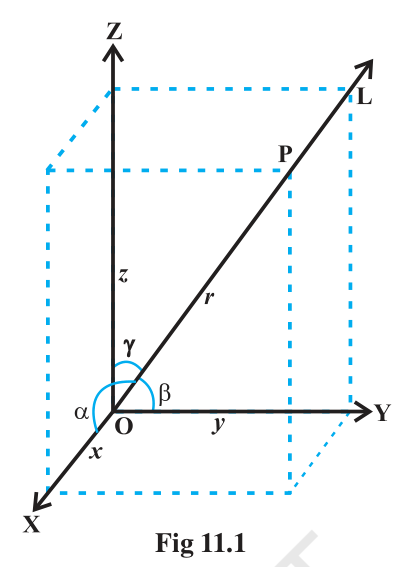
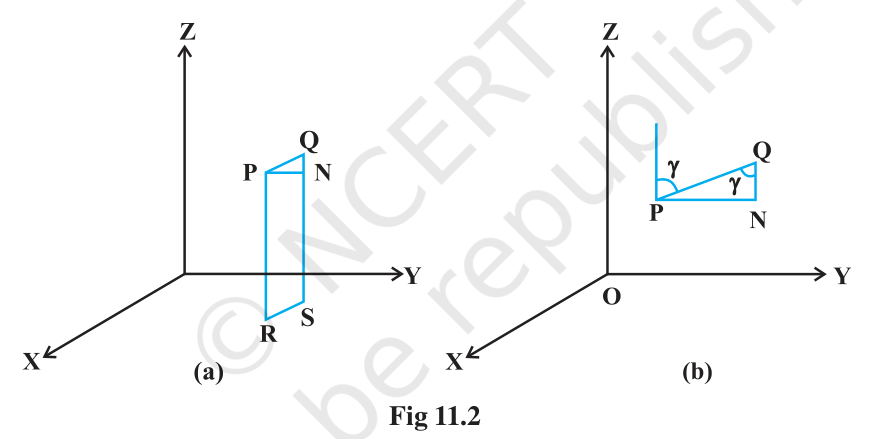
A directed line through the origin making angles alpha, beta and gamma with the coordinate axes, defining the direction cosines.
2.2 The vector equation of a line
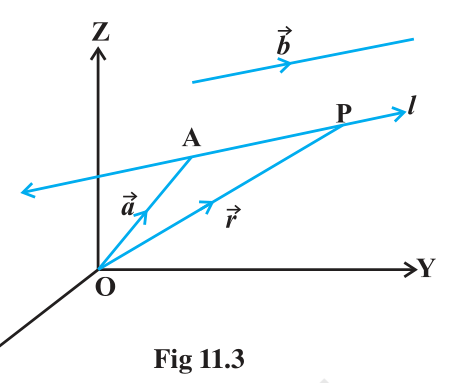
Fix a point A on a line with position vector a and let b be a vector parallel to the line. Any other point P on the line is reached by starting at A and travelling some distance along b, so its position vector has the form a plus a scalar multiple of b. That scalar is the parameter of the line, and as it varies over the real numbers the point P traces the whole line.
This single equation carries both pieces of information: the point gives the location and the vector b gives the direction. Different values of the parameter give different points, and each point on the line corresponds to exactly one value of the parameter.
2.3 The cartesian equation
Writing the vector equation in components gives three scalar equations, one for each coordinate. Eliminating the parameter gives the cartesian form: the differences of the coordinates from the fixed point are proportional to the direction ratios. The denominators are the direction ratios of the line, and the fixed numbers in the numerators locate the point.
Reading a cartesian equation is a skill in itself. The point on the line has coordinates that make all three numerators zero, and the direction ratios are the denominators. If a denominator is zero, the corresponding numerator must also be zero for points on the line, and the line lies in a plane of constant coordinate. For example, a line with direction ratios 2, 0, 5 through the point (1, 3, 4) has x and z varying in the ratio 2 to 5 while y stays equal to 3 throughout.
2.4 The line through two points
When two points are given instead of a point and a direction, the direction is the vector joining them. If the points have position vectors a and b, then b minus a is parallel to the line, and the line can be written with either point as the base. The cartesian form follows the same pattern, with the differences of the coordinates of the two points as direction ratios.
One check keeps these answers safe. Substituting the parameter value that returns the second point must give the same coordinates, and the direction ratios must be proportional to the difference of the two points. If the two points have the same y coordinate, the y direction ratio is zero, and the cartesian equation again carries a zero denominator as a condition.
2.5 Worked examples
Example 1. A line runs from A(2, 3, 4) to B(4, 7, 8). The direction ratios are the differences (2, 4, 4), whose magnitude is 6, so the direction cosines are 1/3, 2/3 and 2/3.
Example 2. Find the vector equation of the line through P(1, 2, 3) with direction 2 i - j + 4 k. The answer is r = i + 2 j + 3 k plus lambda times (2 i - j + 4 k).
Example 3. Write the cartesian equation of the line through (2, -1, 4) with direction ratios 3, 2, -5. The equation is (x - 2)/3 = (y + 1)/2 = (z - 4)/(-5).
Example 4. Convert the cartesian equation (x - 1)/2 = (y + 2)/3 = (z - 4)/(-1) into vector form. The point is (1, -2, 4) and the direction is 2 i + 3 j - k, so r = i - 2 j + 4 k plus lambda times (2 i + 3 j - k).
Example 5. Find the vector equation of the line through the points A(2, 3, 5) and B(4, 7, 9). The direction is B minus A, which is 2 i + 4 j + 4 k, so r = 2 i + 3 j + 5 k plus lambda times (2 i + 4 j + 4 k).
Exam
A one-mark direction question asks only for the ratios to be normalised. Show the magnitude under the square root, divide all three ratios by it, and keep one common sign. For a line written in cartesian form, copy the denominators as the direction ratios and the numbers from the numerators with the opposite sign as the point. These two habits cover most objective questions in this chapter.
Common mistake
Do not treat a zero denominator as a division by zero. It says the corresponding coordinate does not change, so the numerator must be zero on the line. Also, do not mix the point and the direction: the numbers subtracted in the numerators are the point's coordinates, and the denominators are the direction ratios, not the other way round.