

Concepts: antiderivatives and standard integrals
Integrals20 min readLesson 2 of 8
2.1 Reversing the derivative
For every derivative rule there is a matching integration rule read right to left. The derivative of x cubed is three x squared, so an antiderivative of three x squared is x cubed. The derivative of sine is cosine, so an antiderivative of cosine is sine. Because a constant has zero derivative, adding a constant to an antiderivative gives another antiderivative, and the indefinite integral always carries a plus C. Two students who write different constants have both written correct antiderivatives, and a question that wants one particular member of the family supplies a value of the function.
The power rule covers every power except minus one. At minus one the antiderivative of one over x is the natural logarithm of the absolute value of x, because the derivative of the logarithm is one over x. The absolute value is needed because the logarithm is defined only for positive arguments but one over x is also defined for negative x.
2.2 The standard table with worked lines
The table in the formula sheet should be reproduced from memory. Three quick checks keep it honest. Differentiate the answer and see whether the original integrand returns. Check the units of the power rule: the power has to rise by one. Check the signs of the circular forms, because the cosine family and the secant family carry minus signs that are easy to drop.
Example 1: a polynomial. The integral of four x cubed minus two x plus five is x to the fourth minus x squared plus five x plus C. Differentiating gives back the polynomial, which confirms every term.
Example 2: a root. The integral of the square root of x, that is x to the power one half, is x to the power three halves divided by three halves, which simplifies to two thirds x to the power three halves plus C. The power rose by one as required.
Example 3: a sum of standard forms. The integral of one over x squared plus one over the square root of one minus x squared is minus one over x plus the inverse sine of x plus C, because each term is a standard form from the table.
Slideshow, slide 1 of 3. Use the left and right arrow keys to change slides and the space bar to play or pause.
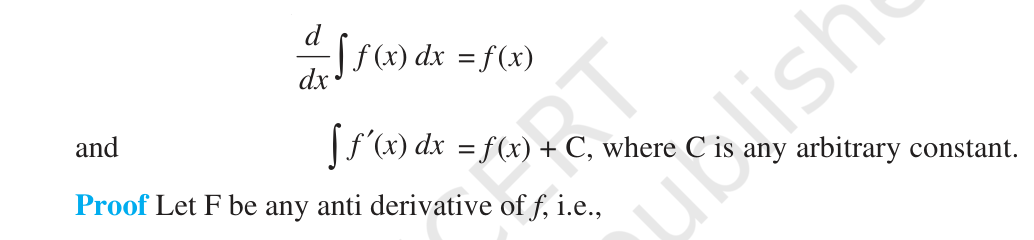
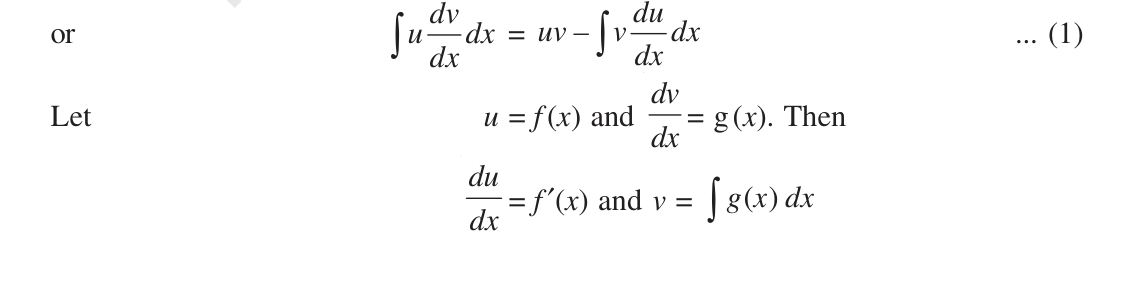

Official NCERT display of the properties of the indefinite integral from section 7.2.1.
2.3 Properties of the indefinite integral
The indefinite integral is linear: the integral of a sum is the sum of the integrals, and a constant factor can be taken outside. These two properties let any finite sum of standard forms be integrated term by term without extra work. The properties do not extend to products and quotients, which is why the next pages develop substitution, partial fractions and by parts.
An initial condition turns a family of curves into one curve. If the velocity of a particle is the derivative of its position, integrating the velocity gives the position plus a constant, and the position at one instant fixes that constant. The same pattern appears in every applied question: integrate first, then substitute the given pair of values to find C.
2.4 Common mistakes and exam tip
Dropping the constant of integration costs a mark in an indefinite integral. Forgetting the absolute value in the logarithm loses a mark in questions that integrate over negative values. Applying the linearity property to a product, and writing the integral of a product as the product of the integrals, is a conceptual error rather than a slip. In an exam, write the standard form that you are using above the integral sign; it shows the examiner which rule has been applied.
2.5 Checking an answer by differentiating
Every indefinite integral in this chapter can be checked in one line, and the check is worth doing in the exam because it catches sign and coefficient errors immediately. Differentiate the answer term by term and compare with the integrand. If a coefficient is wrong, the derivative comes back multiplied by that coefficient. If a sign is wrong, the derivative comes back with the opposite sign. The check takes less than a minute and converts a guess into a verified answer.
2.6 Why initial conditions are common in applied questions
A differential equation of the form dy by dx equals f of x has a one-parameter family of solutions, and an applied question usually supplies the value of y at one point. The procedure is always the same: integrate to get y plus C, substitute the given point to solve for C, then write the particular solution. Velocity and position, marginal cost and total cost, and the growth of a population all follow this pattern, so the same two lines of working appear in subjects outside mathematics.
A final check on any standard form: the unit of the answer should match the unit of the integrand multiplied by the unit of x, and the power of x should rise by one in every polynomial term.