

Concepts: definite integrals, properties and the limit of a sum
Integrals24 min readLesson 5 of 8
5.1 From area to number
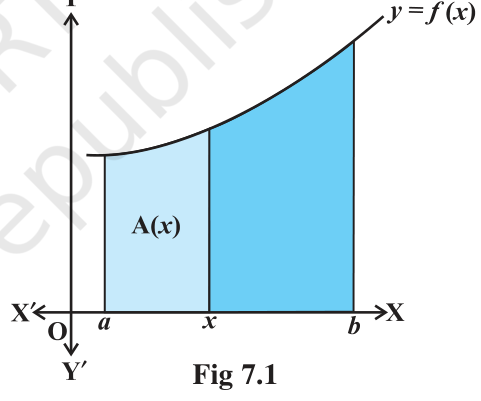
The definite integral of a positive function from a to b is the area between the curve, the x-axis and the two vertical lines x equal to a and x equal to b. When the curve lies below the axis the integral is negative, and it is the signed area that the integral reports. The area function A of x is defined as the integral from a fixed point a to x, and its derivative is the integrand. That statement is the first fundamental theorem, and it says that the area function is an antiderivative.
The second fundamental theorem turns the first into a computing tool. If F is any antiderivative of f, the definite integral from a to b is F of b minus F of a. The constant of integration no longer appears because it cancels in the subtraction. This is why the whole method of the chapter reduces areas to a search for an antiderivative followed by two substitutions.
5.2 The properties that save work
Several properties are used so often that they should be automatic. Reversing the limits changes the sign of the integral and equal limits make it zero. Splitting the interval at a point allows a piecewise function or an absolute value to be handled one piece at a time. Substituting a minus x for x converts an integral from zero to a into a mirror integral, and adding the two often doubles a simpler expression. For an even function the integral over a symmetric interval is twice the integral over half the interval, and for an odd function it is zero.
A typical board question gives an integral that seems impossible and becomes trivial after the replacement x goes to a minus x. The sum of the integral and its mirror image often simplifies the integrand to the sum of two standard pieces.
5.3 Substitution with limits
When a definite integral is evaluated by substitution, the limits must be transformed as well. If u is a function of x, then the lower limit a becomes u of a and the upper limit b becomes u of b. The converted integral is then evaluated entirely in u and no back substitution is needed. This is cleaner than evaluating the indefinite integral and then substituting the x limits, and it reduces the chance of an error in the conversion.
5.4 The limit of a sum
The definite integral is defined as the limit of a sum of rectangle areas. Divide the interval into n equal parts of width h equal to (b minus a) over n, evaluate the function at the left end of each part, add the n products and let h tend to zero. For a continuous function this limit exists and equals the definite integral. The method is used for integrals of simple polynomials where the antiderivative is hard to write or when the question specifically asks for the limit of a sum. The sums of first powers, squares and cubes of the first n natural numbers are needed, namely n(n+1)/2, n(n+1)(2n+1)/6 and n squared times (n+1) squared over four.
5.5 Worked examples
Example 1: a direct application. The integral from one to two of x squared is x cubed over three evaluated between the limits, which is eight thirds minus one third, equal to seven thirds.
Example 2: an odd function. The integral from minus pi to pi of sine cubed x is zero because the integrand is odd and the interval is symmetric about the origin. Checking symmetry first saves three lines of work.
Example 3: the reflective property. For the integral from zero to pi of x sine x over one plus cosine squared x, applying x to pi minus x and adding gives pi over two times an integral whose substitution turns it into an inverse tangent, with the final value pi squared over four.
5.6 Common mistakes and exam tip
Forgetting to change the limits after substitution is the most common definite integral error. Treating the integral of an absolute value as if the function were linear across the whole interval, without splitting at the point where the expression changes sign, is the second. In a property question, state which property is being applied before writing the transformed integral. Finish a definite integral with the numerical value or the exact expression, not with plus C.
5.7 A worked property question
For the integral from zero to pi of x sine x over one plus cosine squared x, apply the reflective property and add the two forms. The x terms then add to pi, and the remaining integral is pi times the integral of sine x over one plus cosine squared x. Substitute t equal to cosine x and the integral becomes the integral of one over one plus t squared, which is an inverse tangent. The final value is pi squared over four.