Concepts: order, degree, formation and solutions
Differential Equations20 min readLesson 2 of 7
2.1 Reading an equation
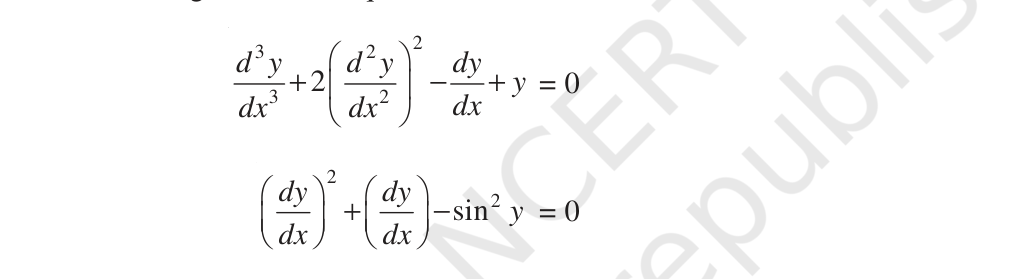
A differential equation relates a function to its derivatives. Its order is the highest derivative that appears. Its degree is the power of that highest derivative once the equation is written as a polynomial in the derivatives. The words polynomial and derivatives together matter: an equation containing a sine of a derivative, or a derivative inside a logarithm, is not of defined degree until it is rewritten, and some equations cannot be rewritten at all. For example, dy by dx plus y equal to zero is first order and first degree, while the square of d squared y by dx squared plus dy by dx equals zero is second order and second degree.
2.2 Forming an equation from a family
A family of curves with one parameter has a first order differential equation. For the family of circles centred at the origin, x squared plus y squared equal to a squared, differentiate once to get two x plus two y y dash equal to zero, and the parameter disappears, leaving x plus y y dash equal to zero. For the family y equal to m x plus c with two parameters, one differentiation gives y dash equal to m and a second gives y double dash equal to zero, a second order equation.
The number of arbitrary constants in the family equals the order of the equation obtained. That is the reason a general solution carries as many constants as the order, and why one initial condition fixes one constant. When a parameter is eliminated, the equation that remains holds for every member of the family; solving it should give the family back with a constant.
2.3 General and particular solutions
The general solution of a first order equation contains one arbitrary constant. A particular solution is obtained by using a given value of the function at a point, called the initial condition. Geometrically the general solution is a family of curves and the particular solution is the one curve through the given point.
Verification is a standard one mark step. Differentiate the proposed solution as many times as the order of the equation, substitute into the equation, and simplify. If the result is an identity, the solution is correct. The check catches a missing constant, a wrong sign in the integrating factor and an arithmetic slip in the integration, so it is worth doing even in the exam.
2.4 Worked examples
Example 1: order and degree. The equation d y by dx whole cubed plus y equal to zero is first order and third degree. The equation d squared y by dx squared plus sine of y dash equal to zero is second order but of undefined degree, because the equation is not polynomial in the derivative.
Example 2: forming an equation. The family of parabolas y squared equal to four a x has one parameter. Differentiating gives two y y dash equal to four a, and eliminating four a between the two relations gives y equal to two x y dash, a first order equation.
Example 3: verifying a solution. Check y equal to x squared plus C against dy by dx equal to two x. Differentiating gives two x, and substituting gives an identity, so the solution is correct. If the proposed solution were x squared alone, it would still satisfy the equation, which shows that a particular solution is also allowed.
2.5 Common mistakes and exam tip
Counting the degree before clearing the radicals is the most common error. A second is writing a general solution with too few constants. A third is checking a solution by substitution without differentiating first. In an exam, write the order and the degree as a separate line before solving anything; it is usually a one mark part of the question and it organises the rest of the answer.
2.6 Families and their equations
A family with one parameter yields a first order equation and a family with two parameters yields a second order equation. The converse is also useful: a first order equation has a one parameter family of solutions and a second order equation has a two parameter family. When the question gives a family, count the parameters first and plan that many differentiations. When the question gives an equation, the general solution must show exactly as many constants as its order.
2.7 A check that catches most mistakes
After finding a solution, differentiate it once and see whether the original equation comes back. In a formation question, substitute the family into the equation you have found and check that the parameter cancels. In an order and degree question, clear the radicals as a separate step and only then read the power. These three checks take a minute each and they catch the errors that cost most marks in this chapter.