

Concepts: variable separable and homogeneous equations
Differential Equations22 min readLesson 3 of 7
3.1 Separating the variables
An equation is variable separable when it can be written as the derivative equal to a function of x times a function of y. Dividing by the y function and multiplying by dx puts all the y terms on one side and all the x terms on the other, and each side is integrated independently. The general solution is the integrated relation with one constant. No substitution is needed, but the division is valid only where the y function is not zero, so constant solutions can be lost when dividing; for board purposes the integrated family is the expected answer.
The method covers the exponential growth and decay equations, the cooling equation and many geometric problems. In each case the physical or geometric statement is translated into dy by dx equal to a product, and the integration gives the relation between the variables.
3.2 Worked separable examples
Example 1: a reciprocal case. For dy by dx equal to y over x, separate to dy by y equal to dx by x, integrate to log y equal to log x plus a constant, and write y equal to C x. The constant carries the sign and is fixed by an initial condition.
Example 2: a power case. For dy by dx equal to x squared y cubed, separate to y to the minus three dy equal x squared dx and integrate to minus one half y to the minus two equal x cubed over three plus C. Solving for the constant with y of zero equal to one gives the particular solution.
Example 3: a trigonometric case. For dy by dx equal to sine x cosine y, separate to secant y dy equal sine x dx, and the integral gives the logarithm of secant y plus tangent y equal to minus cosine x plus C.
3.3 Homogeneous equations
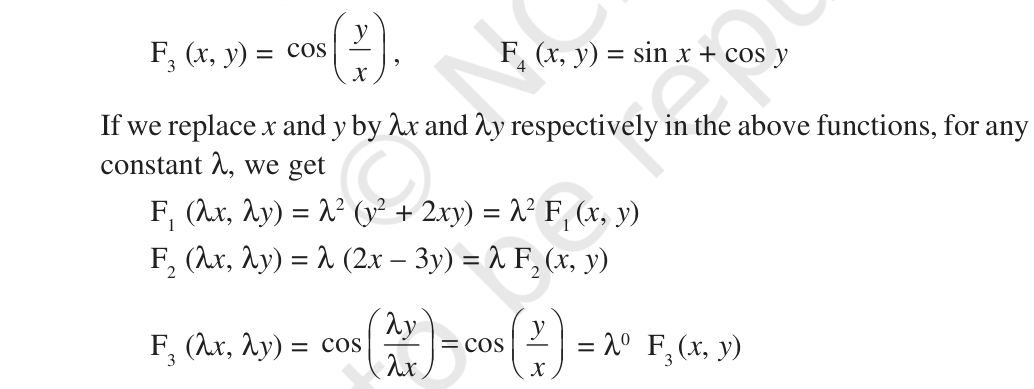
A first order equation is homogeneous when the right side can be written as a function of the ratio y by x. The test is to replace x by lambda x and y by lambda y: if every term scales by the same power of lambda, the equation is homogeneous. The substitution y equal to v x changes the left side to v plus x dv by dx, and the resulting equation is separable in v and x. After integrating, replace v by y over x to finish.
The substitution works only for homogeneous equations; applying it to a non-homogeneous equation produces a worse equation, which is a signal to check the homogeneity test again. The final answer is often left in implicit form, since solving explicitly for y may not be possible.
3.4 Worked homogeneous examples
Example 1: a quadratic case. For dy by dx equal to y squared plus two x y over x squared, substitute y equal to v x. The equation becomes v plus x dv by dx equal v squared plus two v, so x dv by dx equal v squared plus v. Separating gives the integral of dv over v squared plus v equal the integral of dx over x, and partial fractions finish the problem.
Example 2: a linear ratio case. For x dy equal y dx, the equation is homogeneous and the substitution gives x dv equal zero, so v is constant and y is proportional to x. Example 3: with an initial condition. For x squared dy plus y times x plus y dx equal zero with y of one equal to one, the substitution gives a separable equation in v; integrating gives a relation, and the initial condition fixes the constant.
3.5 Common mistakes and exam tip
Dropping the x dv by dx term after the substitution is the most common homogeneous error. In the separable case, forgetting the constant of integration, or applying the initial condition before integrating, gives a wrong constant. Always write the equation in the standard form of the chosen method first; the examiner awards the method marks for that line even if the integration is imperfect.
3.6 Recognising the separable form quickly
Look for a right side that can be split into a factor containing only x and a factor containing only y. Products such as x times e to the y, and quotients such as y squared over x, both separate. A sum such as x plus y does not separate, and that is the signal to test for homogeneity instead. Writing the right side as a product is usually the fastest way to see the method.
3.7 Checking homogeneity in one line
Replace x by lambda x and y by lambda y in the right side. If every term scales by the same power of lambda, the equation is homogeneous and the substitution y equal to v x is the right move. If the powers differ, the equation is not homogeneous and the substitution will not simplify it, so look for a separable form or a linear form instead.
Slideshow, slide 1 of 3. Use the left and right arrow keys to change slides and the space bar to play or pause.

Official NCERT formula display of the first order first degree equation in the form dy by dx equal F of x and y, printed in section 9.4.1.