

Concepts: bar magnet, magnetic dipole and field lines
Magnetism and Matter22 min readLesson 2 of 6
2.1 The bar magnet as a dipole
A bar magnet has two poles, and the magnetic moment m points from the south pole to the north pole inside the magnet. The strength of the dipole is measured by m, whose unit is ampere metre squared. Isolated magnetic poles do not exist: if a magnet is broken, each piece is again a dipole with its own north and south pole, which is why the magnetic moment is the natural quantity for describing a magnet rather than pole strength.
The field of a short bar magnet can be worked out in the same way as the field of an electric dipole. On the axis, at a distance r from the centre, the field points along the axis and equals (mu0 / 4 pi)(2m / r cubed). On the equatorial line at the same distance the field is half as large, (mu0 / 4 pi)(m / r cubed), and it points opposite to the magnetic moment. Both results assume r is much larger than the length of the magnet, which is what the phrase short magnet means.
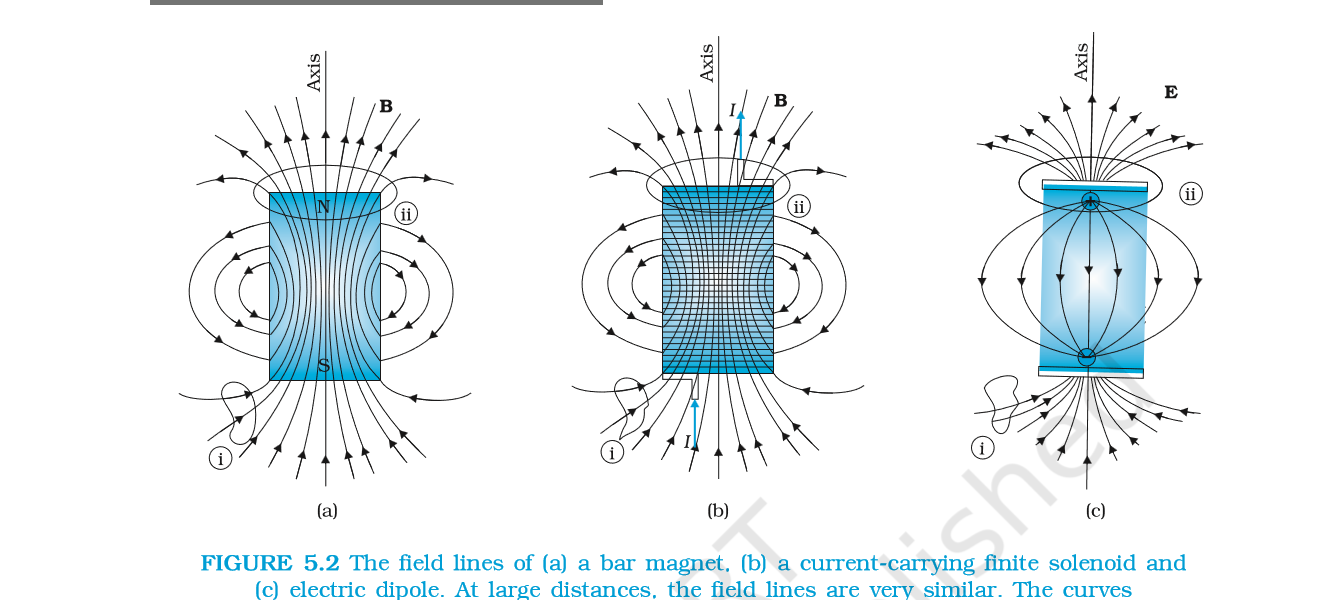
The textbook figure 5.2 shows the field lines of a bar magnet, a current carrying finite solenoid and an electric dipole side by side. At distances large compared with their sizes, the patterns look very similar. That is the visual statement of a deeper fact: a current loop has a magnetic moment m = IA, and a solenoid wound with N turns of area A carrying current I has m = NIA, so the two can replace each other in the far field.
2.2 Torque and energy in a uniform field
When a magnet is placed in a uniform field, the two poles feel equal and opposite forces, so there is no net force but there is a torque. The torque is the cross product of the magnetic moment and the field, tau = m x B, and its magnitude is mB sin theta where theta is the angle between m and B. The torque is zero at theta equal to 0 and 180 degrees and largest at 90 degrees. It always acts to turn the magnet towards the direction of the external field.
The potential energy of the magnet in the field is U = -m cos theta times B, that is, minus the dot product of m and B. The energy is lowest, -mB, when m is parallel to B, which is the stable equilibrium. It is highest, +mB, when m is antiparallel to B, which is the unstable equilibrium. Turning the magnet from angle theta1 to theta2 needs work W = mB(cos theta1 minus cos theta2).
2.3 Field lines and Gauss's law for magnetism
Magnetic field lines form closed loops. Outside a magnet they run from north to south, and inside they continue from south to north, so a field line never begins or ends at a point. The tangent to a field line gives the direction of B, the density of lines gives its magnitude, and field lines never cross, because a crossing would make the direction ambiguous.
Those properties are summed up in Gauss's law for magnetism: the flux of B out of a closed surface adds up to zero. Written as an integral, the flux of B over a closed surface vanishes, which says there is no magnetic monopole to act as a source or sink of field lines. Every field line that enters a closed surface must leave it again. Inside the field of a current carrying solenoid, or in the field of a bar magnet, this rule holds for every closed surface drawn anywhere.
Slideshow, slide 1 of 3. Use the left and right arrow keys to change slides and the space bar to play or pause.
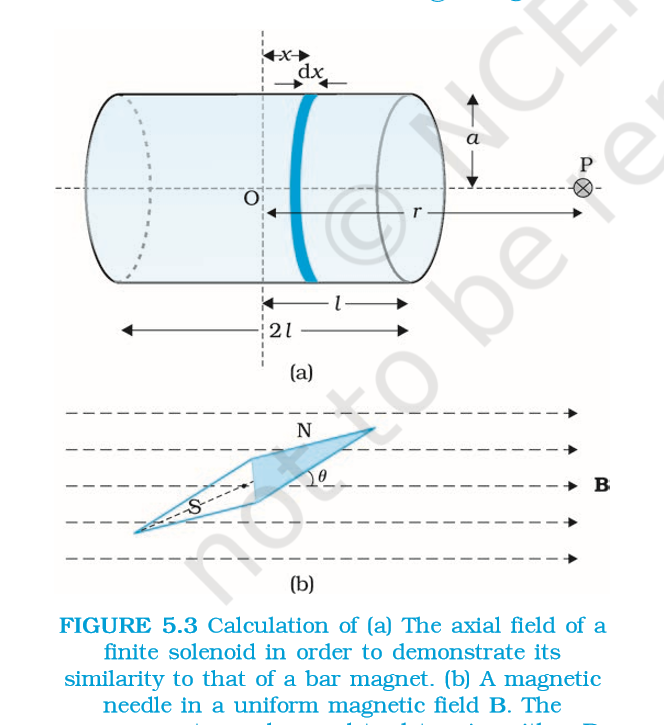
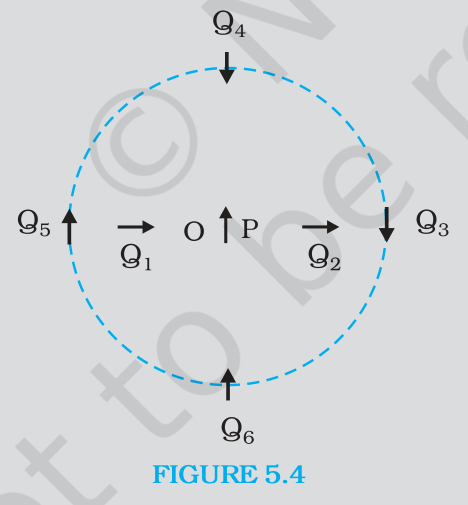
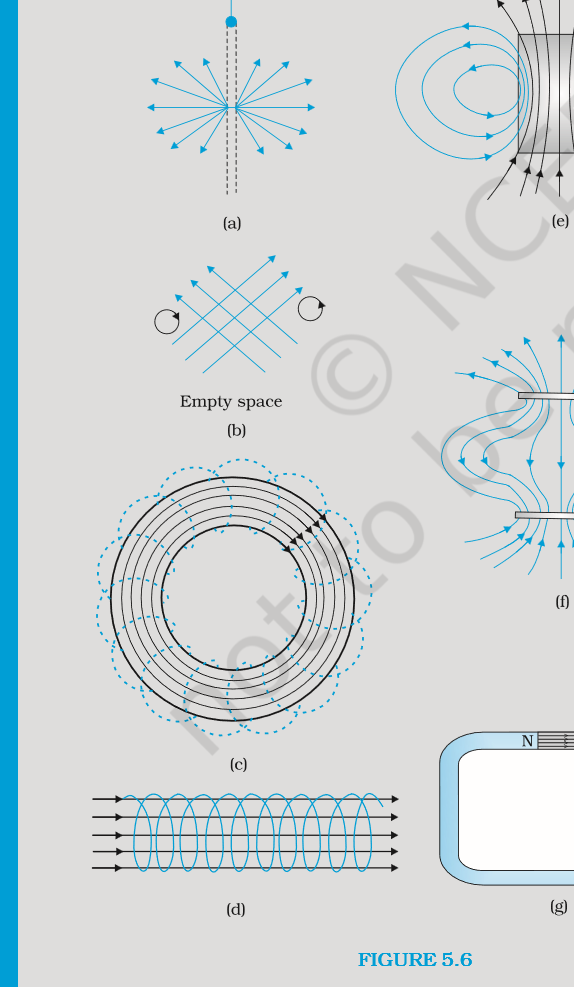
Figure 5.3 calculation of the axial field of a finite solenoid, and a magnetic needle in a uniform field used to find B or the magnetic moment.
2.4 The solenoid as a bar magnet
A current carrying solenoid produces a field like a bar magnet. On its axis at a point far from the ends, the field works out to (mu0 / 4 pi)(2m / r cubed) with m = NIA, which is exactly the axial field of a short bar magnet of the same moment. Inside a long solenoid the field is nearly uniform, B = mu0 n I, and outside the lines spread out just like those of a bar magnet. This equivalence means a long solenoid can be used as a strong artificial magnet, and the direction of the magnetic moment follows the right hand rule: curl the fingers along the current and the thumb points along m.
2.5 Two worked checks
Take a magnet of moment 0.32 A m squared in a field of 0.15 T. In the stable position, when m is parallel to B, the potential energy is -mB, that is -0.048 J. In the unstable position, when m is antiparallel, the energy is +0.048 J.
For a torque question, a magnet with m parallel to the plane at angle theta feels tau = mB sin theta. If the torque is halved when the angle changes from 90 degrees, then sin theta becomes one half, so the angle is 30 or 150 degrees, and the magnet has turned by 60 degrees from the starting position.
Exam
In every magnetism question, first decide whether the field is along the axis or the equatorial line, because the axial field is twice the equatorial field. Then draw the vector m and the field, and write the angle between them into the torque or energy formula.