

Earth's magnetism, magnetisation and magnetic materials
Magnetism and Matter22 min readLesson 3 of 6
3.1 The earth as a magnet
The earth behaves as if a bar magnet were placed inside it, but the magnetic south pole of that imaginary magnet is near the geographic north pole. That is why the north pole of a compass needle points towards the geographic north. The magnetic axis is tilted by about 11.3 degrees from the rotation axis, so the magnetic poles do not coincide with the geographic poles.
The earth's field at a place is described by three quantities called the magnetic elements. The declination D is the angle between the magnetic meridian and the geographic meridian, so it tells you how far a compass deviates from true north. The angle of dip or inclination delta is the angle the earth's total field makes with the horizontal, being zero at the magnetic equator, 90 degrees at the magnetic poles and intermediate elsewhere. The horizontal component B_H is the part of the field along the surface, and the vertical component B_V is the part perpendicular to it. The relations are B_H = B cos delta, B_V = B sin delta and tan delta = B_V / B_H.
3.2 Magnetisation and magnetic intensity
When a material is placed in a magnetic field, its atomic moments partly align and the material itself becomes magnetised. The magnetisation M is the magnetic moment per unit volume, M = m_net / V, and its unit is ampere per metre. The externally applied field is described by the magnetic intensity H, defined as B_0 / mu0 where B_0 is the field that would be present without the material. The two together give the field inside the material, B = mu0 (H + M).
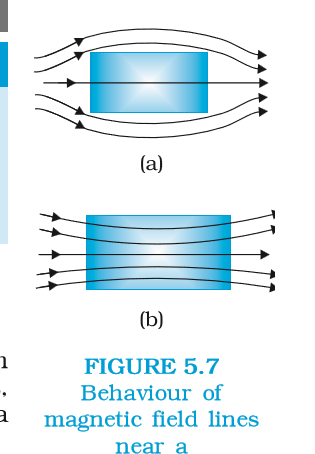
The response of a material is measured by its susceptibility chi, the ratio M to H, and by the relative permeability mur = 1 + chi. A material with a large positive chi is easily magnetised and draws field lines into itself; a material with a small negative chi is weakly repelled. These two numbers sort materials into the three magnetic classes and also define the permeability mu = mu0 mur that appears in the field formulas for magnetic circuits.
3.3 Diamagnetic, paramagnetic and ferromagnetic materials
A diamagnetic material has no permanent atomic moment and the applied field induces a moment in the opposite direction. The result is a small negative susceptibility, typically of the order of minus one in a million, and a relative permeability just below one. The material is weakly repelled by a magnet and moves from a stronger field region to a weaker one. Bismuth, copper, water and most organic compounds are diamagnetic. Diamagnetism is present in every material but is swamped by the other effects when they are stronger.
A paramagnetic material has permanent atomic moments that are randomly oriented in the absence of a field. The field partly aligns them, so the material is weakly attracted, with a small positive susceptibility of the order of one in a thousand or less and a relative permeability just above one. Aluminium, sodium, calcium and oxygen are paramagnetic. The alignment is opposed by thermal motion, so the susceptibility falls as temperature rises, following Curie's law that chi is proportional to 1/T.
A ferromagnetic material has domains, regions of about a micrometre in which the atomic moments are spontaneously aligned. In an applied field the domains pointing along the field grow at the expense of the others, which produces a very large magnetisation and a susceptibility in the hundreds or thousands. Iron, cobalt, nickel and gadolinium are ferromagnetic, and their relative permeability can exceed 1000. Above a temperature called the Curie temperature the domain order breaks down and the material becomes paramagnetic.
3.4 Hysteresis and permanent magnets
When a ferromagnet is taken through a cycle of magnetisation, the magnetisation does not retrace the same path. Plotting B against H gives a closed loop. The value of B that remains when H is reduced to zero is the retentivity, and the reverse field needed to bring B back to zero is the coercivity. The area of the loop measures the energy lost as heat in one cycle, which is why transformer cores use a soft magnetic material with a narrow loop.
Soft iron has high permeability and low coercivity, so it is easily magnetised and demagnetised and is the right material for electromagnets and transformer cores. Steel and alnico, an alloy built from iron, aluminium, nickel and cobalt with a little copper, have lower permeability but high coercivity and high retentivity, which makes them suitable for permanent magnets such as compass needles and loudspeaker magnets. Lodestone, the naturally magnetised iron ore, is an example of a permanent magnet found in nature. The choice between permanent magnet and electromagnet therefore comes down to the shape of the hysteresis loop: a wide loop for a magnet that must keep its magnetism, a narrow loop for one that must change it quickly.
- Can I write the axial and equatorial field of a short dipole and explain the factor of two?
- Can I relate declination, dip and the two components of the earth's field?
- Can I place a material in the right magnetic class from the sign and size of its susceptibility?