

Concepts: current, drift velocity and Ohm's law
Current Electricity22 min readLesson 2 of 6
2.1 Electric current
Electric current is the amount of charge passing through a cross section of a conductor per unit time. The SI unit is the ampere, one coulomb per second. In a metal the charge carriers are free electrons, and they move opposite to the direction of the current by convention. In an electrolyte both positive and negative ions move, and in a gas the carriers can be ions and electrons together.
Current is a scalar even though the charges move through space. Direction matters in circuit problems as a sign convention, not as a vector direction. Current density is the vector version of the same idea: it gives the current per unit area and points along the flow.
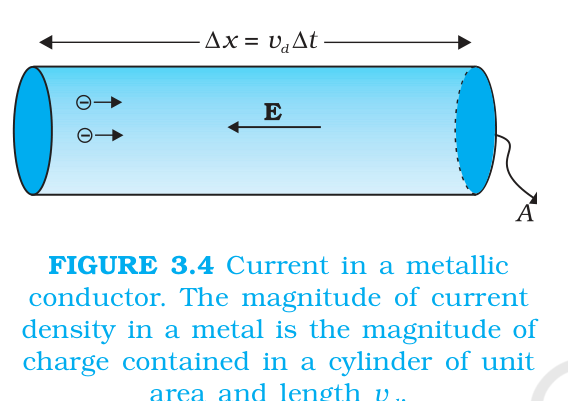
The current through a conductor depends on how many charge carriers it has, how fast they drift and how much charge each carries. For a wire of cross section A, number density n and drift speed v, the current is n e A v. That relation connects a microscopic quantity, the drift speed, to the ammeter reading.
2.2 Drift velocity and relaxation time
Apply a field to a metal and the free electrons accelerate for a short time before a collision scatters them. The average time between collisions is the relaxation time. In the steady state the electrons do not keep accelerating: the field speeds them up, collisions slow them down, and they settle into a small average drift velocity superimposed on their random thermal motion.
The drift velocity is proportional to the field and to the relaxation time, and inversely proportional to the electron mass. It is very small, of the order of a millimetre per second, but the random thermal speed is enormous by comparison, about a million metres per second at room temperature. The field is not carried by the electrons shooting quickly down the wire; it is established along the wire at close to the speed of light, and the electrons everywhere start drifting almost at once.
2.3 Ohm's law and its graph
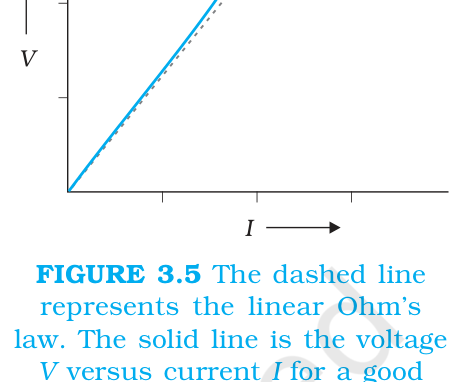
Ohm's law states that the current through a conductor is proportional to the potential difference across it when the temperature and other physical conditions stay fixed. The ratio is the resistance. A plot of current against potential difference is a straight line through the origin for an ohmic conductor, and the slope gives the conductance.
Ohm's law is not a universal law. A diode, a thermistor, a filament lamp and an electrolyte all show curved or one-sided characteristics, so the ratio of voltage to current changes with the operating point. Even a metal wire stops obeying Ohm's law when it heats up under a large current, because the temperature change alters the resistivity.
2.4 Resistance and resistivity
Resistance measures how strongly a particular conductor opposes current. It depends on the material, the length and the cross-sectional area: a longer wire has more resistance, a thicker wire has less. Resistivity is the property of the material alone, and it does not change when the dimensions change. Copper has a low resistivity and is used for wires, while nichrome, with a much higher resistivity and a weak temperature dependence, is used for heater elements.
The resistance of a wire also changes when the wire is stretched. Stretching keeps the volume constant, so if the length becomes n times longer, the area becomes n times smaller, and the resistance grows by n squared. That square law is a favourite one-mark question.
For a conductor carrying current, the field inside is uniform and equals the potential difference divided by the length. Combine that with the drift velocity relation and the current density relation, and the resistance comes out as rho l / A. This chain of reasoning is the standard derivation of the resistance formula.
Warning
Resistance and resistivity are different things. A thick short copper wire can have a small resistance even though its resistivity is a fixed material property. In answers, write resistivity as ohm metre and resistance as ohm.
2.5 A numerical on drift speed
A copper wire of length 1 m and cross section 1 mm^2 carries 2 A. If the number density is 8.5 × 10^28 m^-3, the drift speed is I / (n e A) = 2 / (8.5 × 10^28 × 1.6 × 10^-19 × 10^-6), about 1.5 × 10^-4 m s^-1. The electrons take more than an hour to travel one metre on average, yet the lamp lights instantly because the field sets every electron drifting at nearly the same moment. This contrast is worth one line in a long answer.
2.6 Common mistakes
Do not use the drift speed to find the time a lamp takes to light up. Do not forget that current density is a vector while current is a scalar. And do not write V = I R for a diode, because its characteristic is not a straight line through the origin.