

Derivations: resistivity, cells, Kirchhoff's rules and the bridge
Current Electricity24 min readLesson 3 of 6
3.1 Temperature dependence
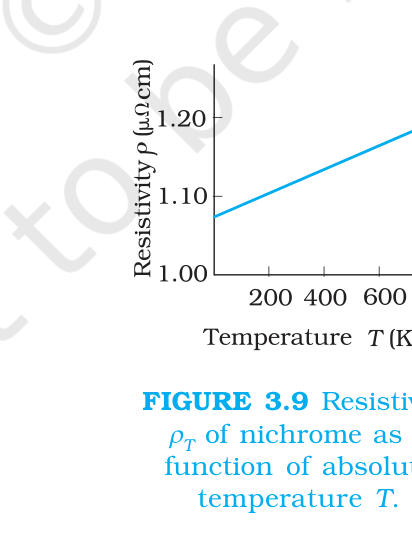
In a metal the number density of free electrons hardly changes with temperature, but the lattice vibrates more strongly and the electrons collide more often. The relaxation time falls, so resistivity rises. Over a moderate range the change is roughly linear, and the temperature coefficient of resistivity is positive.
In a semiconductor the number of charge carriers grows rapidly with temperature, and that effect dominates over the collision rate. Resistivity therefore falls as temperature rises, and the temperature coefficient is negative. An alloy such as nichrome has a high resistivity but a very small temperature coefficient, which is why alloys make good standard resistors and heater elements.
A thermistor is a semiconductor device whose resistance changes sharply with temperature, and it is used as a temperature sensor. A superconductor is the other extreme, where resistivity drops to zero below a critical temperature.
3.2 Cells and internal resistance
A cell has an emf E and an internal resistance r. When the cell is not connected, the potential difference across its terminals equals the emf. When it drives a current I through an external resistance R, the current is E / (R + r), and the terminal voltage is E - I r. The lost volt I r appears as heat inside the cell.
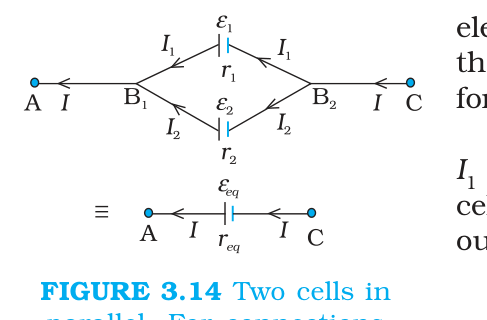
The maximum current a cell can deliver is E / r, obtained by shorting the terminals, and that is a destructive operation in practice. When two cells are joined in series, their emfs add and their internal resistances add. When they are joined in parallel, the equivalent emf and internal resistance follow the parallel formulas, and identical cells give an emf equal to one cell with the internal resistance divided by the number of cells.
3.3 Kirchhoff's rules
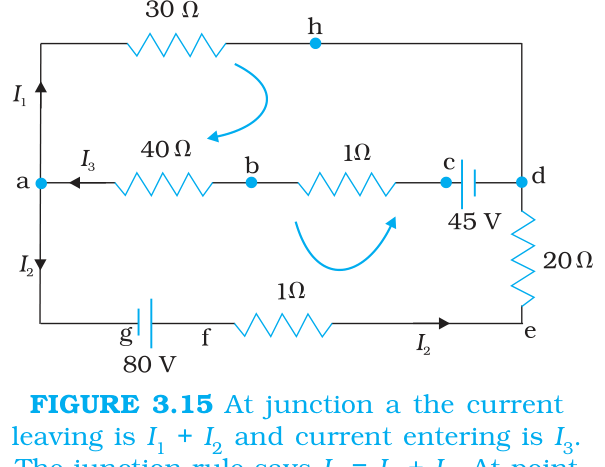
The junction rule says the current entering a junction equals the current leaving it, which is charge conservation applied to a steady state. The loop rule says the algebraic sum of the potential changes around any closed loop is zero, which is energy conservation: a charge that returns to its starting point cannot have changed its energy.
Use the rules systematically. Mark a current in each branch with an assumed direction, write a junction equation for enough junctions, then write loop equations for independent loops. A sign convention must be fixed before starting: across a resistor in the direction of current the potential falls, and across a source from negative to positive the potential rises. If a calculated current comes out negative, the real direction is opposite to the one you assumed, and that is a complete answer, not an error.
3.4 Wheatstone bridge and potentiometer
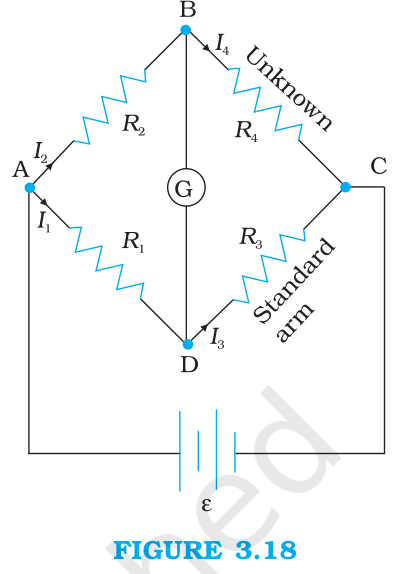
The Wheatstone bridge is four resistors in a diamond with a galvanometer across one diagonal and a cell across the other. The bridge is balanced when the galvanometer reads zero, which happens when the ratio of the two resistances in one branch equals the ratio in the other. At balance no current flows through the galvanometer, and the unknown resistance can be found from three known ones. The bridge is a null method, so its accuracy does not depend on the calibration of the galvanometer.
The metre bridge is a practical Wheatstone bridge with a uniform wire and a movable jockey. The balance point divides the wire in the same ratio as the resistances, and the unknown resistance is found from the balancing length and the known resistance.
A potentiometer compares emfs without drawing current. A uniform wire carries a steady current, so the potential drop along the wire is proportional to length. Connect a cell and adjust the jockey until the galvanometer shows no deflection; then the emf is proportional to the balancing length. Because no current is drawn from the cell at balance, the potentiometer measures the true emf rather than the terminal voltage, which is why it is preferred for accurate comparisons.
Slideshow, slide 1 of 3. Use the left and right arrow keys to change slides and the space bar to play or pause.
A junction in a circuit with currents entering and leaving, illustrating that the sum of currents entering a junction equals the sum leaving it.
Exam
For Kirchhoff problems, draw the circuit and label every current with an arrow before writing any equation. In Wheatstone and potentiometer answers, state the null condition first: the galvanometer shows no deflection, so no current flows through it.
3.5 A cell numerical
A cell of emf 1.5 V and internal resistance 0.5 ohm drives a current through a 2.5 ohm resistor. The current is 1.5 / 3 = 0.5 A, the terminal voltage is 1.5 - 0.5 × 0.5 = 1.25 V, and the power delivered to the external resistor is I^2 R = 0.625 W. The power wasted inside the cell is I^2 r = 0.125 W. When the external resistance equals the internal resistance, the external power is maximum, which is a standard result worth remembering for numericals.
3.6 Meter bridge in practice
The metre bridge works best when the balance point sits near the middle of the wire, because the fractional error in the unknown resistance is smallest there. If the balance is found near one end, the standard resistance is changed until the balance moves toward the middle. The wire is uniform and the jockey makes contact only momentarily, otherwise the current through the galvanometer branch alters the balance. These practical points appear in the assertion and reason style questions.