

Concepts: displacement current and the Maxwell correction
Electromagnetic Waves20 min readLesson 2 of 5
2.1 The problem with Ampere's law
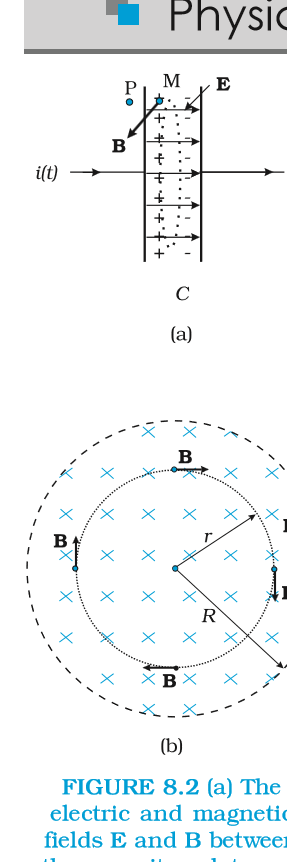
Ampere's law in its original form says that the line integral of the magnetic field around a closed loop equals mu0 times the conduction current passing through any surface bounded by the loop. The trouble appears when the loop is drawn around the wire of a charging capacitor, with one surface cutting the wire and another passing between the plates. The surface that cuts the wire encloses a current, so there is a magnetic field; the surface between the plates encloses no conduction current at all, so the same loop would give zero field. The law cannot give two answers for the same loop.
Maxwell resolved this by noticing that while the capacitor charges, the electric field between the plates is changing. The changing electric flux acts like a current and produces the same magnetic field as the current in the wire. He called it the displacement current, I_d = epsilon0 d(phi_E)/dt, and added it to the conduction current on the right hand side of Ampere's law. With this correction the loop gives the same answer whichever surface is chosen.
The name is a little misleading: there is no charge moving across the gap of the capacitor. The displacement current is a changing electric field, and it exists whenever the electric flux changes with time. In the wire, the current is carried by electrons; between the plates, the same strength of current continues as a displacement current, so the circuit behaves as if it were continuous.
2.2 The Maxwell equations in words
The four Maxwell equations are the complete description of electricity and magnetism. Gauss's law for electricity says that the electric flux through a closed surface is proportional to the charge enclosed. Gauss's law for magnetism says that the net magnetic flux through a closed surface is zero, because there are no magnetic monopoles. Faraday's law says that a changing magnetic flux produces an electric field, which is the induction law of the previous chapters. The Ampere Maxwell law says that a magnetic field is produced both by a conduction current and by a changing electric flux.
Notice the symmetry: a changing magnetic field produces an electric field, and a changing electric field produces a magnetic field. That symmetry is the seed of the electromagnetic wave. A changing electric field produces a magnetic field, that magnetic field is also changing, and its change produces an electric field further on, and so the disturbance travels through space without needing any medium. Maxwell derived the speed of this disturbance from the constants of electricity and magnetism alone, c = 1 divided by the square root of mu0 epsilon0, and found the value to match the measured speed of light. That agreement was the first indication that light itself is an electromagnetic wave.
2.3 The capacitor check
A parallel plate capacitor of very large plate area has an electric field between the plates equal to the surface charge density divided by epsilon0, so the flux is q/epsilon0. Differentiating gives d(flux)/dt equal to (1/epsilon0) dq/dt, and multiplying by epsilon0 gives the displacement current as dq/dt, exactly the charging current in the wire. So the displacement current between the plates equals the conduction current in the wire at every instant, which is the statement that the circuit is continuous.
2.4 A numerical check
A capacitor of plate area 0.001 square metre and plate separation 0.0001 m is connected to a supply whose voltage rises at 10 to the power 8 V per second. The electric field rises at (10^8)/(10^-4) = 10^12 V per metre per second. The displacement current is epsilon0 times the area times the rate of change of E, which is 8.85 x 10^-12 x 0.001 x 10^12 = 8.85 x 10^-3 A. This is the same current that flows in the connecting wires, and it is a standard textbook exercise.
Another numerical asks in which region a displacement current exists when the electric field is given in different forms. The displacement current depends on the time derivative of the field, so it is nonzero only where the field varies with time. A field of the form E0 sin (kz minus omega t) varies with time, while a constant field, a field of the form E0 sin kz or one of the form E0 cos kz is static in time and gives no displacement current.