

Nature of electromagnetic waves, energy and the spectrum with exercise practice
Electromagnetic Waves24 min readLesson 3 of 5
3.1 The properties of electromagnetic waves
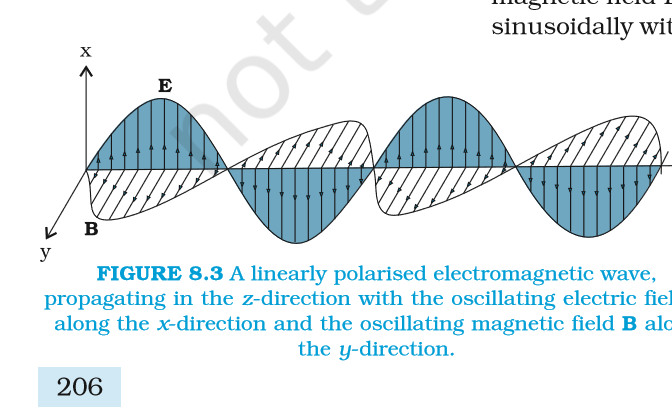
An electromagnetic wave is a travelling disturbance in which the electric field and the magnetic field oscillate in phase, perpendicular to each other and perpendicular to the direction of travel. The wave is therefore transverse, and the direction of travel is along the vector E cross B. In a plane wave the electric field is along one fixed direction and the magnetic field along another fixed perpendicular direction, so the wave can be polarised. Unlike sound, electromagnetic waves need no medium, which is why they cross the vacuum of space and why light from the Sun reaches the Earth.
The electric and magnetic fields in the wave are always in phase: they reach their maximum together and pass through zero together. Their amplitudes are related by E0/B0 = c, so a wave with a strong electric field has a correspondingly strong magnetic field, with the magnetic part weaker by the factor c. In a medium the speed is c divided by the square root of the product of the relative permeability and relative permittivity, and the ratio of the amplitudes becomes the speed in that medium.
Slideshow, slide 1 of 3. Use the left and right arrow keys to change slides and the space bar to play or pause.
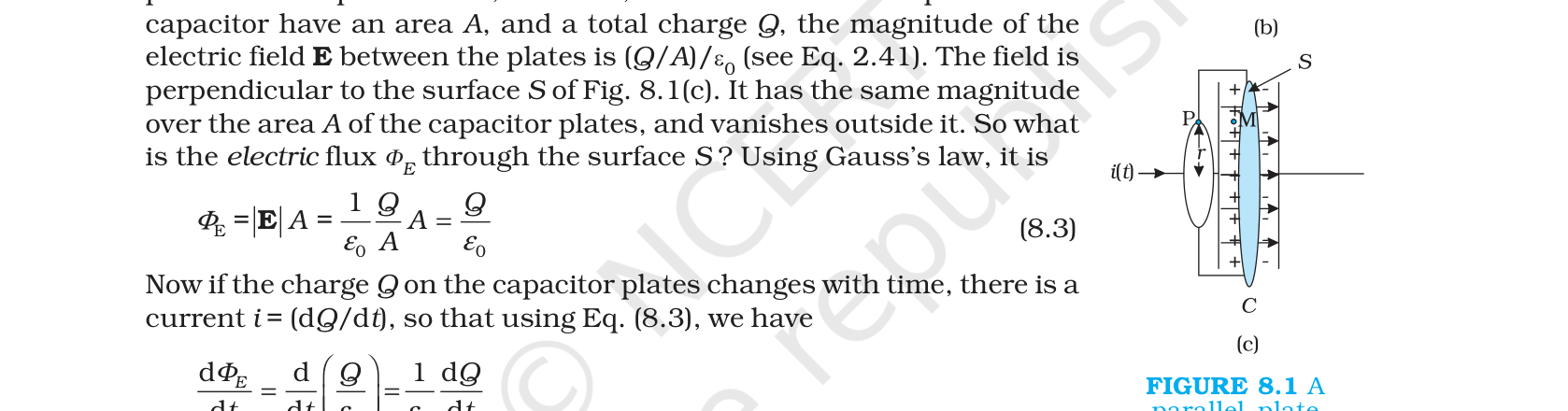
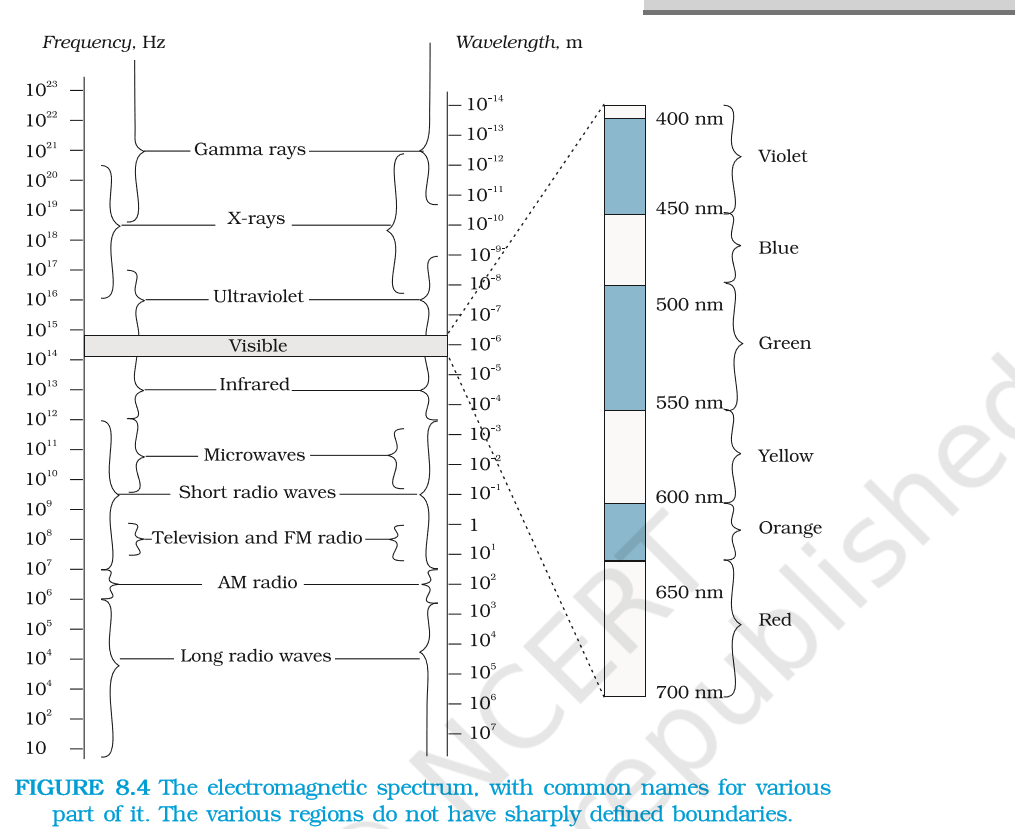

Figure 8.1 displacement current between the plates of a charging capacitor, equal to the conduction current in the wire.
3.2 Energy and momentum
The electric and magnetic fields of the wave both carry energy. The average energy density in the electric field is half epsilon0 E0 squared, and the magnetic field carries an equal average share, so the total average energy density is epsilon0 E0 squared. The intensity of the wave, which is the energy crossing unit area per unit time, is this energy density multiplied by the speed. A wave also carries momentum, equal to its energy divided by c, and when it strikes a surface it exerts a radiation pressure: the pressure is the intensity divided by c when the wave is completely absorbed and twice that when it is perfectly reflected. These numbers are small in everyday life, but they matter for a comet tail, for the solar sail and for a laser beam.
3.3 The spectrum
The electromagnetic spectrum runs from radio waves with wavelengths of kilometres down to gamma rays with wavelengths of picometres, and every band travels at c in vacuum. Radio waves are produced by accelerated charges in conducting wires and are used for communication. Microwaves are produced by klystrons and magnetrons, and they are used in radar and in microwave ovens, where they match the resonant frequency of water molecules and heat food. Infrared is produced by hot bodies and by molecular vibrations, and it is felt as heat; it is responsible for the greenhouse effect. Visible light is produced by electron transitions in atoms and spans about 400 nm to 700 nm. Ultraviolet comes from very hot bodies and special lamps, and it is absorbed by the ozone layer. X-rays come from high energy electron transitions or from electron bombardment of a metal target and are used for medical imaging and for studying crystal structures. Gamma rays come from nuclear transitions and radioactive decay and are used in cancer treatment.
3.4 Exercise practice
8.1 displacement current in a capacitor. The plate separates by 5 cm and had radius 12 cm, with a charging current of 0.15 A. The capacitance is epsilon0 A/d, the rate of change of potential is I/C, and the displacement current across the plates equals the charging current, 0.15 A. Kirchhoff's junction rule is valid at each plate once the displacement current is included: the current that flows into one plate continues between the plates as a displacement current and out of the other plate as a conduction current.
8.2 and 8.3 field amplitudes. The amplitude of the magnetic field is E0/c. For E0 = 900 V per metre, B0 = 900/(3 x 10^8) = 3 x 10^-6 T. The frequency follows from the wavelength by nu = c/lambda, so a wavelength of 300 m gives 1 MHz, and a visible wavelength of 500 nm gives 6 x 10^14 Hz.
8.4 and 8.5 spectrum questions. The band with wavelength longer than radio is not part of the standard list; the band used in radar is microwave, the band absorbed by the ozone layer is ultraviolet, the band used in crystal structure study is X-ray, and the band that causes the greenhouse effect is infrared. These are the standard identifications asked in the exercise.
- Can I explain why the displacement current is needed to make Ampere's law consistent?
- Can I state the transverse nature, the phase relation and the E0/B0 = c relation?
- Can I place a named band correctly in the spectrum with its production and one use?