Concepts: Mass defect, binding energy and nuclear force
Nuclei20 min readLesson 3 of 6
3.1 Mass is energy
Special relativity gives the relation E = m c squared. A particle with mass m has an energy m c squared even when it is at rest, and any change in energy is matched by a change in mass. Nuclear physics applies the relation most directly, because nuclear energies exceed chemical ones by about a factor of a million, and the mass differences scale the same way.
3.2 Mass defect and binding energy
The mass of a nucleus is always slightly less than the total mass of its separate protons and neutrons. The difference is the mass defect:
ΔM = [Z m p + (A - Z) m n] - M
The lost mass appears as the energy that binds the nucleons. Multiplying by c squared gives the binding energy of the nucleus:
E b = ΔM c squared
Binding energy is the energy that must be supplied to split the nucleus into its separate nucleons, and it is also the energy released when those nucleons come together. A useful comparison is to divide by the number of nucleons: E bn = E b/A, the binding energy per nucleon. The same mass difference also fixes the Q value of a nuclear reaction, since Q is the mass before minus the mass after, converted to energy. The same mass difference also gives the Q value of any nuclear reaction, since Q is just the total mass before minus the total mass after, converted to energy. This figure says how tightly bound the average nucleon is, and it makes nuclei of different sizes comparable.
3.3 The binding energy curve
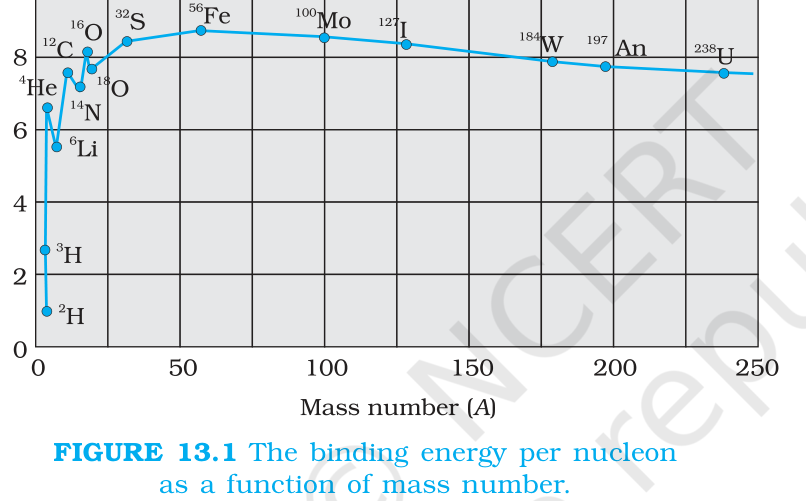
Figure 13.1 plots binding energy per nucleon against mass number for a large set of nuclei. The curve has a striking shape. It rises steeply for the lightest nuclei, levels off at about 8 MeV per nucleon through the middle range 30 < A < 170, peaks near 8.75 MeV at A = 56, and then falls slowly for heavy nuclei, reaching about 7.6 MeV at A = 238.
Two conclusions follow. First, a heavy nucleus such as A = 240 has a lower binding energy per nucleon than a medium nucleus such as A = 120. If the heavy nucleus splits into two medium nuclei, the nucleons end up more tightly bound, so energy is released; this is the basis of nuclear fission. Second, when two very light nuclei (A of about 10 or less) join to form a heavier one, the binding energy per nucleon of the product is higher, so energy is released; this is nuclear fusion and it is the source of the sun's energy.
The flat middle of the curve also needs explaining. It follows from the short range of the nuclear force. A nucleon inside a large nucleus interacts only with the nucleons close to it; more distant nucleons have no effect on it. Each nucleon can have only a limited number of neighbours within the range of the force, so its binding energy is roughly fixed, which makes the average constant. This limited-neighbour behaviour is called the saturation of the nuclear force. Nuclei near the ends of the curve are exceptions for other reasons: light nuclei are dominated by surface effects, and heavy nuclei suffer increasing Coulomb repulsion between their protons.
3.4 The nuclear force
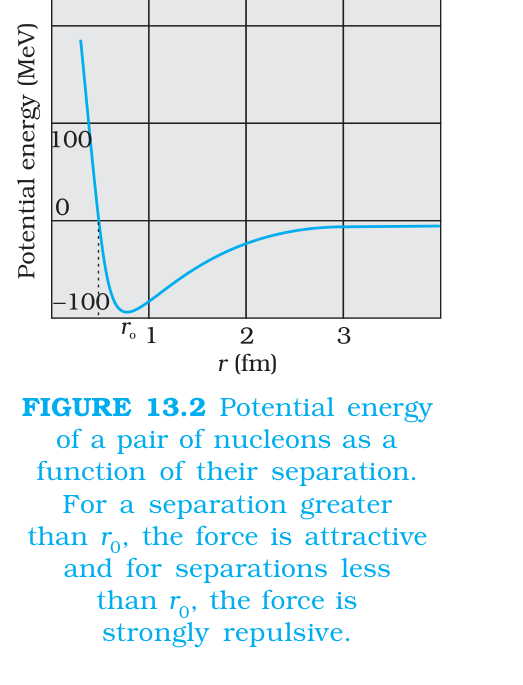
The force that holds nucleons together cannot be gravitational, since gravity is far too weak, and it cannot be electrical, since protons repel each other. It is a separate interaction, the strong nuclear force, with a set of measured properties. It is much stronger than the Coulomb force at nuclear distances. It is short-ranged, falling rapidly to zero beyond a few femtometres. It acts on protons and neutrons without distinguishing between them, which is a charge-independent force. It is attractive at nuclear separations but becomes strongly repulsive when two nucleons are pushed very close together, which is why nuclei have a definite size rather than collapsing.
In Figure 13.2 the potential energy of two nucleons is plotted against their separation. At large separations the potential is nearly zero; as the nucleons come close it dips to a minimum of about -100 MeV at a separation r0 of about 0.8 fm, which is the most stable separation. Beyond r0, the force is attractive; inside r0, the potential turns strongly positive and the force is repulsive. The minimum and the steep inner wall together explain both the binding and the finite size of nuclei.