

Concepts: the photoelectric effect: Dual Nature Of Radiation And Matter
Dual Nature of Radiation and Matter26 min readLesson 2 of 5
2.1 Early observations of the photoelectric effect
When ultraviolet light falls on a metal surface, electrons are emitted. This was first seen by Hertz and later studied carefully by Lenard, who measured how the emission depended on the light and on the metal. Three observations could not be explained by the wave picture of light. First, for a given metal there is a minimum frequency below which no electrons are emitted, no matter how intense the light. Second, the fastest electrons leave with more energy when the light is bluer, while making the beam brighter leaves their maximum energy unchanged. Third, emission begins almost instantly when light of sufficient frequency falls on the surface, even if the intensity is very low. The wave picture predicts the opposite. A weak wave would take time to supply enough energy, and a bright wave should give faster electrons. The packet picture resolves all three observations. ### The photon and the work function
Light of frequency nu is made of photons of energy h nu. To escape from the metal an electron must be given at least the minimum energy that binds it inside the metal, called the work function. A photon of energy greater than the work function gives the electron a kinetic energy equal to the excess; a photon of smaller energy cannot eject an electron at all. The threshold frequency is the frequency whose photon energy equals the work function. It depends on the metal and not on the light intensity. Metals with low work functions emit at visible frequencies, while metals with higher work functions need ultraviolet light. ### The stopping potential
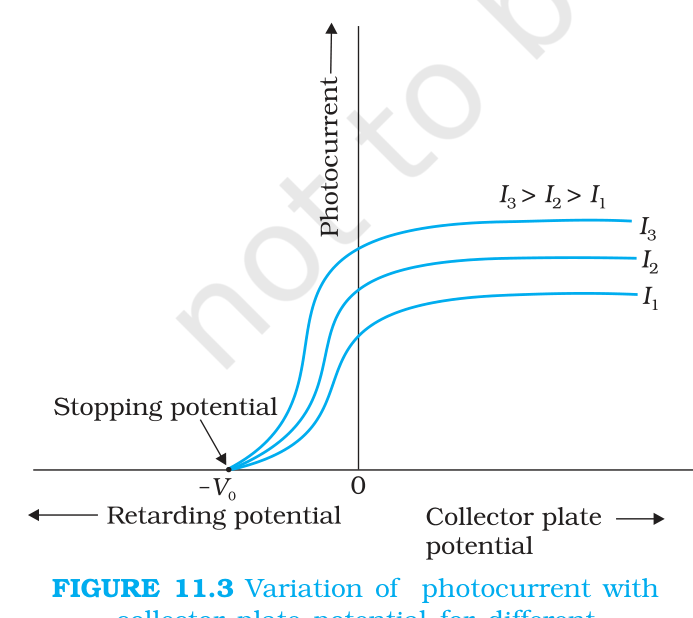
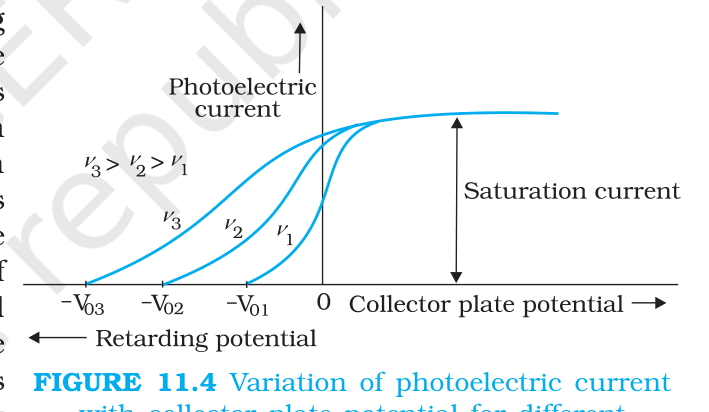
The emitted electrons have a range of kinetic energies, with the fastest electrons having the maximum kinetic energy. If a retarding potential is applied between the collector and the emitter, a small value stops the slowest electrons and a larger value stops the fastest. The potential at which the current just falls to zero is the stopping potential. The stopping potential multiplied by the electron charge gives the maximum kinetic energy. This links a measured voltage directly to the energy of the emitted electrons and makes the photoelectric equation testable. ### Graphs and the experimental laws
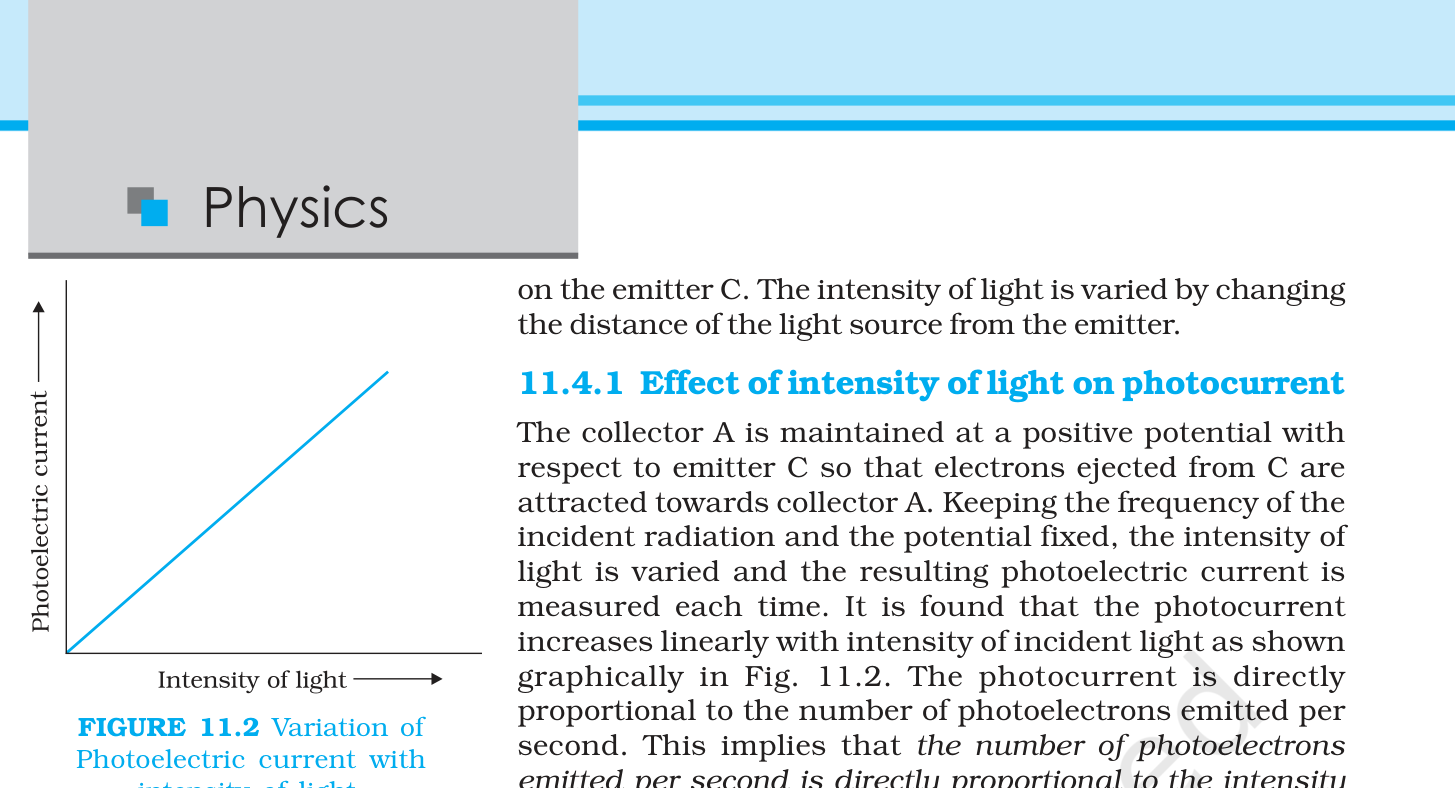
The photocurrent against voltage curves for different intensities have the same stopping potential but different saturation currents. The photocurrent against intensity curves are straight lines through the origin for light above the threshold frequency. The maximum kinetic energy against frequency graph is a straight line whose slope is Planck's constant and whose intercept on the energy axis is minus the work function. ### Exercise coverage
Exercise questions here ask for the stopping potential, the threshold wavelength, the work function from a graph, and the effect of changing the intensity or the frequency. A standard item gives the wavelength and the work function and asks for the maximum kinetic energy and the stopping potential. Convert the wavelength to photon energy in electron volts first, then subtract the work function.
Slideshow, slide 1 of 3. Use the left and right arrow keys to change slides and the space bar to play or pause.
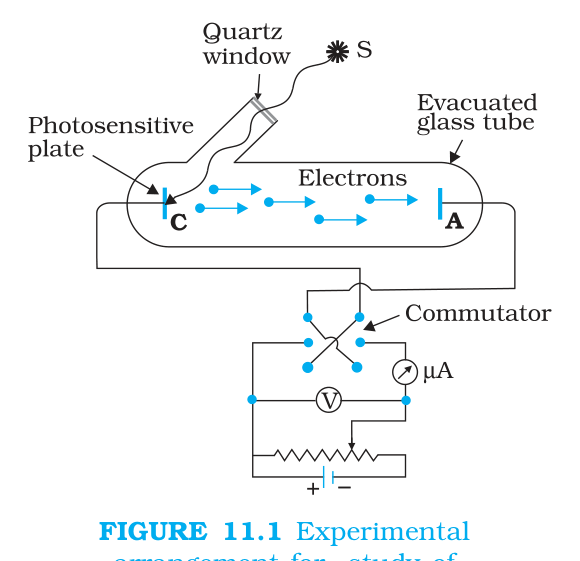
Experimental arrangement for the study of the photoelectric effect with an evacuated glass tube
Warning
Intensity changes the number of photons and so the current, while frequency changes the energy of each photon and so the stopping potential. Do not mix the two effects in a table.