

Exercise practice 2: Proportional Reasoning-1
Proportional Reasoning-126 min readLesson 4 of 5
4.1 Figure it Out: sharing and mixtures
This page answers the third Figure it Out set on page 175 and the fourth set on pages 176 and 177. Every question and sub-part is solved with steps.
4.1.1 FIO 3, Q1: divide ₹4,500 in the ratio 2 : 3
Key step: the ratio has 2 + 3 = 5 equal parts. Each part is 4,500 ÷ 5 = ₹900. The shares are 2 × 900 and 3 × 900.
Answer: ₹1,800 and ₹2,700. Check: 1,800 + 2,700 = 4,500 and 1,800 : 2,700 = 2 : 3.
4.1.2 FIO 3, Q2: acid and water in 240 mL of solution
Statement: a solution is made by mixing acid with water in the ratio 1 : 5. Find the amount of each in 240 mL of that solution.
Key step: the ratio has 6 parts. Acid is 1 part and water is 5 parts. Each part is 240 ÷ 6 = 40 mL.
Answer: 40 mL of acid and 200 mL of water. Check: 40 : 200 = 1 : 5.
4.1.3 FIO 3, Q3: blue and yellow paint
Statement: blue and yellow are mixed in the ratio 3 : 5 to make green paint. Find the amounts for 40 mL of green paint, then find the new ratio after adding 20 mL of yellow.
Key step: 40 mL is 8 parts, each part 5 mL. Blue is 3 × 5 = 15 mL and yellow is 5 × 5 = 25 mL. After adding 20 mL of yellow, yellow becomes 45 mL while blue stays 15 mL.
Answer: 15 mL blue and 25 mL yellow; the new ratio is 15 : 45 = 1 : 3.
4.1.4 FIO 3, Q4: rice and urad dal for idlis
Statement: rice and urad dal are mixed in the ratio 2 : 1. How much of each is needed for 6 cups of the mixture?
Key step: 6 cups are 3 parts of 2 cups each. Rice is 2 parts = 4 cups and urad dal is 1 part = 2 cups.
Answer: 4 cups of rice and 2 cups of urad dal.
4.1.5 FIO 3, Q5: red and yellow paint in two buckets
Statement: one bucket of orange paint mixes red and yellow in the ratio 3 : 5. Another full bucket of yellow paint is added. Find the new ratio of red to yellow.
Key step: in the first bucket, red is 3/8 of a bucket and yellow is 5/8 of a bucket. After adding one full bucket of yellow, yellow is 5/8 + 1 = 13/8 of a bucket while red stays 3/8. So red : yellow = 3/8 : 13/8 = 3 : 13.
Answer: the new ratio is 3 : 13.
4.1.6 FIO 4, Q1: orange and apple juice
Statement: 600 mL of orange juice is mixed with 900 mL of apple juice. Write the ratio in simplest form.
Key step: divide 600 and 900 by their HCF 300.
Answer: 2 : 3.
4.1.7 FIO 4, Q2: buses for the school trip
Statement: last year 3 full buses carried 162 students and teachers. This year 204 people are going. How many buses are needed, and will all be full?
Key step: capacity of one bus is 162 ÷ 3 = 54. The number of buses needed is 204 ÷ 54 = 3 remainder 42, so 4 buses are needed. Four buses hold 4 × 54 = 216 people, so 216 − 204 = 12 seats stay empty.
Answer: 4 buses, with 12 seats vacant; the buses will not all be full.
4.1.8 FIO 4, Q3: which city is more crowded?
Statement: Delhi has about 30 million people spread over 1,484 sq km; Mumbai has about 20 million people spread over 550 sq km. Which city packs more people into each square kilometre?
Key step: crowdedness means people per square kilometre. Delhi: 30,000,000 ÷ 1,484 ≈ 20,216 people per sq km. Mumbai: 20,000,000 ÷ 550 ≈ 36,364 people per sq km.
Answer: Mumbai is more crowded, because it has more people per square kilometre even though Delhi has more people in total.
4.1.9 FIO 4, Q4: the crane and the neck ratio
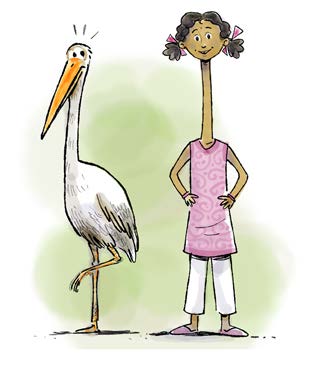
Statement: a crane stands 155 cm tall, and its long neck relates to the remainder of its body as 4 : 6. Apply that same split to your own height and work out your neck length.
Key step: the neck is 4 parts out of 4 + 6 = 10 parts, so it is 4/10 of the total height. Measure your height and multiply by 4/10. For a height of 150 cm the neck would be 60 cm, and for a height of 160 cm it would be 64 cm.
Answer: neck length = 4/10 × your height.
4.1.10 FIO 4, Q5: saffron for nine niskas
Statement: 2½ palas of saffron cost 3/7 niskas. How much saffron can be bought for 9 niskas?
Key step: set up 3/7 niskas : 5/2 palas :: 9 niskas : x. Cross multiply: x = 9 × 5/2 ÷ (3/7) = (45/2) × (7/3) = 315/6 = 52.5 palas.
Answer: 52.5 palas of saffron.
4.1.11 FIO 4, Q6: Harmain's age
Statement: Harmain is 1 year old and her brother is 5. When will the ratio of their ages be 1 : 2?
Key step: after x years their ages are 1 + x and 5 + x. We need (1 + x)/(5 + x) = 1/2. Cross multiply: 2 + 2x = 5 + x, so x = 3.
Answer: after 3 years, when Harmain is 4 and her brother is 8. Check: 4 : 8 = 1 : 2.
4.1.12 FIO 4, Q7: the mass of gold
Statement: for equal volumes, the masses of gold and water compare as 37 : 2. Given that a litre of water has a mass of 1 kg, what mass does a litre of gold have?
Key step: set 37 : 2 :: x : 1 and cross multiply. x = 37 × 1 ÷ 2 = 18.5.
Answer: 1 litre of gold has mass 18.5 kg.
4.1.13 FIO 4, Q8: cow manure for the tomato plot
Statement: farmers apply about 10 tonnes of cow manure to each acre. A tomato plot measures 200 ft by 500 ft. Using the acre conversion earlier in the chapter, find the manure needed.
Key step: the plot area is 200 × 500 = 100,000 sq ft. Set 43,560 sq ft : 10,000 kg :: 100,000 sq ft : x. Then x = 10,000 × 100,000 ÷ 43,560 ≈ 22,956.8 kg.
Answer: about 22,956.8 kg, which is about 22.96 tonnes.
4.1.14 FIO 4, Q9: filling a bucket with the same tap
Statement: a tap fills a 500 mL mug in 15 seconds. How long does it take to fill a 10-litre bucket?
Key step: 10 litres = 10,000 mL, which is 20 times 500 mL. The time is 20 × 15 = 300 seconds.
Answer: 300 seconds, which is 5 minutes.
4.1.15 FIO 4, Q10: price of a smaller plot
Statement: land sells at ₹15,00,000 for an acre. What price would a plot of 2,400 square feet fetch? Use the acre conversion from the chapter.
Key step: set 43,560 sq ft : 1,500,000 rupees :: 2,400 sq ft : x. Then x = 1,500,000 × 2,400 ÷ 43,560 ≈ 82,644.6.
Answer: about ₹82,645.
4.1.16 FIO 4, Q11: oxen and a tractor
Statement: a tractor ploughs four times as fast as a pair of oxen. The oxen take 6 hours per acre, and the field is 20 acres. Find the time with oxen and with the tractor.
Key step: oxen need 20 × 6 = 120 hours. The tractor takes one quarter of the oxen's time, so 120 ÷ 4 = 30 hours.
Answer: 120 hours with the oxen and 30 hours with the tractor.
4.1.17 FIO 4, Q12: the metals in a ₹10 coin
Statement: a cupro-nickel ₹10 coin has mass 7.74 g, with copper and nickel in the ratio 3 : 1. Copper costs ₹906 per kg and nickel ₹1,341 per kg. Find the cost of the metals in one coin.
Key step: copper is 3/4 × 7.74 = 5.805 g and nickel is 1/4 × 7.74 = 1.935 g. Cost of copper = 5.805 g × ₹906 per 1000 g = ₹5.259, about ₹5.26. Cost of nickel = 1.935 g × ₹1,341 per 1000 g = ₹2.595, about ₹2.59.
Answer: about ₹5.26 of copper and ₹2.59 of nickel, a total of about ₹7.85.