

Revision and important questions: We Distribute, Yet Things Multiply
We Distribute, Yet Things Multiply20 min readLesson 5 of 6
5.1 The identity box
Every calculation in the chapter comes from these forms. Learn them as sentences as well as symbols: the square of a sum has a plus 2ab, the square of a difference has a minus 2ab, and the difference of two squares has no middle term at all.
- Distributive property: a(b + c) = ab + ac.
- Change of factors: Identity 1, which expands two changed factors into four terms.
- Square of a sum: (a + b)² = a² + 2ab + b².
- Square of a difference: (a − b)² = a² − 2ab + b².
- Difference of two squares: (a + b)(a − b) = a² − b².
- Pattern 1: 2(a² + b²) = (a + b)² + (a − b)².
- Shortcut: a² = (a + b)(a − b) + b².
5.2 Mind the mistake, mend the mistake
Section 6.3 lists twelve simplifications. Four are correct and eight contain errors. Find the error first, then read the repair.
- −3p(−5p + 2q) is not −3p + 5p − 2q. The multiplier −3p must meet both terms: 15p² − 6pq.
- 2(x − 1) + 3(x + 4) is not 5x + 3. Distribute both brackets: 2x − 2 + 3x + 12 = 5x + 10.
- y + 2(y + 2) is not (y + 2)². The expression is y + 2y + 4 = 3y + 4; it is not a square.
- (5m + 6n)² is not 25m² + 36n². The middle term 2 × 5m × 6n = 60mn was dropped: 25m² + 60mn + 36n².
- (−q + 2)² = q² − 4q + 4 is correct, because (−q + 2) = (2 − q) and (2 − q)² = 4 − 4q + q².
- 3a(2b × 3c) is not 6ab × 9ac. The bracket is a single product 6bc, so 3a × 6bc = 18abc.
- Half of 10s minus 6, plus 3, becomes 5s minus 3 plus 3, which is 5s. This line is correct.
- 5w² + 6w is not 11w². The terms are unlike, so the expression stays 5w² + 6w.
- 2a³ + 3a³ + 6a²b + 6ab² is not 5a³ + 12a²b². Only 2a³ and 3a³ are like terms: 5a³ + 6a²b + 6ab².
- (a + 2)(b + 4) is not ab + 8. Every term of the first bracket meets every term of the second: ab + 4a + 2b + 8.
- ab² + a²b + a²b² = ab(b + a + ab) is correct.
- (x + 2)(x + 5) = x² + 7x + 10 is correct.
The four correct lines are 5, 7, 11 and 12. The rest show the same three habits: missing one product, dropping the middle term, or adding unlike terms.
5.3 Nine exam-style questions with answers
- Expand (2x + 3)(4x − 5). Answer: 8x² − 10x + 12x − 15 = 8x² + 2x − 15.
- Use Identity 1A to find 205². Answer: (200 + 5)² = 40000 + 2000 + 25 = 42025.
- Simplify (x + 3)² − (x − 3)². Answer: (x² + 6x + 9) − (x² − 6x + 9) = 12x.
- Evaluate 53 × 47 without long multiplication. Answer: (50 + 3)(50 − 3) = 2500 − 9 = 2491.
- Find (a + 2)(a² − 2a + 4). Answer: a³ − 2a² + 4a + 2a² − 4a + 8 = a³ + 8.
- A pattern has k² + 2k circles in Step k. How many circles are in Step 15? Answer: 225 + 30 = 255.
- A tile pattern has (n + 2)² − n² tiles in Step n. Simplify the expression and find Step 10. Answer: (n + 2)² − n² = 4n + 4, so Step 10 has 44 tiles.
- A square of side (m + n) has four rectangles of area mn removed from it. Show that the remaining area is (n − m)². Answer: (m + n)² − 4mn = m² + 2mn + n² − 4mn = m² − 2mn + n² = (n − m)².
- Extend the power-difference pattern from FIO 1, Q5 to the fifth power. Answer: multiply the two brackets term by term; the five positive terms cancel against the five negative terms, leaving a⁵ − b⁵.
5.4 Common mistakes and exam strategy
- Dropping the middle term in a square of a sum or difference.
- Forgetting to distribute a minus sign or a negative multiplier over every term.
- Adding unlike terms such as 5w² and 6w.
- Writing (a + b)² = a² + b², which fails as soon as a and b are both non-zero.
- Forgetting that (a + b)(a − b) has no middle term.
For an expansion question, write the identity, substitute the terms, then simplify and collect. For a numeric question, choose the identity that makes a round number appear. For a pattern question, find the count for the first three steps, guess a formula, then check it on the fourth.
5.5 Try this: Coin Conjoin
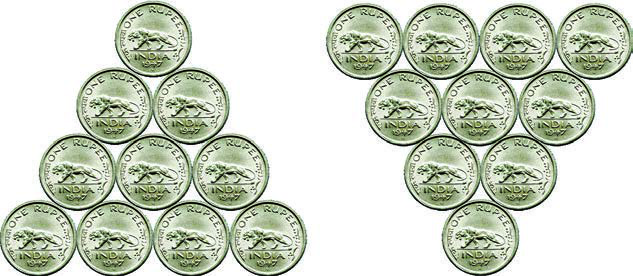
The chapter's try-this puzzle arranges 10 coins in a triangle and asks how many single-coin moves turn the triangle upside down. The answer is 3 moves, which the figure below shows: the three corner coins of the original triangle are moved to the opposite corners.
5.6 Check before you move on
A finished simplification deserves one minute of checking. Substitute a small number for the letter and compare the original expression with your answer. For example, (x + 3)² - (x - 3)² should equal 12x; at x = 2 the original is 25 - 1 = 24 and 12x is also 24. Also check the size of a numeric answer: 205² should be a little above 40000, and 42025 is plausible, while a result near 4000 would signal a lost zero. These two habits, substitution and magnitude, catch many errors before an exam script is handed in.