Exercise practice 2: Algebra Play
Algebra Play26 min readLesson 4 of 6
4.1 Figure it Out: divisibility and puzzles
4.1.1 FIO 3, Q1: the quotient in the reversal trick
Statement: in the trick that reverses a two-digit number and divides the difference by 9, what is the quotient and how does it relate to the number?
Key step: difference = 9(b − a), so the quotient is b − a, the difference between the two digits.
Answer: the quotient equals the difference between the digits (larger minus smaller). For 74 and 47 the quotient is 3, which is 7 − 4.
4.1.2 FIO 3, Q2: reversing and adding
Statement: instead of subtracting, add a two-digit number and its reversal. What happens?
Key step: (10a + b) + (10b + a) = 11(a + b), always a multiple of 11. The examples 31 + 13 = 44, 28 + 82 = 110 and 12 + 21 = 33 are all multiples of 11.
Answer: the sum is always divisible by 11, and the quotient is a + b, the sum of the digits.
4.1.3 FIO 3, Q3: adding the cyclic versions of a three-digit number
Statement: take a three-digit number abc, form bca and cab by cycling the digits, and add all three. Prove the sum is divisible by 37 and check divisibility by 3.
Key step: abc + bca + cab = 111(a + b + c) = 3 × 37 × (a + b + c). The factor 37 makes the sum divisible by 37, and the factor 3 makes it divisible by 3.
Answer: the sum is always divisible by 37 and by 3, whatever the digits.
4.1.4 FIO 3, Q4: repeating the digits of a three-digit number
Statement: form abcabc, divide by 7, then by 11, then by 13. What is the result and why?
Key step: abcabc = 1001 × abc, and 1001 = 7 × 11 × 13. Dividing by the three factors therefore removes 1001 and leaves abc.
Answer: the result is the original three-digit number abc.
4.1.5 FIO 3, Q5: the three magical shrines
Statement: a traveller has some flowers. Each of three magical ponds doubles the flowers he carries, and after each dip he places an equal number of flowers at that shrine. At the end nothing is left. Find a possible starting number and the number placed at each shrine.
Key step: let each shrine receive f flowers. Before the third dip he had f/2 flowers; before the second dip, (f + f/2)/2 = 3f/4; before the first dip, (f + 3f/4)/2 = 7f/8. Choose f = 8 to keep everything whole: 7 flowers to start.
Check: 7 doubles to 14, place 8 and keep 6; 6 doubles to 12, place 8 and keep 4; 4 doubles to 8 and all 8 go to the third shrine.
Answer: with the smallest whole numbers, he starts with 7 flowers and places 8 at each shrine. Any multiple (7k flowers and 8k per shrine) also works.
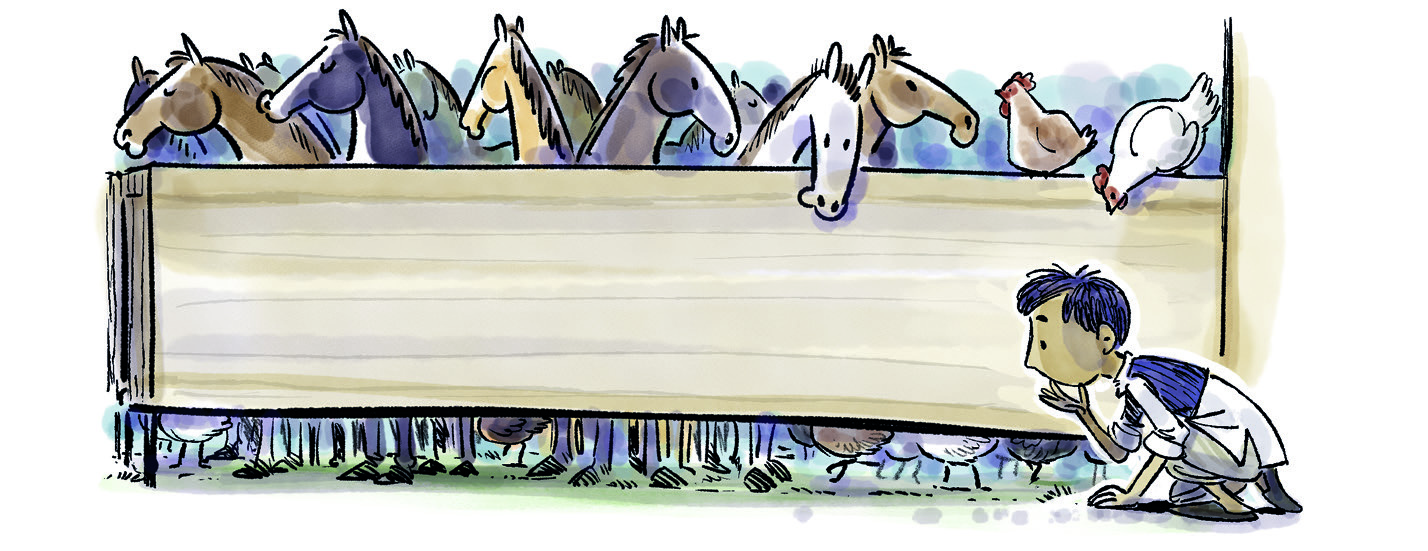
4.1.6 FIO 3, Q6: horses and hens
Statement: a farm has 55 heads and 150 legs. How many horses and how many hens?
Key step: let horses be h and hens be n. Then h + n = 55 and 4h + 2n = 150. Divide the second equation by 2: 2h + n = 75. Subtract the first equation: h = 20, so n = 35.
Answer: 20 horses and 35 hens. Check: 20 × 4 + 35 × 2 = 80 + 70 = 150.
4.1.7 FIO 3, Q7: mother and daughter
Statement: a mother is 5 times her daughter's age. In 6 years she will be 3 times her daughter's age. Find the daughter's age.
Key step: let the daughter be d and the mother be 5d. In 6 years: 5d + 6 = 3(d + 6). So 5d + 6 = 3d + 18, 2d = 12 and d = 6.
Answer: the daughter is 6 and the mother is 30. Check: in 6 years they are 12 and 36, and 36 = 3 × 12.
4.1.8 FIO 3, Q8: Gauri's and Naina's cows
Statement: Naina has twice as many cows as Gauri. If Naina gives Gauri three cows, they have equal numbers. How many does each have?
Key step: let Gauri have g and Naina 2g. After the transfer, 2g − 3 = g + 3, so g = 6 and 2g = 12.
Answer: Gauri has 6 cows and Naina has 12.
4.1.9 FIO 3, Q9: the dosa cart
Statement: rent is ₹5,000 per day and each dosa costs ₹10 to make. (i) Find the selling price for 100 dosas to earn ₹2,000. (ii) If the price is ₹50, how many dosas are needed for ₹2,000 profit?
Key step: (i) total cost = 5,000 + 100 × 10 = ₹6,000, and profit ₹2,000 means revenue ₹8,000, so price = 8,000 ÷ 100 = ₹80. (ii) With price ₹50, profit = 50n − (5,000 + 10n) = 40n − 5,000. Set 40n − 5,000 = 2,000, so 40n = 7,000 and n = 175.
Answer: ₹80 per dosa, and 175 dosas at ₹50.
4.1.10 FIO 3, Q10: the fraction pattern
Statement: work out the first three terms of the chapter's fraction pattern. The first term is one third, the second has 1 + 3 on top and 5 + 7 below, and the third has 1 + 3 + 5 over 7 + 9 + 11. Explain why every term is the same.
Key step: the numerator of the kth term is the sum of the first k odd numbers, which is k². The denominator is the sum of the next k odd numbers, which is 3k².
- k = 1: 1/3.
- k = 2: 4/12 = 1/3.
- k = 3: 9/27 = 1/3.
Answer: every term equals 1/3, because the numerator is k² and the denominator is 3k².
4.1.11 FIO 3, Q11: Karim and the genie
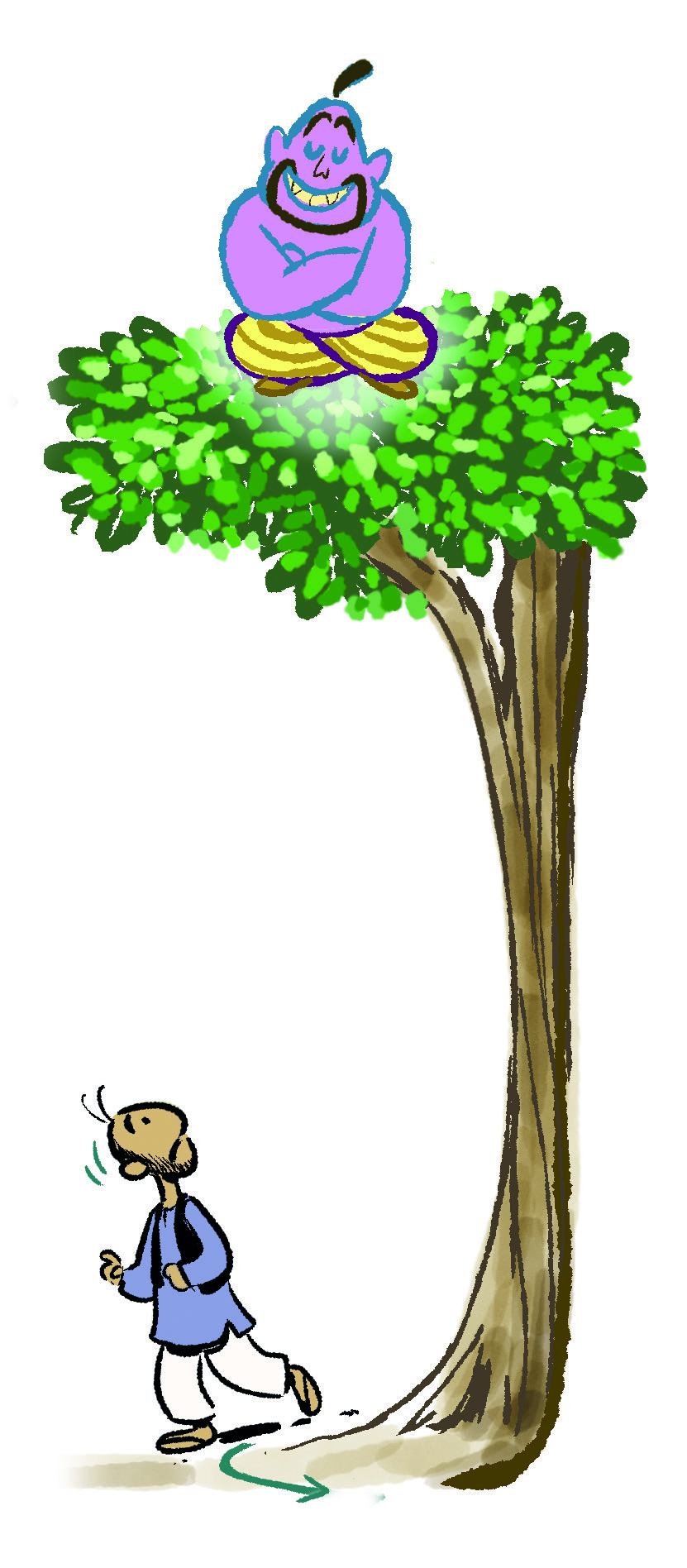
Statement: Karim's coins double each time he circles the tree, and he pays 8 coins to the genie after each round. After the third doubling he has exactly 8 coins. (i) How many did he start with? (ii) When should he accept the deal? (iii) How can the genie set the cost to take everything?
Key step: work backwards. Before the third doubling he had 4; before the third payment he had 4 + 8 = 12; before the second doubling 6; before the second payment 14; before the first doubling 7.
For a general starting number N with cost c per round, after r rounds the coins are 2ʳ N − c(2ʳ − 1). Karim gains when this is more than N, which simplifies to c < N. The genie takes everything when the expression becomes 0, that is c = 2ʳ N/(2ʳ − 1) for some whole number r.
Answer: (i) 7 coins; (ii) accept only if the cost per round is less than the coins he starts with; (iii) the genie sets the cost to 2ʳ N/(2ʳ − 1), which for N = 7 and r = 3 gives 8 coins per round and leaves Karim with nothing.