

Concepts: Aerobic respiration and the citric acid cycle
Respiration in Plants22 min readLesson 2 of 6
2.1 The link between glycolysis and the cycle
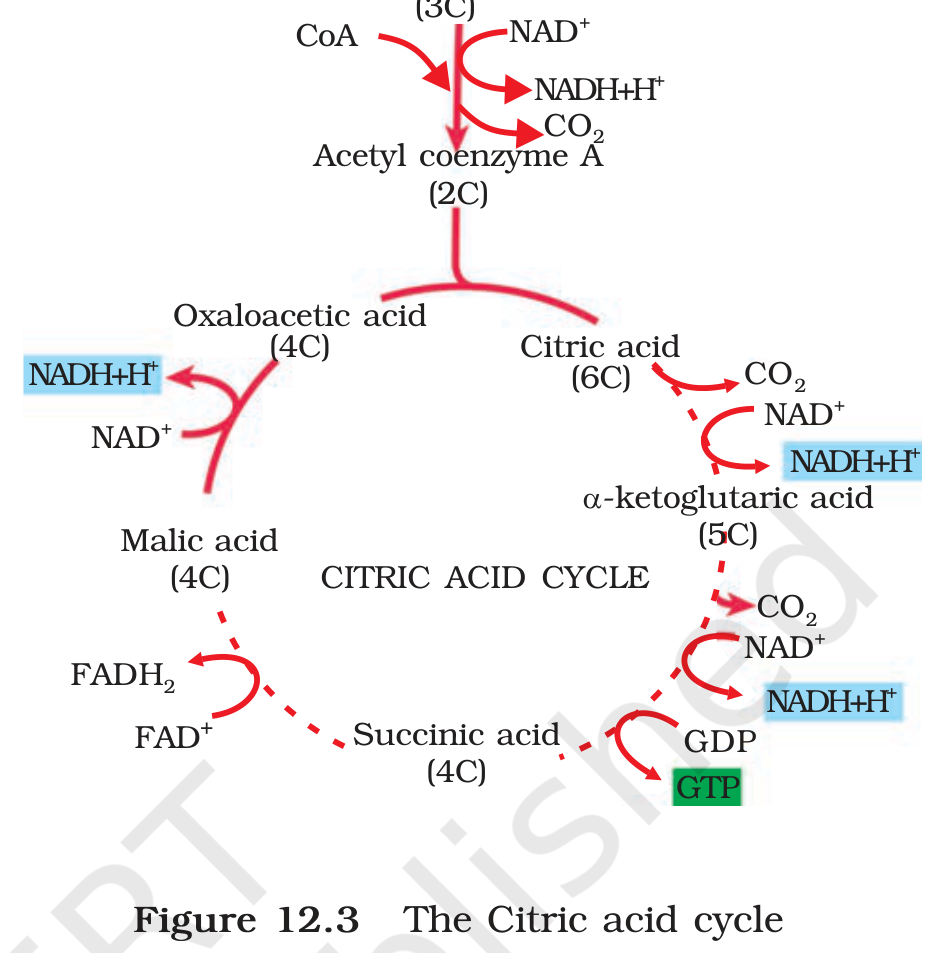
In aerobic respiration the pyruvate made in the cytoplasm enters the mitochondrion. There it is decarboxylated and dehydrogenated by the pyruvate dehydrogenase complex. One carbon leaves as CO2, the remaining two-carbon acetyl group is attached to coenzyme A to form acetyl CoA, and one NADH is produced. This step is called the link reaction because it joins glycolysis to the citric acid cycle, and it happens in the mitochondrial matrix. Coenzyme A is a carrier of the acetyl group, while NAD and magnesium ions are needed by the enzyme complex.
2.1.1 The citric acid cycle
The citric acid cycle is also called the Krebs cycle after Hans Krebs, and the tricarboxylic acid cycle after its three-carboxyl acid intermediates. It runs in the mitochondrial matrix. The cycle begins when the two-carbon acetyl group of acetyl CoA is joined to the four-carbon oxaloacetic acid, giving the six-carbon citric acid. Citric acid is then rearranged to isocitric acid, which loses CO2 and hydrogen to become alpha ketoglutaric acid, which loses another CO2 and hydrogen to become succinyl CoA. Succinyl CoA gives its coenzyme A back and becomes succinic acid, and here one ATP is made by substrate level phosphorylation. Succinic acid is then oxidised through fumaric acid and malic acid back to oxaloacetic acid, so the starting compound is regenerated and the cycle can repeat.
For each turn of the cycle, one acetyl group is completely oxidised. The products are two CO2, three NADH, one FADH2 and one ATP, and these numbers are worth memorising because most questions on the cycle reduce to them. The NADH and FADH2 carry their electrons to the electron transport system of the inner mitochondrial membrane, and the CO2 leaves the mitochondrion and then the plant.
A single turn uses one acetyl group, so two turns are needed for one glucose, because glycolysis produced two pyruvate and each pyruvate gives one acetyl CoA. The cycle is also the point where many other fuels enter. Fatty acids are broken down to acetyl CoA, and amino acids can enter as pyruvate or as cycle intermediates after deamination, which is why the cycle is central to the metabolism of all the major fuel groups.
2.1.2 Why the cycle matters
The citric acid cycle collects hydrogen from the fuel and hands it to the carriers. Almost all the energy of glucose that has not been captured in glycolysis and the link reaction is now in NADH and FADH2, and the rest is still in the reduced intermediates. The cycle itself makes very little ATP directly. If the electron transport chain stops, the carriers stay reduced and the cycle stops too, because there is no NAD+ or FAD to accept hydrogen. This coupling explains why a plant without oxygen cannot keep the cycle running for long. The cycle is regulated by its own products too: a high NADH to NAD+ ratio slows the dehydrogenases because they need NAD+, and when the chain reoxidises NADH the cycle speeds up again. The GTP made in one turn is readily converted to ATP, so the direct ATP gain of the cycle is counted as one per turn. Fats are first broken down into glycerol and fatty acids, and then fatty acids are degraded to acetyl CoA while glycerol enters as PGAL. Proteins are broken into amino acids that enter the cycle at several points after deamination. Carbohydrate, fat and protein therefore all meet at the cycle, and the same set of intermediates also supplies the cell with carbon skeletons for synthesis, which is the reason the pathway is called amphibolic. Because oxaloacetic acid is regenerated, a small amount of starting material can keep oxidising a large amount of acetyl CoA, and the cycle can turn many times without any net loss of its own intermediates.
2.1.3 Practice from the NCERT exercises, questions 4, 5 and 7(b)
Exercise 4. The main steps in aerobic respiration are glycolysis in the cytoplasm, the link reaction and the citric acid cycle in the mitochondrial matrix, and the electron transport system on the inner mitochondrial membrane. It takes place in the cytoplasm and the mitochondrion together.
Exercise 5. The schematic of the cycle should begin with acetyl CoA plus oxaloacetic acid, show citric acid, isocitric acid, alpha ketoglutaric acid, succinyl CoA, succinic acid, fumaric acid and malic acid, and mark the CO2, NADH, FADH2 and ATP released at their steps.
Exercise 7(b). Glycolysis is the first stage and ends at pyruvate with a net gain of two ATP, while fermentation follows glycolysis in the absence of oxygen and uses the pyruvate to regenerate NAD+ at the cost of the hydrogen carried by NADH. Fermentation produces no extra ATP.
Exam
A citric acid cycle answer that lists the intermediates in order and marks the two decarboxylations, the three NADH, the one FADH2 and the one ATP will carry the marks. If the question asks where the cycle happens, write mitochondrial matrix. If it asks for the products per glucose rather than per turn, remember that two pyruvate give two turns and therefore twice the products.
Common mistake
Do not say that the citric acid cycle needs oxygen directly. It does not use oxygen in its reactions, but it stops in the absence of oxygen because the electron transport chain cannot regenerate NAD+ and FAD. Do not place the cycle on the inner membrane; the enzymes are in the matrix. Do not claim that all the ATP of aerobic respiration is made here, because most ATP comes later from the carriers.