

Concepts: The electron transport system and oxidative phosphorylation
Respiration in Plants24 min readLesson 3 of 6
3.1 Passing electrons down the chain
The electron transport system sits on the inner mitochondrial membrane. It is a series of protein complexes and mobile carriers that pass electrons from NADH and FADH2 to oxygen. NADH gives its electrons to complex I, while FADH2 gives them to complex II. The electrons then move through ubiquinone, complex III, cytochrome c and complex IV. Oxygen is the final electron acceptor of this chain: at complex IV, cytochrome oxidase passes the electrons to oxygen, and each oxygen atom with two protons forms one water molecule.
As electrons travel down the chain, their energy is used to pump protons from the mitochondrial matrix into the intermembrane space. This creates a proton gradient, with more protons outside than inside. The gradient is the same kind of store of energy that the chloroplast builds across the thylakoid membrane, and the logic of chemiosmosis carries over from photosynthesis.
3.1.1 ATP synthase and oxidative phosphorylation
Complex V is the ATP synthase of the mitochondrion. It has two parts. The F1 headpiece is the knob that sticks out into the matrix; it is a peripheral protein complex and it carries the catalytic site where ADP and inorganic phosphate are joined. F0 sits inside the membrane and gives protons a passage back into the matrix. As protons flow through F0 down the gradient, the enzyme changes shape and the F1 head makes ATP. Because the energy for this phosphorylation comes from oxidation reactions of the electron transport chain, the whole process is called oxidative phosphorylation.
3.1.2 Counting the ATP
With the standard textbook assumptions, each NADH is taken to yield three ATP and each FADH2 two ATP. One glucose gives ten NADH, two FADH2 and four ATP directly, so the theoretical net gain works out to 38 ATP per glucose. The number is a balance sheet figure, not a measurement: the actual yield in a living cell is lower because some energy is spent in preparing the intermediates and the conversion is never perfectly efficient. The assumptions behind the figure are listed on the next page.
3.1.3 What stops the chain
If oxygen is absent, complex IV cannot pass on its electrons, the carriers stay reduced, the proton gradient cannot be maintained and the ATP synthase stops. This is why the whole chain is described as oxygen dependent even though oxygen itself appears only at the very end. The cycle and the chain are coupled through the NAD+/NADH and FAD/FADH2 pools, and neither can run alone for long. The gradient is a rechargeable store rather than a one-time charge, because every turn of the chain adds to it and every ATP made draws it down.\n\n### The gradient in numbers
Electron transport leaves the intermembrane space richer in protons than the matrix, and this electrochemical proton gradient is the energy store for ATP synthesis. The ATP synthase uses the F0 channel, which opens through the inner membrane from the intermembrane space to the matrix, and the passage of four protons through F0 is coupled to the production of one ATP at the F1 catalytic site. ATP synthase therefore converts the gradient into chemical energy, and the process is called oxidative phosphorylation because the energy comes from the oxidation of the carriers.
The chain itself is arranged in complexes. NADH is oxidised by NADH dehydrogenase, complex I, and its electrons pass to ubiquinone inside the inner membrane. Complex II takes electrons from succinate as the citric acid cycle oxidises it. The reduced ubiquinone passes those electrons on to cytochrome c through the cytochrome bc1 complex, complex III, and the small mobile cytochrome c then carries them to complex IV. Complex IV is the cytochrome c oxidase complex, which contains cytochromes a and a3 along with two copper centres, and it is here that oxygen accepts the electrons. With the standard assumption, the oxidation of one NADH yields three ATP and one FADH2 yields two ATP.
3.1.4 Practice from the NCERT exercises, questions 6, 11 and 1(b)
Exercise 6. The electron transport system is a set of protein complexes and carriers on the inner mitochondrial membrane. NADH and FADH2 hand over electrons, oxygen accepts them at the end, and the energy of the transfer pumps protons to build a gradient that drives ATP synthase. F1 and F0 are the two parts of this synthase.
Exercise 11. Oxidative phosphorylation is the formation of ATP from ADP and inorganic phosphate using the energy released when electrons pass through the electron transport chain, with the proton gradient as the intermediate store of that energy.
Exercise 1(b). Glycolysis is the cytoplasmic breakdown of glucose to pyruvate with a net gain of two ATP and two NADH, while the citric acid cycle is the mitochondrial cycle that oxidises acetyl CoA completely to CO2 and yields three NADH, one FADH2 and one ATP per turn.
Slideshow, slide 1 of 3. Use the left and right arrow keys to change slides and the space bar to play or pause.
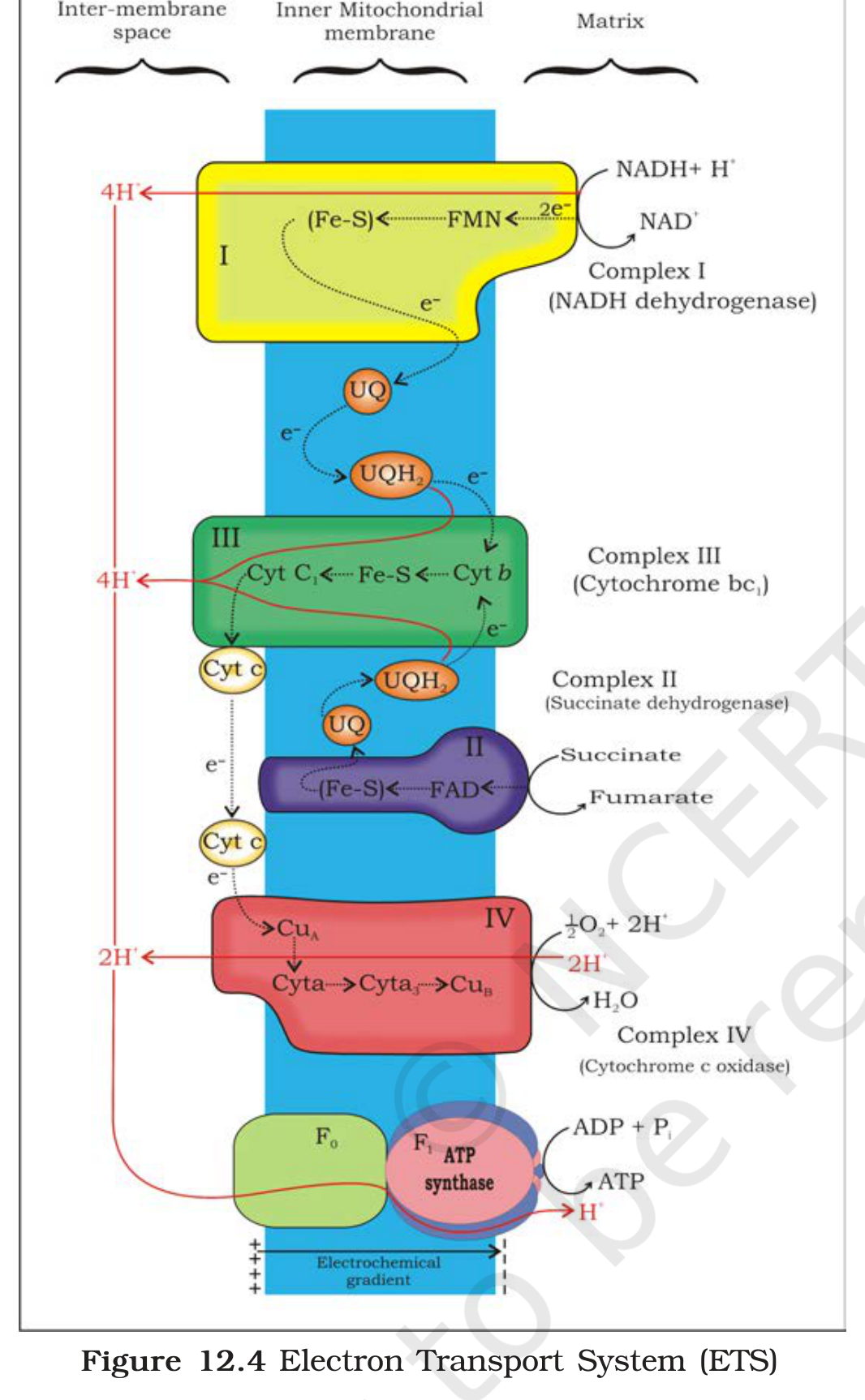
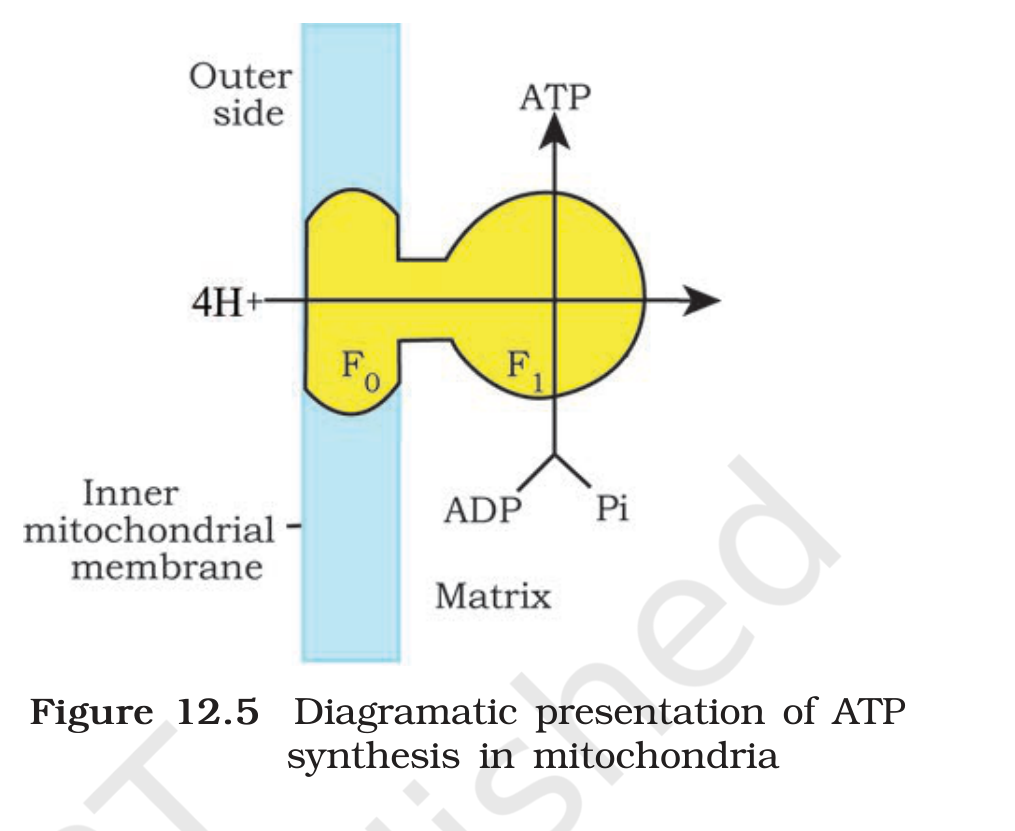
Figure 12.4: electron transport system on the inner mitochondrial membrane with complexes I to V, NADH, FADH2 and oxygen as the final acceptor
Exam
For an oxidative phosphorylation answer, name the location, the two electron donors, oxygen as the final acceptor, the proton pumping to the intermembrane space, the two parts of ATP synthase and the meaning of the word oxidative. The examiner also expects the ATP arithmetic per glucose and the statement that 38 is a theoretical balance sheet value.
Common mistake
Do not write that oxygen is used at the start of the chain. It accepts electrons only at complex IV, but without it the whole chain jams. Do not place the electron transport system in the matrix or the outer membrane, since it sits on the inner membrane. Do not say that F1 is the proton channel; F1 carries the catalytic site and F0 forms the channel. And do not present the 38 ATP figure as an exact measured yield.