

Concepts: Respiration, glycolysis and fermentation
Respiration in Plants24 min readLesson 1 of 6
1.1 What respiration is
Respiration is the enzymatically controlled, step-wise oxidation of food materials inside a living cell, with the captured energy stored in ATP. The overall equation for aerobic respiration of glucose is C6H12O6 + 6O2 gives 6CO2 + 6H2O + energy. The energy does not appear as heat or light only, because a large part of it is trapped in the phosphate bonds of ATP and used later by the cell.
Respiration is not the same as burning. Combustion is a single, uncontrolled release of energy at high temperature, and almost all the energy escapes as heat and light. Respiration happens at body temperature, is controlled by enzymes, and releases the energy of glucose in a series of small steps so that the cell can capture a useful share of it. This step-wise release is also what makes the process safe for the cell: a sudden release of the same energy would damage the cell.
1.1.1 Respiratory substrates
The substance oxidised during respiration is called the respiratory substrate. Carbohydrate, usually glucose, is the most common substrate. Proteins, fats and even organic acids can also be used as respiratory substrates in some plants and under certain conditions, but carbohydrate remains the favoured fuel because it is the first choice of most cells.
1.1.2 Glycolysis
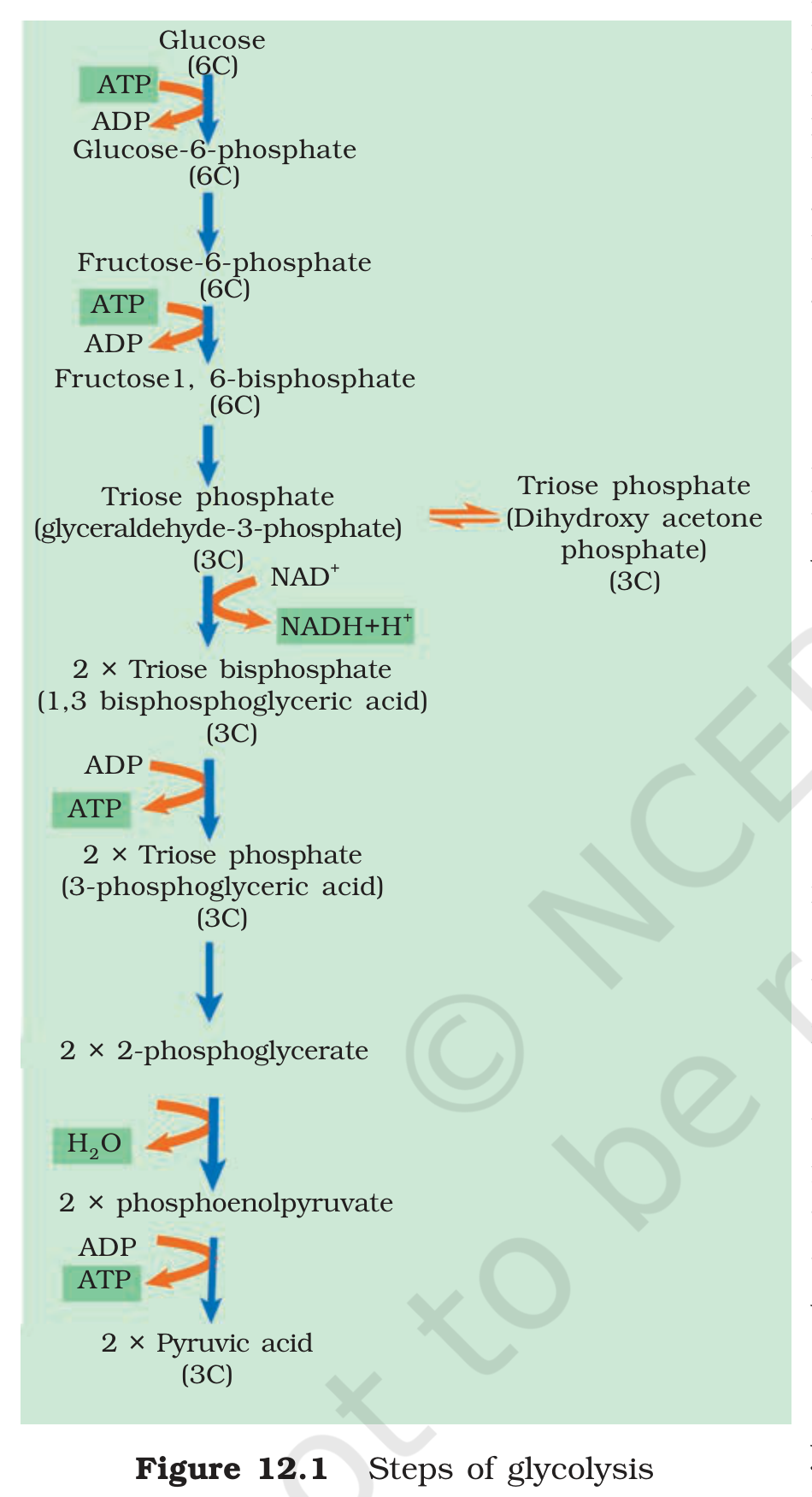
Glycolysis is the first stage of respiration and happens in the cytoplasm. The name means sugar splitting, and that is what happens: a six-carbon glucose molecule is broken into two three-carbon pyruvate molecules. The pathway runs in ten enzyme-catalysed steps and does not need oxygen. It begins with phosphorylation of glucose by hexokinase, which costs ATP, then goes through isomerisation and a second phosphorylation by phosphofructokinase. The six-carbon sugar phosphate is split into two triose phosphates, which are oxidised and rearranged to pyruvate while four ATP molecules are produced.
Two ATP are used and four ATP are gained, so the net gain from glycolysis is two ATP. Two molecules of NADH are also formed when the triose phosphate is oxidised. The ATP made here is formed by substrate level phosphorylation, which means the phosphate is transferred directly from a substrate molecule to ADP without the help of an electron transport chain. The figure of the glycolysis pathway shows the ATP and NADH entries and the names of the intermediate compounds.
1.1.3 Fermentation
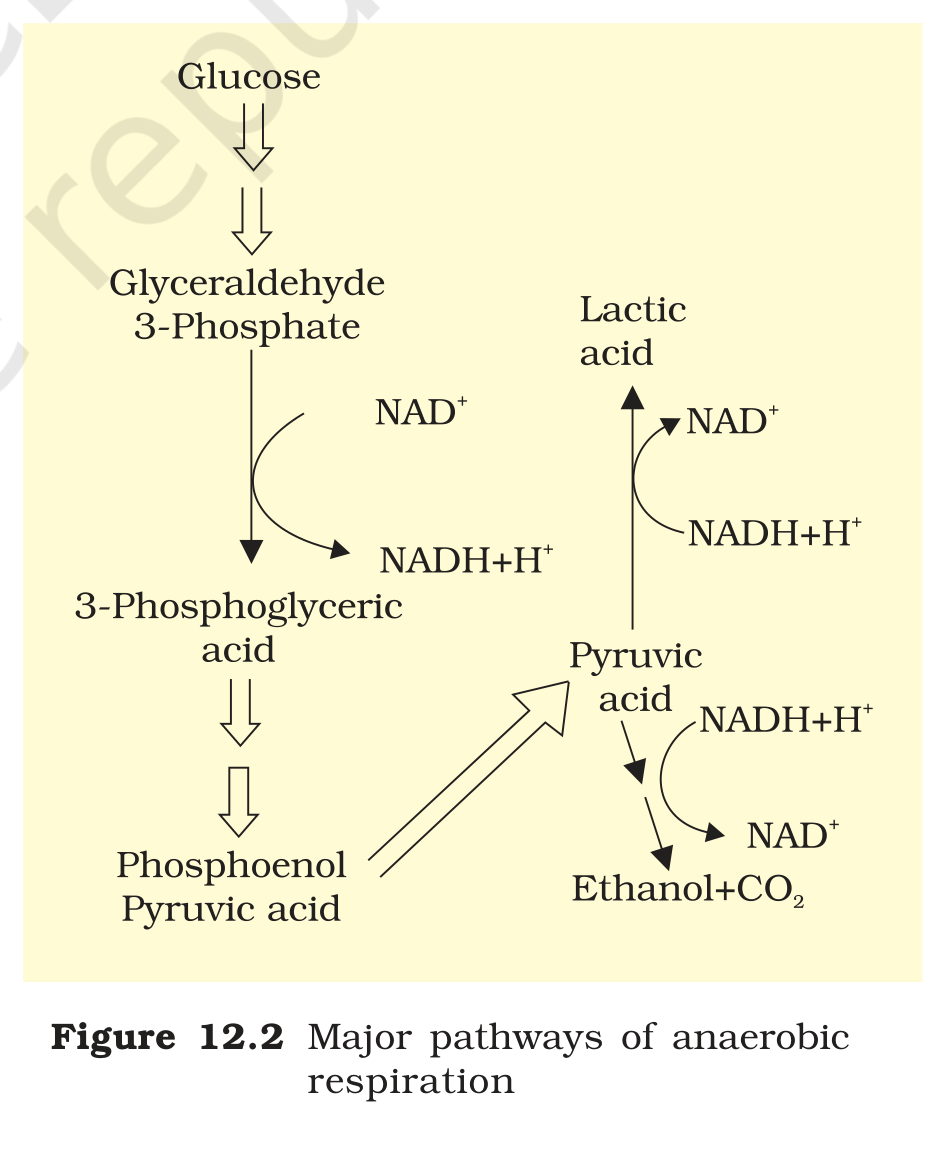
When oxygen is not available, pyruvate cannot enter the citric acid cycle. It is instead reduced in a process called fermentation, and the NADH made in glycolysis is used up in the same step so that NAD+ returns to the cytoplasm and glycolysis can continue. In yeast, pyruvate is decarboxylated to acetaldehyde and ethanol, and this is alcoholic fermentation, the route used in baking and brewing. In a working muscle the same pyruvate is converted to lactic acid instead, with lactate dehydrogenase doing the reduction, and the route is called lactic acid fermentation.
The net yield of fermentation is only two ATP per glucose, because the NADH formed in glycolysis is spent on reducing pyruvate back and does not reach the electron transport chain. The energy left in ethanol or lactic acid is therefore still locked in those molecules. Fungi and some bacteria use fermentation in the absence of oxygen, and it also occurs in plant cells under waterlogging. The ten steps of glycolysis can be grouped into three phases: an investment phase that uses two ATP, a cleavage phase that produces two three-carbon molecules, and a payoff phase that yields four ATP and two NADH. Glycolysis also needs a steady supply of NAD+ in the cytoplasm, and the NAD+ pool is small, so it has to be regenerated continuously. Under aerobic conditions the pyruvate enters the mitochondrion and the NADH is reoxidised to NAD+, so the carriers keep working. Under anaerobic conditions the same NADH is used up in reducing pyruvate. That single fork decides whether the glucose yields two ATP or the much larger aerobic return.
1.1.4 Practice from the NCERT exercises, questions 1(a), 1(c), 3 and 7(c)
Exercise 1(a). Respiration is a controlled, enzyme-catalysed, step-wise process at living temperature that stores energy in ATP, while combustion is a rapid, uncontrolled chemical change at high temperature that releases energy as heat and light.
Exercise 1(c). Aerobic respiration needs oxygen, breaks glucose completely to CO2 and water and yields far more ATP, while fermentation works without oxygen, stops at ethanol or lactic acid and yields only two ATP per glucose.
Exercise 3. The schematic of glycolysis must show glucose, fructose bisphosphate, the split into two triose phosphate molecules, the two pyruvate products, and the ATP and NADH entries at the correct steps.
Exercise 7(c). Glycolysis is common to both aerobic and anaerobic routes and ends at pyruvate, while the citric acid cycle runs only in aerobic conditions and starts from acetyl CoA, oxidising it completely to CO2.\n\nExercise 7(a). Aerobic respiration needs oxygen, oxidises glucose completely through glycolysis, the link reaction, the citric acid cycle and the electron transport system, and yields a large number of ATP. Anaerobic respiration runs without oxygen, ends at lactic acid or at ethanol and CO2, and yields only two ATP per glucose because the NADH made in glycolysis is used to reduce pyruvate instead of reaching the chain.
Exam
For glycolysis, write the starting material, the end product, the location and the net gain: one glucose to two pyruvate in the cytoplasm with a net gain of two ATP and two NADH. For fermentation, name the two routes and the product of each, and add the reason the yield is only two ATP: the NADH is consumed in reducing pyruvate and never reaches the electron transport chain.
Common mistake
Do not write that glycolysis produces 4 ATP as the gain. Four are produced but two are spent, so the net gain is two. Do not place glycolysis in the mitochondrion, because it happens in the cytoplasm. Do not say that fermentation produces NADH overall, because the NADH made in glycolysis is used up when pyruvate is reduced. And do not confuse the two fermentation products: yeast gives ethanol and CO2, muscle gives lactic acid.