

Concepts: Analysing chemical composition and metabolites
Biomolecules20 min readLesson 1 of 7
1.1 Living matter and non-living matter
If a plant tissue, an animal tissue and a sample of the earth's crust are each analysed for elements, the same elements appear in all three lists. Carbon, hydrogen, oxygen, nitrogen and the rest are present everywhere. The difference is not in the kind of elements but in their proportions. Living tissue holds a much larger share of carbon and hydrogen per unit mass than the crust does, and that difference in abundance is the first clue that life has its own chemistry. Water dominates the living tissue, and the organic compounds that carry that chemistry contain carbon as their frame.
1.1.1 The acid-soluble and acid-insoluble fractions
To study the compounds of a tissue, the tissue is ground in trichloroacetic acid with a mortar and pestle, which gives a thick slurry. Strained through cheesecloth, the slurry separates into two parts. The liquid that passes through is the filtrate, or the acid-soluble pool. The solid that stays behind is the retentate, or the acid-insoluble fraction. Thousands of organic compounds appear in the soluble pool, and the insoluble fraction holds only four classes of compounds: proteins, nucleic acids, polysaccharides and lipids.
The soluble pool contains small molecules, roughly 18 to 800 daltons in mass. The insoluble fraction contains the big molecules, which are polymeric except for lipids and have masses of ten thousand daltons and more. Lipids seem to break the size rule because their own mass stays below 800 daltons, but when a tissue is ground, membranes break into vesicles and those fragments are not soluble in water, so lipids travel with the insoluble pool. The chapter therefore adds a practical note: lipids are not strictly macromolecules even though they are counted with the macromolecular fraction.
The soluble pool shows roughly the cytoplasmic composition, while the macromolecules from the cytoplasm and the organelles make the insoluble fraction. Together they describe the chemical composition of the tissue. Ranked by abundance, water comes first in living organisms, then proteins, with nucleic acids next and carbohydrates and lipids after them.
1.1.2 Primary and secondary metabolites
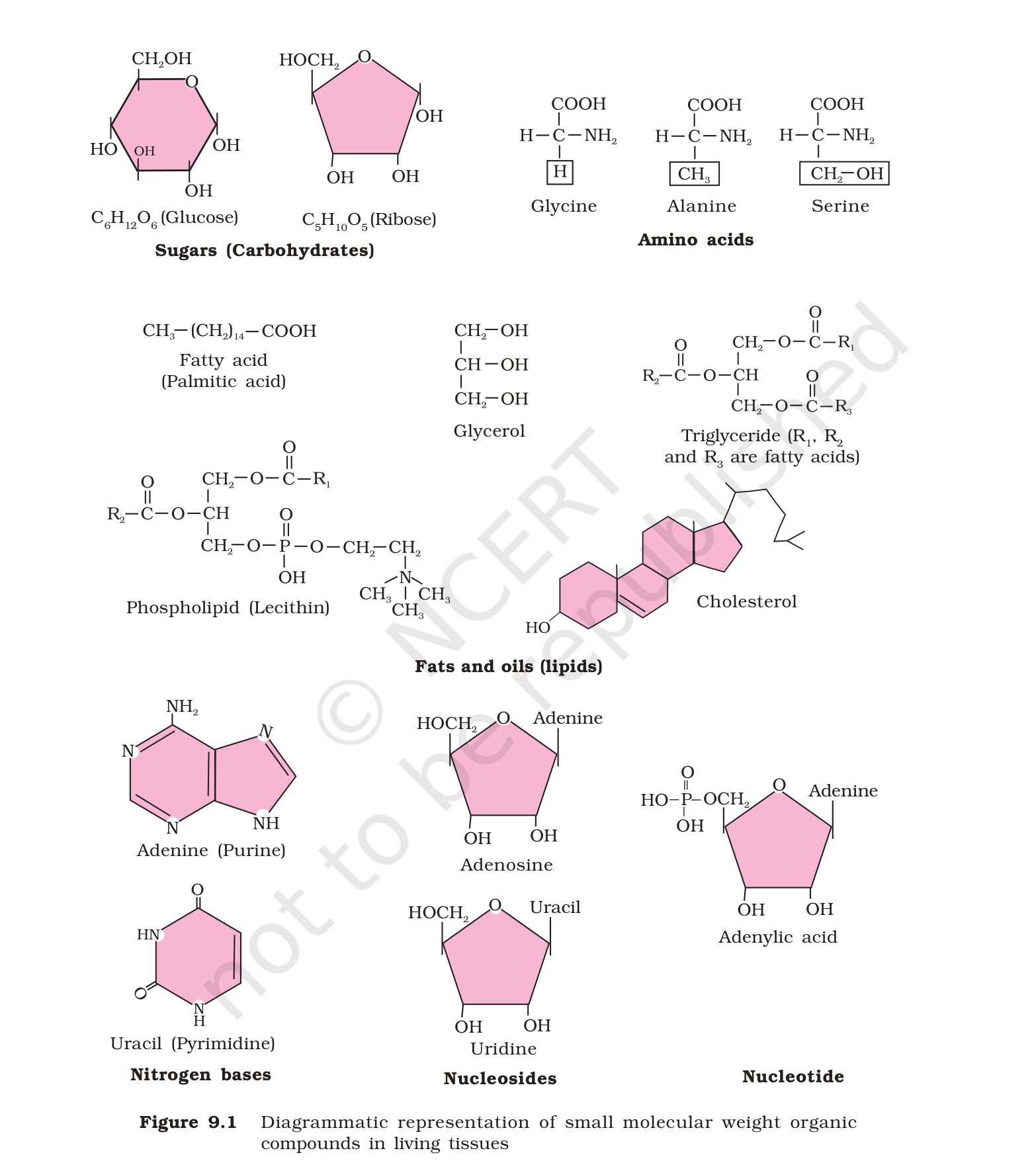
The small biomolecules taken together are called metabolites. In an animal tissue the compounds of the soluble pool are the primary metabolites: amino acids, sugars, nucleotides, fatty acids and the like, all with clear roles in normal physiology. Plants, fungi and microbes make thousands of other compounds on top of these, the secondary metabolites. Alkaloids, flavonoids, rubber, essential oils, antibiotics, pigments, scents, gums and spices belong here. Not all of their roles in the organism are understood, but many are useful to people, and some have ecological importance.
The analysis can go further in two directions. Elemental analysis gives the elements and their amounts, while compound analysis gives an idea of which organic and inorganic compounds are present. From a chemistry angle the compounds can be grouped by functional group; from a biology angle they are grouped as amino acids, nucleotide bases, fatty acids and so on. That biological grouping is how the rest of the chapter is arranged.
1.1.3 Why the analysis matters
A composition list is only the start. Once the list is known, the biologist can ask which compound does which job, and that question connects chemistry to physiology. A molecule that appears only in a particular tissue is a clue about that tissue's work; a compound that changes with disease is a clue about the disease. The two fractions make this comparison practical: the soluble pool changes quickly with the cell's activity, while the insoluble fraction is more stable because it holds the structural and informational molecules. That is why the chapter starts with analysis and only then describes the classes of molecules.
1.1.4 The size classes
Small molecules are called micromolecules or simply biomolecules, while the large ones are macromolecules. The cut is usually made at about one thousand daltons. The soluble pool is well below the cut, while proteins, nucleic acids and polysaccharides are far above it. Lipids sit below the cut yet appear in the macromolecular fraction, and that exception is exactly the kind of detail a board question likes to test.
1.1.5 Ash and the inorganic part
A tissue test has two other weights worth knowing. The wet weight is taken before drying, and the dry weight after the water has gone, so the difference gives the water content. If the dried tissue is burned completely, its carbon compounds leave as carbon dioxide and water vapour and the residue is ash. Ash holds the inorganic elements, such as calcium and magnesium, and the acid-soluble fraction also carries inorganic ions and compounds such as sulphate and phosphate. Elemental analysis and compound analysis therefore describe two different faces of the same tissue: one lists elements, the other lists the compounds those elements build. A board answer that mentions wet weight, dry weight and ash is complete on the practical side of this section.
Exam
Composition questions are answered in two steps. First, the same elements occur in living and non-living matter, so the difference lies in relative abundance, with carbon, hydrogen and oxygen higher in living tissue. Second, the tissue fractions: acid-soluble for small cytoplasmic molecules, acid-insoluble for proteins, nucleic acids, polysaccharides and lipids. Add that lipids are small yet still appear in the macromolecular fraction because membrane fragments are insoluble.
Common mistake
Do not say living tissue has different elements from the crust, since the same elements are present in both. Do not call lipids macromolecules without the explanation about membrane vesicles. And do not confuse the two metabolite groups: primary metabolites run normal physiology, while secondary metabolites include alkaloids, rubber and antibiotics.