

Concepts: Carbohydrates and polysaccharides
Biomolecules18 min readLesson 2 of 7
2.1 Sugars
Carbohydrates are the sugars, and the name records the formula: carbon with water, C(H2O), in multiples. A hexose has six carbon atoms, twelve hydrogen atoms and six oxygen atoms, and glucose is the standard hexose. Fructose is another hexose and has the same formula as glucose. Ribose and ribulose are pentoses, with five carbons, and erythrose is a tetrose. The smallest sugars are the simple sugars, the monosaccharides; two monosaccharides joined together make a disaccharide, and a long chain of sugars makes a polysaccharide.
In the soluble pool the sugars are small and free, so they appear with the metabolites. In the insoluble fraction they appear as polysaccharides, which are long chains of sugar units and belong to the true macromolecules. The difference between starch, glycogen and cellulose is a good example of how the same building block gives different materials.
2.1.1 Polysaccharides and their building blocks
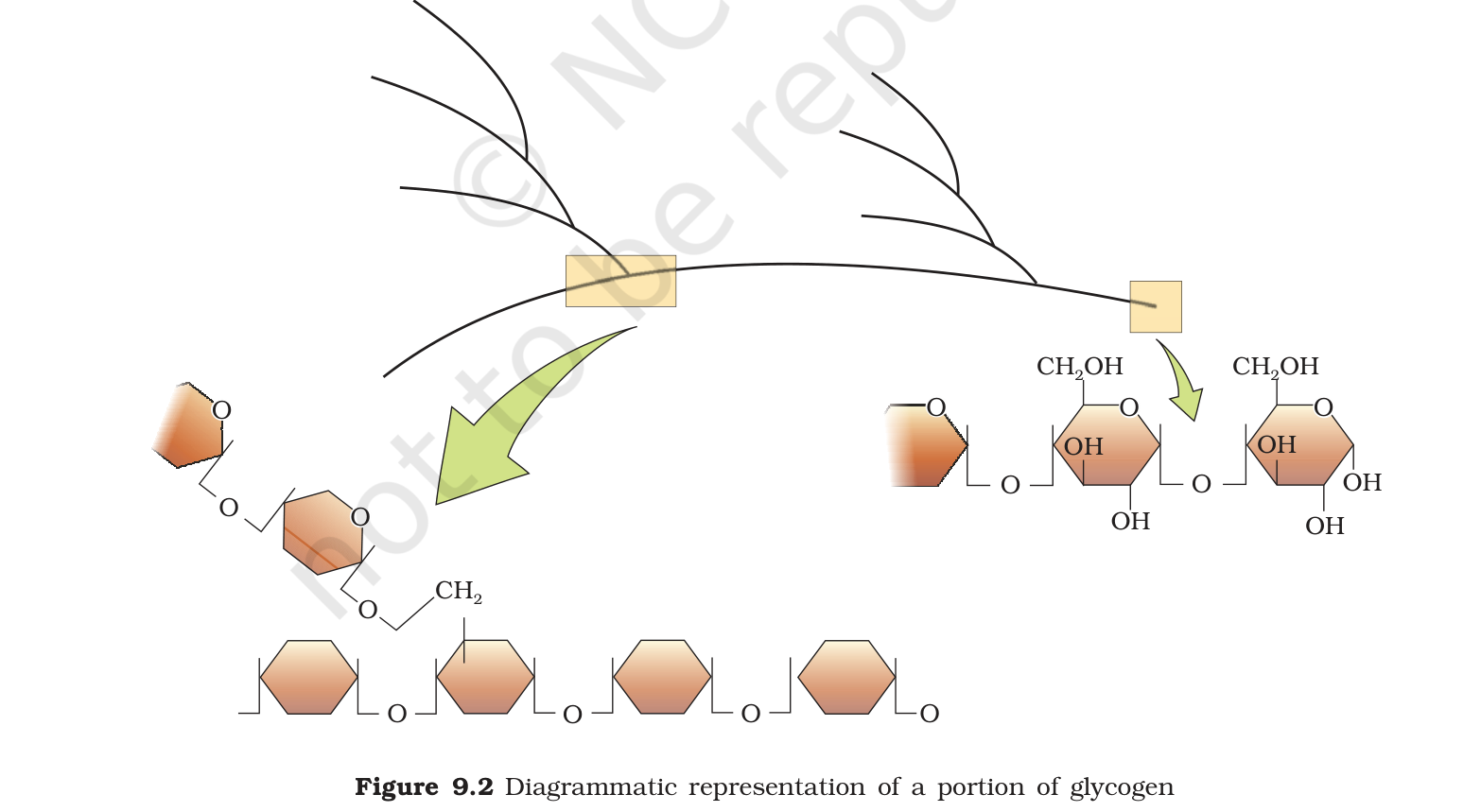
A polysaccharide is a long chain of sugars. Cellulose is a polymer of glucose alone, so it is a homopolymer. Starch is another glucose polymer, but in plants it serves as the store of energy. Animals store a variant called glycogen, which has a branched shape. Inulin is a polymer of fructose. A polysaccharide chain carries two differently named ends: one reducing and one non-reducing. Because glycogen is highly branched, its ends equal the branch points plus one.
Starch forms a helical secondary structure, and the helix can hold iodine molecules inside it. That is why the starch-iodine test gives a blue colour. Cellulose has no such complex helix, so it cannot hold iodine and gives no blue colour. The two glucose polymers therefore differ in shape, in storage role and in a simple laboratory test, and the difference is one of the easiest comparisons in the chapter.
2.1.2 The complex polysaccharides
Cellulose is the material of plant cell walls, which is why paper, cotton fibre and wood are cellulosic. Some polysaccharides are more complex and use amino sugars and chemically modified sugars as building blocks: glucosamine and N-acetyl galactosamine are examples. The exoskeleton of arthropods is made of chitin, a complex polysaccharide. Most of these complex polysaccharides are homopolymers, so the complexity lies in the modified sugar units rather than in a mixture of different monomers.
2.1.3 Why the polysaccharides matter
Polysaccharides do three jobs at once. They store energy, as starch in plants and glycogen in animals. They build structure, as cellulose in plant walls and chitin in arthropod exoskeletons. And they carry information and recognition in some complex forms, which is a theme that continues in the chapters on cell surfaces. The chapter keeps the point simple: a polymer of a single sugar can be a storehouse, a wall or a skeleton, depending on how the units are joined, and that is the central lesson of the polysaccharide section.
2.1.4 Sugars in the cell
Sugars do more than store energy. A monosaccharide is the cell's quick fuel, a disaccharide is a convenient transport form, and a polysaccharide is the long-term store or the building material. The same glucose unit, joined differently, gives starch, glycogen or cellulose, which is why the chapter stresses the different properties of these three. Cellulose cannot be digested by humans, yet it is the most abundant organic material on land, and paper, cotton and wood all depend on it. The comparison of starch and cellulose is therefore a lesson in how the arrangement of identical units decides what a molecule can do.
2.1.5 How sugars are joined
When two monosaccharides join, a glycosidic bond forms with the loss of a water molecule, and the product is a disaccharide. Sucrose, lactose and maltose are familiar disaccharides, and each is built from two specific monosaccharides. The chain grows by repeating this linkage, and a polysaccharide may hold hundreds or thousands of sugar units. The number and arrangement of the linkages decide whether the chain is straight or branched, which is exactly why starch, glycogen and cellulose behave so differently even though all three are glucose polymers. The reducing end of a chain is the end that still has a free aldehyde or ketone group, and the non-reducing end has lost it in the linkage. That detail explains why a branched molecule like glycogen has many ends: every branch finishes with one.
2.1.6 Why the sequence of sugars matters
A polysaccharide is more than a pile of sugar units. The way the units are linked decides whether the chain coils, stays straight or branches, and that shape decides what the molecule can do. A straight, tightly packed chain gives strength, which is why cellulose works as a wall material. A branched chain exposes many ends, which is why glycogen can be broken down quickly when a muscle needs glucose. A coiled chain can trap small molecules, which is how starch holds iodine and gives the blue colour in the test. Same monomer, three behaviours, and the linkage makes the difference.
Exam
For the polysaccharide answer, keep one table in mind: cellulose, starch and glycogen have glucose as the unit; starch is the plant store, glycogen the animal store, cellulose the structural material; starch gives a blue colour with iodine and cellulose does not. The numbers of ends and branches belong with glycogen.
Common mistake
Do not say cellulose is branched, because it is a straight glucose polymer; glycogen is the branched one. Do not write that inulin is a polymer of glucose, since it is a polymer of fructose. And do not call all polysaccharides homopolymers of glucose, because chitin uses modified amino sugars.