

Concepts: Enzymes
Biomolecules24 min readLesson 5 of 7
5.1 What an enzyme is
Almost all enzymes are proteins, and a few nucleic acids behave as catalysts; those are called ribozymes. An enzyme has the same four levels of structure as any protein, and its catalytic power comes from the tertiary fold. When the folded chain criss-crosses itself, crevices and pockets form on the surface, and one such pocket is the active site. The substrate fits into that pocket, and the fit is what makes the reaction go quickly.
Enzymes differ from inorganic catalysts in one practical way. Inorganic catalysts work well at high temperature and pressure, while enzymes are damaged above about 40 degrees Celsius. Enzymes taken from organisms that live in hot vents and sulphur springs are the exception, because they stay stable and keep their catalytic power up to 80 or 90 degrees Celsius; this thermal stability is a property of those thermophilic enzymes.
5.1.1 Reactions and rates
A physical change alters shape or state without breaking bonds, while a chemical reaction breaks old bonds and makes new ones. A reaction rate measures how much product appears in a unit of time. Temperature shifts it, and a rough rule says the rate doubles or halves for each 10 degree step. A catalysed reaction runs far faster than the same reaction without a catalyst. The formation of carbonic acid from carbon dioxide and water is the standard case: without an enzyme about 200 molecules form in an hour, while carbonic anhydrase in the cytoplasm produces about 600,000 molecules every second, an acceleration of roughly ten million times.
A metabolic pathway is a multistep reaction in which each step is catalysed by an enzyme. Glucose to pyruvic acid passes through ten enzyme-catalysed steps, and one or two extra reactions turn that same pathway towards lactic acid in a working muscle or ethanol in yeast. The pathway is therefore shared, and the end product depends on the conditions.
5.1.2 The active site and activation energy
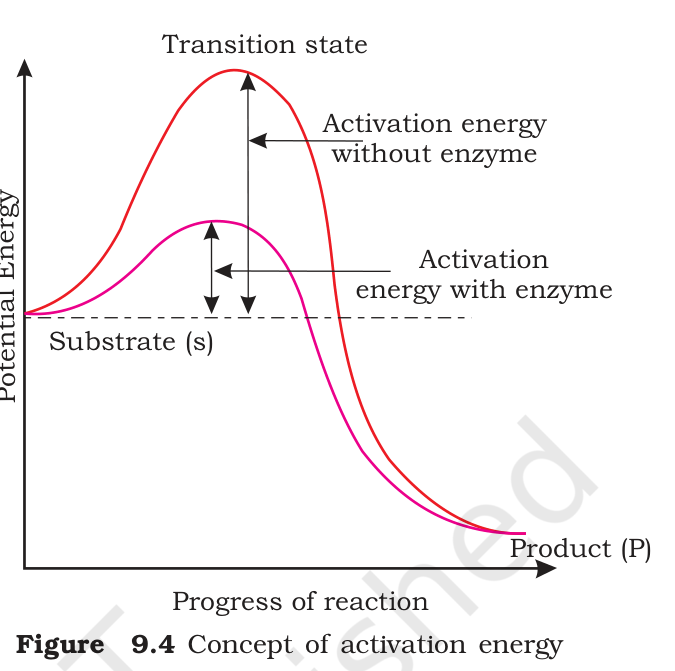
A substrate must diffuse to the active site and bind there, forming an enzyme-substrate complex. That complex is short-lived. While the substrate is bound, it takes an altered shape called the transition state, the bonds break or form, and the product leaves. The route from substrate to product always passes through the transition state, which sits at a higher energy than the substrate. The energy needed to reach that state is the activation energy. An enzyme lowers the activation energy, so the same reaction happens at a much lower energy cost, and this is the central explanation of catalysis.
5.1.3 The catalytic cycle
The cycle runs in four steps. The substrate binds to the active site and fits into it. Binding makes the enzyme alter its shape and grip the substrate more firmly. The active site then breaks the bonds of the substrate and the enzyme-product complex forms. Finally the products are released and the free enzyme is ready for another substrate molecule.
5.1.4 What changes the rate
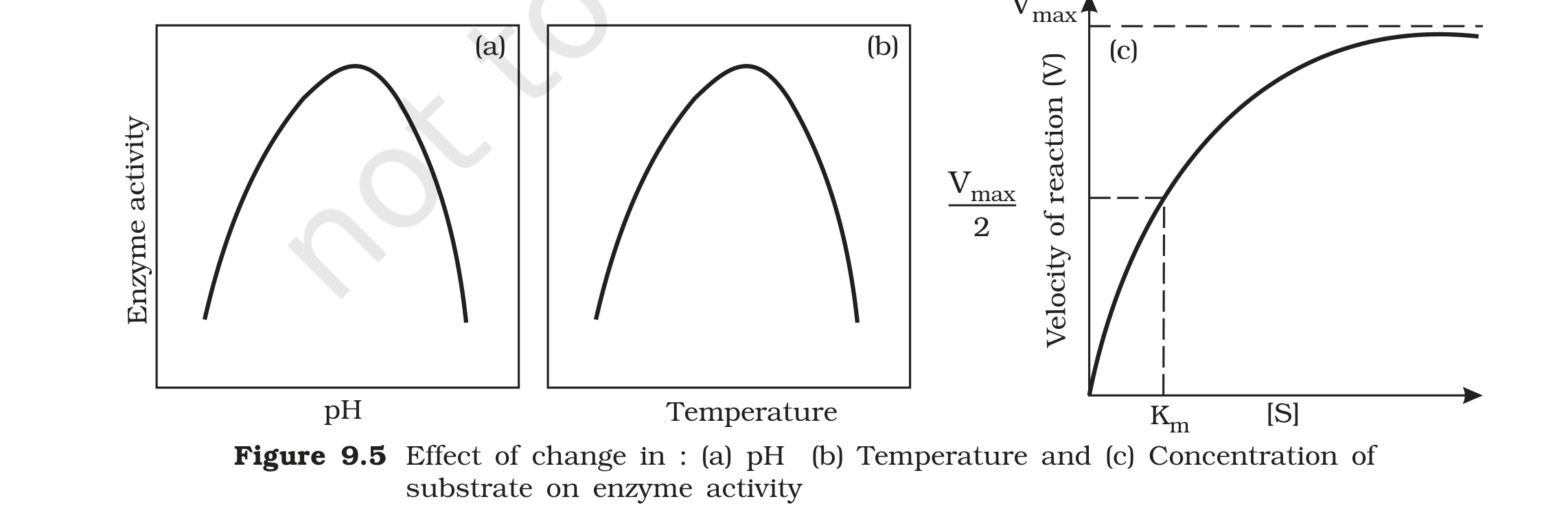
Enzyme activity depends on conditions that alter the tertiary structure. Temperature and pH have narrow working ranges. Each enzyme has an optimum temperature and an optimum pH, and activity falls on both sides of the optimum. Low temperature keeps the enzyme temporarily inactive, while high temperature denatures the protein and destroys activity. Substrate concentration raises the rate at first, but the rate levels off at a maximum velocity, Vmax, because the enzyme molecules are all occupied and no free enzyme remains to bind more substrate.
Specific chemicals can bind an enzyme and shut off its activity; this is inhibition and the chemical is an inhibitor. A competitive inhibitor resembles the substrate in structure and competes for the substrate-binding site, so the substrate cannot bind. Malonate inhibiting succinic dehydrogenase is the standard example, and such inhibitors are used against bacterial pathogens.
5.1.5 Classification and cofactors
Enzymes are classified into six classes by the reaction they catalyse, and each class has subclasses named by a four-digit number. Oxidoreductases catalyse oxidation-reduction between two substrates. Transferases move a group other than hydrogen from one substrate to another. Hydrolases break ester, ether, peptide, glycosidic, carbon-carbon, carbon-halide or phosphorus-nitrogen bonds by hydrolysis. Lyases remove groups by means other than hydrolysis and leave double bonds. Isomerases interconvert optical, geometric or positional isomers. Ligases join two compounds by making carbon-oxygen, carbon-sulphur, carbon-nitrogen or phosphorus-oxygen bonds.
Some enzymes need a non-protein part to be catalytically active, and that part is a cofactor. The protein part is then called the apoenzyme. Three kinds of cofactor exist. Prosthetic groups are organic and tightly bound; haem in peroxidase and catalase is one, and it is part of the active site. Co-enzymes are organic but only loosely and transiently bound, and they serve many different enzymes; NAD and NADP contain the vitamin niacin. Metal ions form coordination bonds with the side chains at the active site and with the substrate; zinc is the cofactor of the protease carboxypeptidase. Remove the cofactor and catalytic activity is lost, which proves how central it is.
5.1.6 Enzymes in the cell's economy
Enzymes make the difference between a reaction that takes years and one that takes milliseconds. Every metabolic pathway in the cell is a chain of enzyme-catalysed steps, and each step has its own enzyme, its own optimum and its own control. That control is what allows a cell to speed up one pathway and slow another without changing its temperature or its overall chemistry. An inhibitor that mimics a substrate can shut one enzyme down, and that is the principle behind many drugs and antibacterial chemicals. The chapter's list of six enzyme classes follows the same logic: the class name tells the kind of chemistry the enzyme performs.
Slideshow, slide 1 of 3. Use the left and right arrow keys to change slides and the space bar to play or pause.
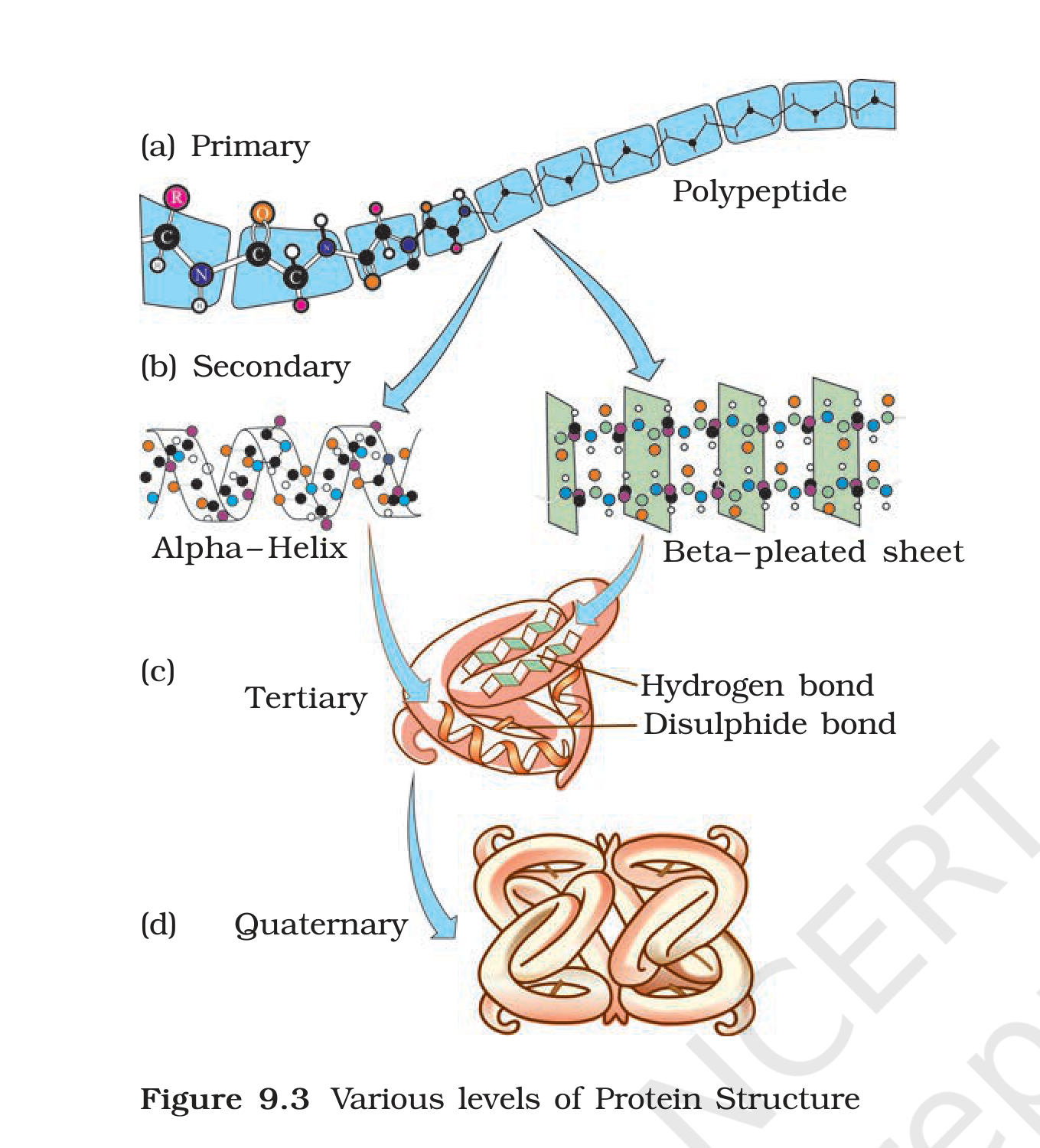
The four levels of protein structure from the NCERT plate: primary, secondary, tertiary and quaternary, with the helix, pleated sheet and subunit assembly shown.
Exam
Enzyme answers repeat four ideas: the active site and the enzyme-substrate complex, the lowering of activation energy, the effect of temperature and pH on the tertiary structure, and the six classes or the cofactor types. The carbonic anhydrase figures are a strong opening line because they show the scale of catalysis in one sentence.
Common mistake
Do not say an enzyme raises activation energy, since it lowers the barrier. Do not say enzymes are used up in the reaction, because the enzyme is released unchanged at the end of the cycle. And do not confuse a co-enzyme with a prosthetic group: a prosthetic group is tightly bound, while a co-enzyme binds only transiently.