

Concepts: Anatomy of the root and the stem
Anatomy of Flowering Plants22 min readLesson 2 of 5
2.1 Reading a transverse section
A mature root or stem is read from the outside inward, one layer at a time. The layers are the same set in every organ, but their number, thickness and arrangement differ between dicots and monocots. That is why a transverse section is the standard practical test for telling the two groups apart.
2.1.1 The dicot root
The outer layer is the epiblema, and many of its cells extend out as unicellular root hairs. Inside it lies the cortex, several layers of thin-walled parenchyma with spaces between the cells. The innermost cortical layer, the endodermis, is a single layer of barrel-shaped cells with no spaces; its radial and tangential walls carry waxy suberin as the Casparian strips, which make the layer a water barrier. Just inside the endodermis are a few layers of thick-walled parenchyma, the pericycle. Lateral roots and the vascular cambium start in the pericycle during secondary growth. The pith at the centre is small or absent. Between xylem and phloem sit parenchyma cells called conjunctive tissue. There are usually two to four separate xylem patches, and a cambium ring can later form between xylem and phloem. Everything inside the endodermis, which means the pericycle, the vascular bundles and the pith, is together called the stele.
2.1.2 The monocot root
Under the microscope the monocot root shows the same set of layers, from the outer epidermis through cortex, endodermis and pericycle to the bundles and the pith. What marks it out is the number of xylem bundles, usually more than six (polyarch), and a large pith. A monocot root does not undergo secondary growth, so it stays as it is formed.
2.1.3 The dicot stem
In a young dicot stem the epidermis is the outer protective layer, with a thin cuticle and a few trichomes and stomata. Below it is the cortex in three parts. The hypodermis just under the epidermis is collenchymatous and gives young stems their strength. Then come rounded, thin-walled parenchyma cells of the cortex with clear spaces between them. The innermost cortical layer is the endodermis, whose cells are full of starch grains, which is why it is called the starch sheath. The pericycle lies on the inner side of the endodermis, above the phloem, as semi-lunar patches of sclerenchyma. Between neighbouring vascular bundles are radial rows of parenchyma, the medullary rays. The vascular bundles are arranged in a ring, which is a character of the dicot stem; each bundle is conjoint and open, with endarch protoxylem, meaning the first-formed xylem lies towards the centre. The central pith is a mass of rounded parenchyma with large spaces.
2.1.4 The monocot stem
The monocot stem is built differently. Its hypodermis is sclerenchymatous, not collenchymatous. The vascular bundles are many and scattered through a large parenchymatous ground tissue, and each bundle is wrapped in a sclerenchymatous bundle sheath. The bundles are conjoint and closed. Bundles near the edge are smaller than the central ones, phloem parenchyma is missing, and cavities holding water sit inside the bundles.
2.1.5 Practice from the NCERT exercises, questions 1, 2 and 3
Exercise 1. For the root pair, draw a dicot root with two to four xylem patches and a small pith, and a monocot root with a polyarch xylem and a large pith. For the stem pair, draw a dicot stem with a ring of open bundles and medullary rays, and a monocot stem with scattered closed bundles inside a bundle sheath.
Exercise 2. A monocot stem shows scattered vascular bundles, a sclerenchymatous hypodermis and no medullary rays; a dicot stem shows bundles in a ring, a collenchymatous hypodermis, medullary rays and open bundles. Those three characters decide the identity from a section.
Exercise 3. The section is a monocot stem. Conjoint, scattered bundles surrounded by sclerenchymatous bundle sheaths and the absence of phloem parenchyma are the three monocot stem characters printed in the chapter. A dicot stem would have shown the bundles in a ring, with medullary rays between them and cambium inside each bundle, and those three differences are enough to rule it out.
2.1.6 A memory line for the layers
The layers of a root follow a fixed order from the outside in: epiblema, cortex, endodermis, pericycle, vascular bundles, pith. A stem replaces epiblema with epidermis and adds a hypodermis inside it, then follows cortex, endodermis, pericycle, vascular bundles, pith. In both organs the endodermis is a single layer and the pericycle lies just inside it, and in both the stele starts at the pericycle. Once that order is fixed in mind, a transverse section can be read from a photograph, and the positions of xylem and phloem then decide whether the organ is a root or a stem.
Slideshow, slide 1 of 3. Use the left and right arrow keys to change slides and the space bar to play or pause.
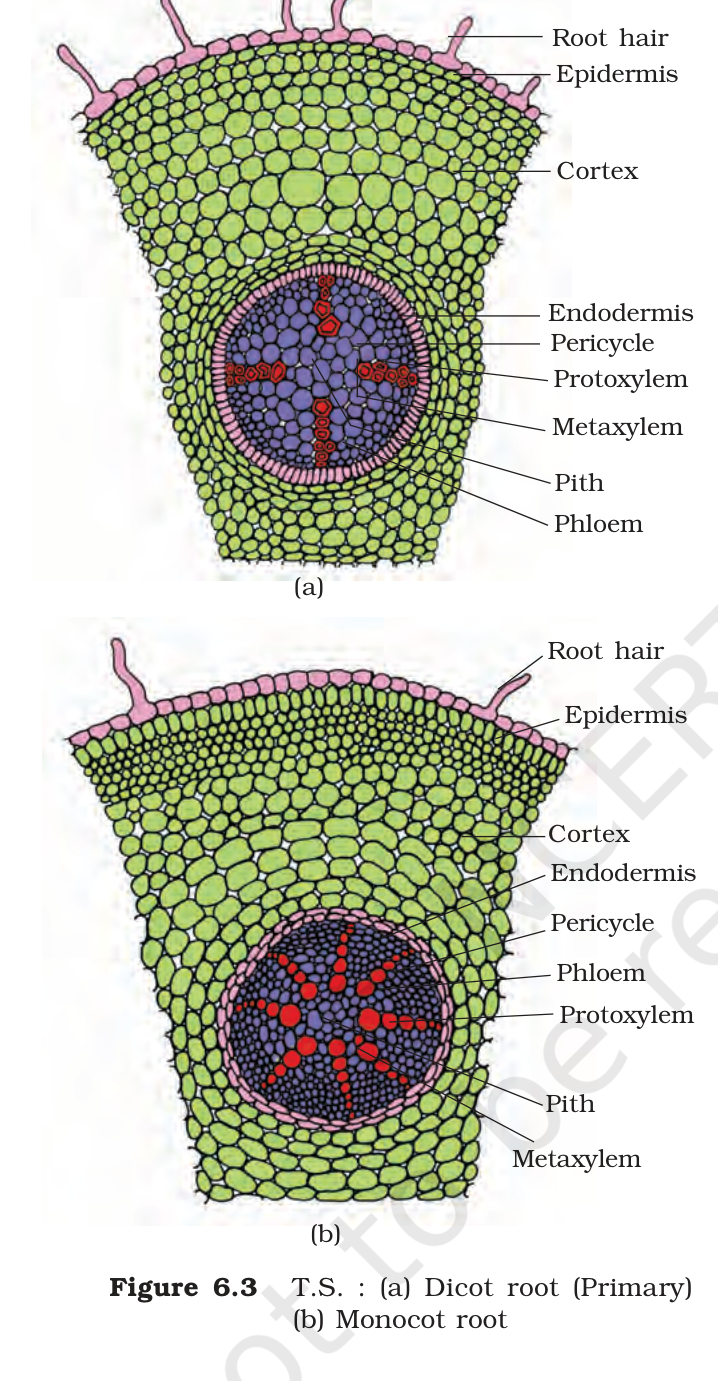
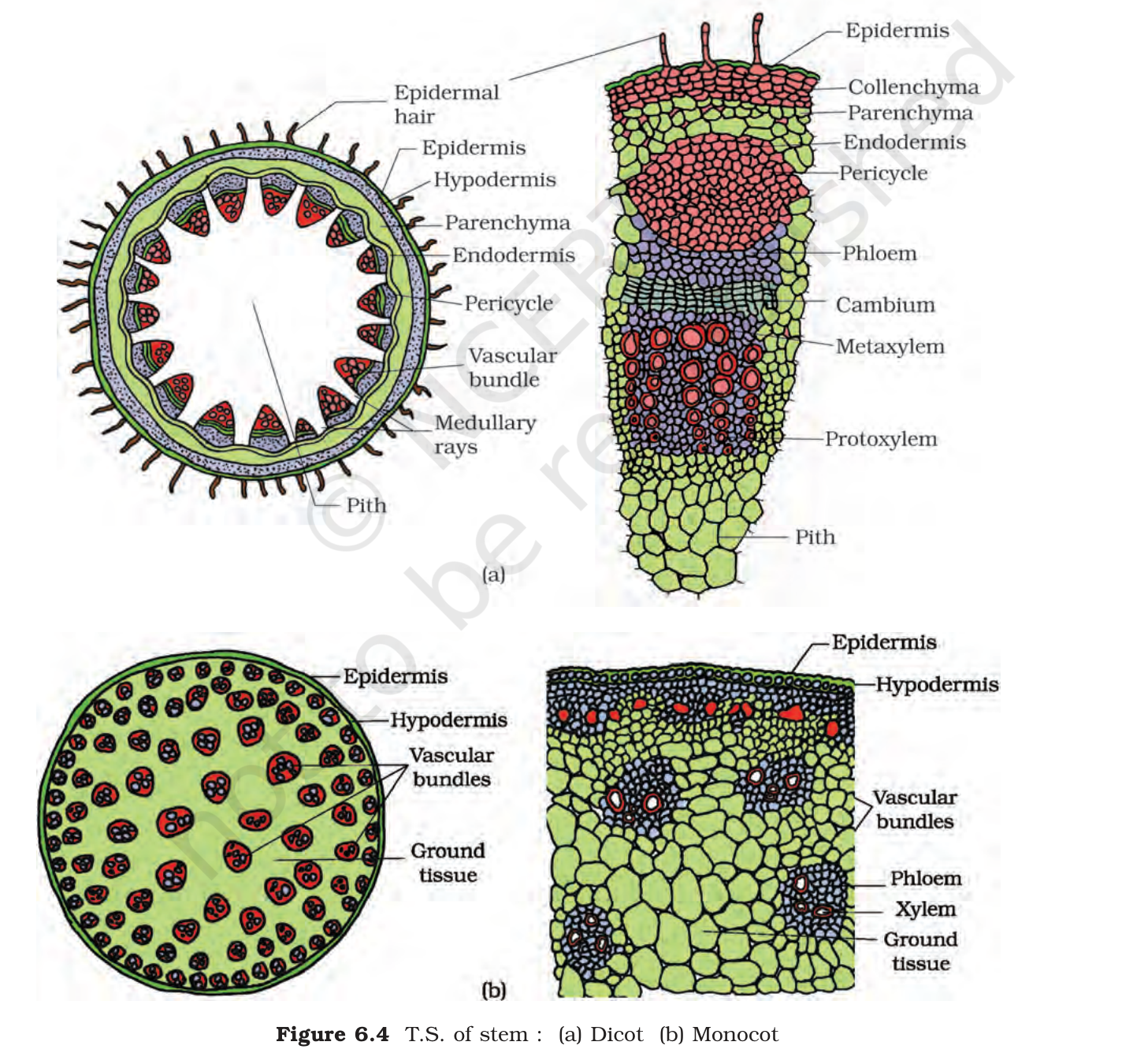
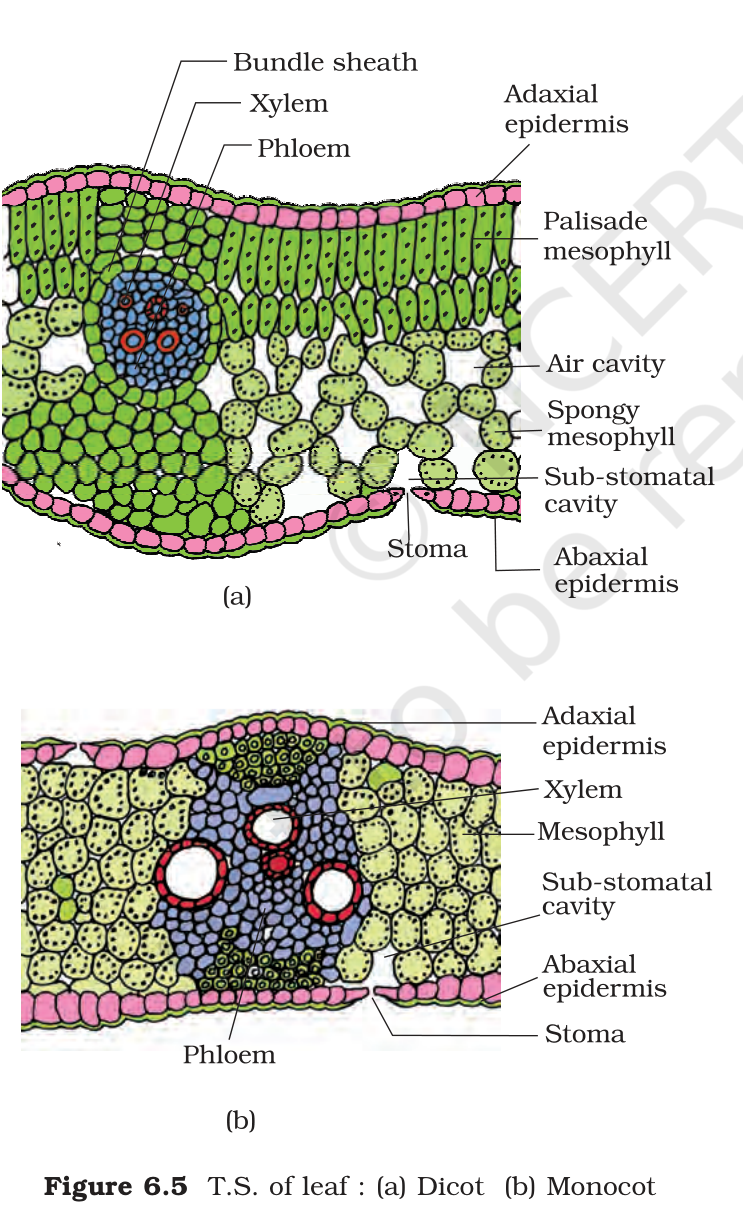
Transverse sections of a dicot root and a monocot root from the NCERT plate, with epiblema, cortex, endodermis, pericycle, xylem, phloem and pith labelled.
Exam
Practical questions reward the outside-in order. Write epiblema, cortex, endodermis, pericycle, vascular bundles, pith for a root, and epidermis, hypodermis, cortex, endodermis, pericycle, vascular bundles, pith for a stem. Then add the two group differences: polyarch xylem and a large pith for the monocot root, scattered closed bundles for the monocot stem.
Common mistake
Do not say the dicot root has a large pith, because its pith is small or absent. Do not call the endodermis of the dicot stem a water barrier in the same sense as in the root; in the stem it is the starch sheath. And do not write that monocot stems have cambium, since their bundles are closed and secondary growth does not happen there.