

Concepts: Plant tissues and the tissue systems
Anatomy of Flowering Plants20 min readLesson 1 of 5
1.1 From cells to tissues
Anatomy is the study of a plant's internal structure. A plant body starts from cells, the cells build tissues, the tissues build organs, and each organ has its own internal arrangement. The chapter compares these arrangements across angiosperms, and monocots and dicots turn out to differ in ways a transverse section shows at a glance.
1.1.1 Meristematic tissue
Meristematic tissue is the tissue that divides. Its cells are small, thin-walled, closely packed and full of dense protoplasm, with no large vacuole. Three kinds are named by position. Apical meristem sits at the root and shoot tips and adds to the length of the plant. Lateral or cambial meristem lies inside the older roots and stems and adds to their girth. Intercalary meristem sits between mature tissues, often at the base of leaves and internodes in grasses, and it lets a cut lawn or grazed grass regrow quickly.
1.1.2 Permanent simple tissue
Permanent tissues stop dividing and take up a fixed job. The simple kinds are built of one cell type. Parenchyma is the most common: thin-walled, living, isodiametric cells with a large central vacuole, found in cortex, pericycle, pith and medullary rays. Its cells store food, help in photosynthesis where they carry chloroplasts, and fill space in soft parts. Collenchyma is also living, but its walls are thickened at the corners with cellulose and pectin; that thickening gives flexible support to young stems and petioles. Sclerenchyma is dead at maturity, with thick lignified walls and narrow lumen, and it supplies hard mechanical support. Its two forms are fibres, which are long and pointed, and sclereids, which are short and irregular.
1.1.3 Complex tissue
Complex tissues are built of more than one cell type. Xylem and phloem are the two. Xylem carries water and minerals upward, and it is made of tracheids, vessels, xylem fibres and xylem parenchyma. Tracheids and vessels are the conducting elements; both are dead and hollow, with lignified walls. Phloem carries the food made in leaves to the rest of the plant. Its conducting elements are sieve tubes, helped by companion cells, and the tissue also has phloem parenchyma and phloem fibres. Sieve tubes are living at maturity and lack a nucleus at the centre, while companion cells keep the transport running.
1.2 The three tissue systems
Tissues also group by position in the plant. The outermost covering makes the epidermal tissue system, the middle filling makes the ground tissue system, and the conducting part makes the vascular tissue system.
1.2.1 Epidermal tissue system
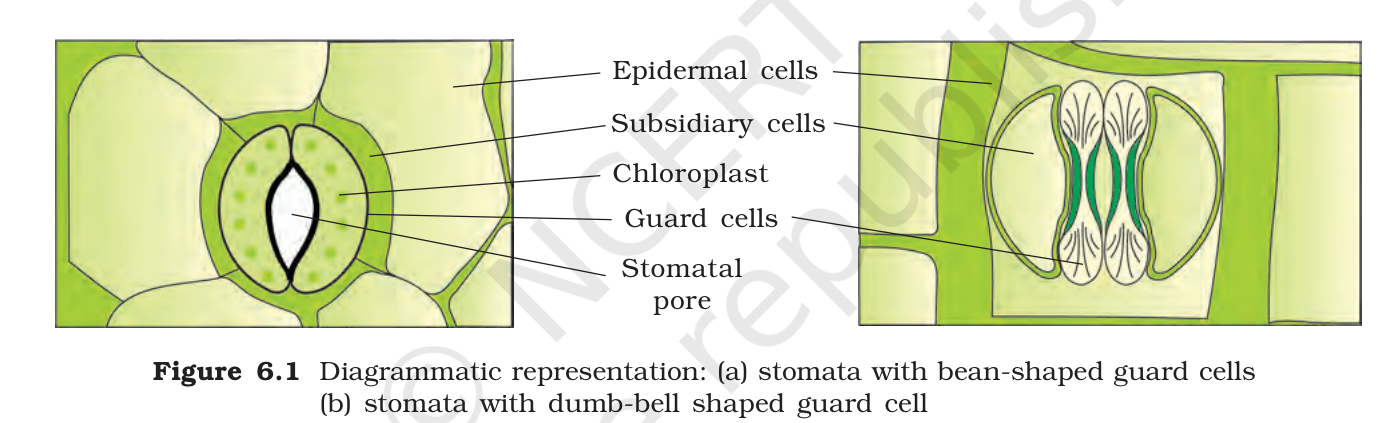
As the outer layer of the primary body, the epidermis is usually one cell thick, with elongated cells that sit compactly in a continuous sheet. A waxy cuticle lies over the outside and limits water loss, and the cuticle is absent in roots. Stomata sit in the leaf epidermis and control the exchange of gases and the loss of water vapour. Two guard cells enclose a pore to make a stoma, and their shape is bean-like in most dicots but dumb-bell-like in grasses. Chloroplasts sit inside the guard cells, which open and close the pore. When a few neighbouring epidermal cells take special shapes, they are subsidiary cells, and the pore, guard cells and subsidiary cells together make the stomatal apparatus. The epidermis also bears hairs: root hairs are single-cell extensions that absorb water and minerals, while shoot hairs, the trichomes, may be many-celled, branched, stiff or soft, and they cut transpiration.
1.2.2 Ground and vascular tissue systems
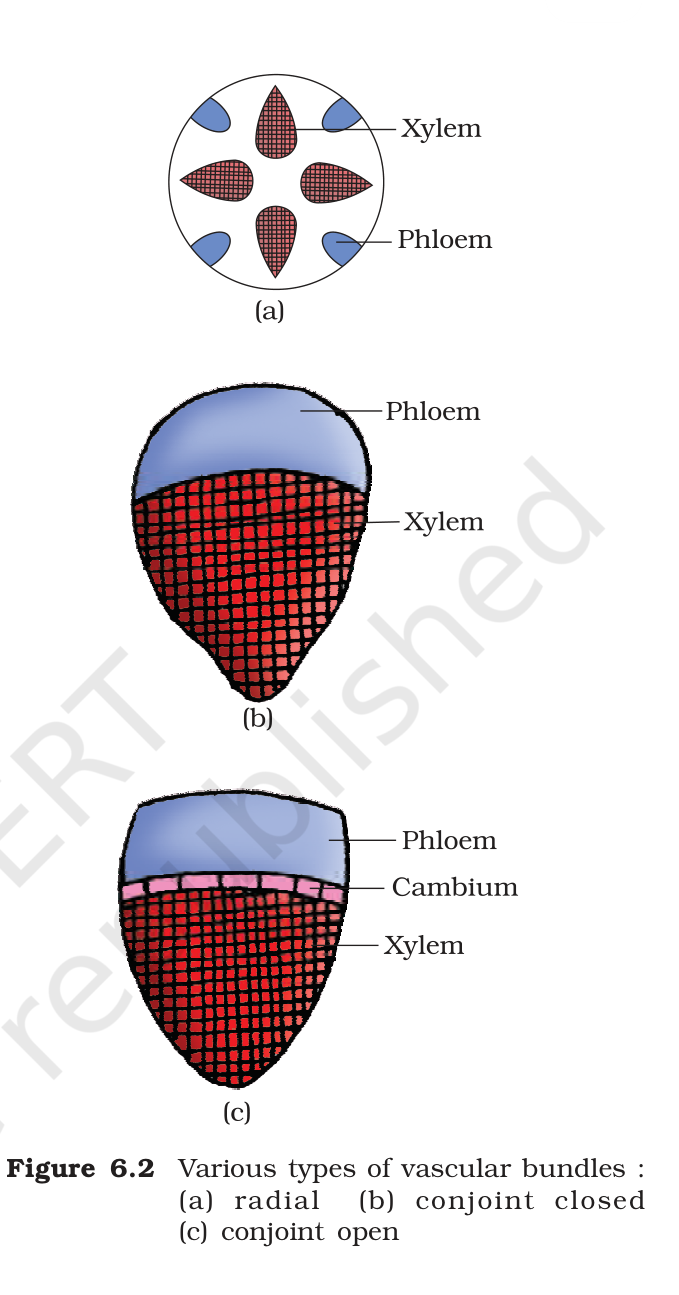
Everything between the epidermis and the vascular bundles forms the ground tissue, which is mostly parenchyma, collenchyma and sclerenchyma. In a leaf this ground tissue is the mesophyll, packed with chloroplasts. The vascular system is the xylem and phloem together, and the two usually travel as a vascular bundle. A bundle with cambium between phloem and xylem is open and can form secondary tissue; a bundle without cambium is closed. When xylem and phloem lie on different radii they make a radial bundle, as in roots, and when both lie on the same radius the bundle is conjoint, as in stems and leaves.
1.2.3 Practice from the NCERT exercises, questions 4 and 5
Exercise 4. The stomatal apparatus is the whole unit of the stomatal pore, the two guard cells around it and the subsidiary cells that touch the guard cells. The guard cells are bean-shaped in dicots and dumb-bell shaped in grasses, they hold chloroplasts, and they open and close the pore as water moves in and out.
Exercise 5. There are three tissue systems. The epidermal system holds epidermis, stomata and epidermal appendages such as trichomes. The ground system holds parenchyma, collenchyma and sclerenchyma and forms the cortex, pericycle and pith. The vascular system holds the xylem and the phloem.
Exam
Questions on the tissue systems are best answered as three short blocks, one per system, with the tissues named under each. For a tissue function question, put the function and the structural reason together: collenchyma supports a young stem because its walls are thickened at the corners with cellulose and pectin, and sclerenchyma gives hard support because its lignified walls are dead and thick.
Common mistake
Do not call collenchyma dead, because its cells are living. Do not say sclerenchyma stores food, since that is the work of parenchyma. Do not mix up the two surfaces for stomata and cuticle: the cuticle is on the outside of the epidermis and absent from roots, and stomata are pores of the leaf epidermis rather than cells of the ground tissue.