

Concepts: Bryophytes
Plant Kingdom18 min readLesson 2 of 6
2.1 The amphibians of the plant kingdom
Bryophytes are the mosses and liverworts that grow in moist, shaded places, especially on hills. The name amphibian of the plant kingdom is used for a reason: these plants live on land but still need water for sexual reproduction. They help in plant succession on bare rock and bare soil, and they are often the first life to settle on such a surface.
The body of a bryophyte has more differentiation than an algal body, but it is still thallus-like. It lies prostrate or grows erect and holds on to the ground through rhizoids, which may be one cell or many cells long. True roots, stems and leaves are absent. Root-like, leaf-like and stem-like parts may be present.
The main plant body is haploid, and because it makes the gametes it is called the gametophyte. The sex organs are many-celled. The male organ is the antheridium, and it makes biflagellate antherozoids. The female organ is the archegonium, which is flask-shaped and holds a single egg. On a wet surface the antherozoids are released, swim in the water film and reach the archegonium. One of them fuses with the egg, and the result is a zygote.
The zygote does not divide meiotically at once. It grows into a many-celled sporophyte. The sporophyte is not free-living: it remains joined to the green gametophyte and takes its food from that partner. Later, certain cells of the sporophyte divide meiotically and give haploid spores. The spores germinate into new gametophytes, and the cycle closes.
2.1.1 Liverworts
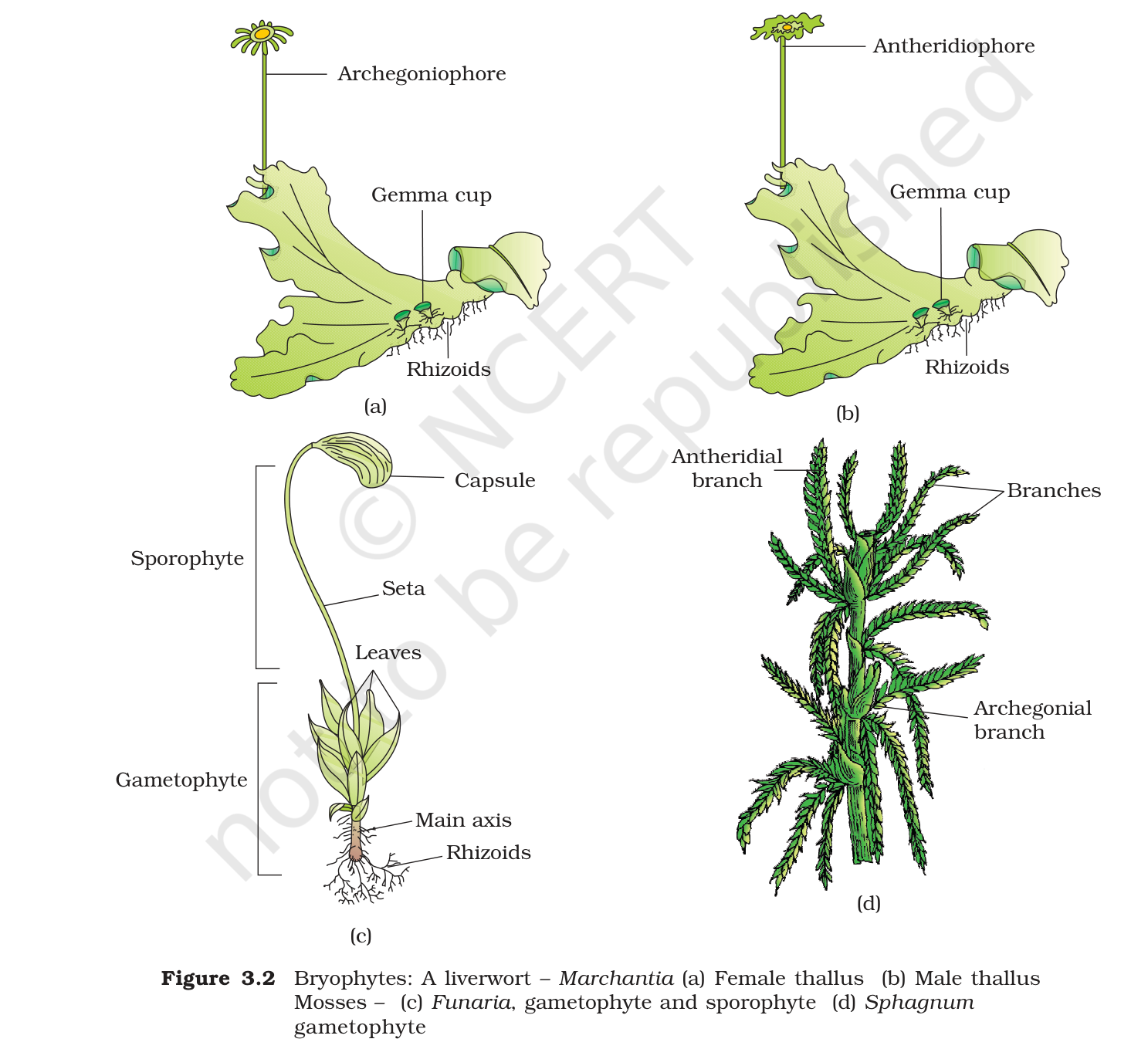
Liverworts grow in damp shade, on stream banks, in marshy ground, on damp soil and bark, and deep in woods. The body may be a thallus, as in Marchantia, and that thallus is dorsiventral, lying close and flat on the surface. Leafy liverworts have tiny leaf-like parts in two rows on a stem-like structure.
Asexual reproduction in liverworts happens by fragmentation or through gemmae, the green many-celled asexual buds that sit in small receptacles called gemma cups on the thallus. A gemma breaks free, falls on damp ground and grows into a new plant. For sexual reproduction, the sex organs grow either on one thallus or on separate thalli. The sporophyte carries a foot, a seta and a capsule; meiosis inside the capsule yields spores, and those spores grow into free-living gametophytes.
2.1.2 Mosses
The gametophyte is the dominant stage in a moss, and it comes in two forms. The protonema develops straight from a spore; it is green, branched, creeping and frequently filamentous. From the secondary protonema a lateral bud produces the leafy stage, whose upright axes carry spirally arranged leaves. Multicellular branched rhizoids anchor it to the soil, and the sex organs are borne at the tip of those leafy shoots.
In mosses, vegetative reproduction takes place by fragmentation and by budding on the secondary protonema. After fertilisation the zygote grows into a sporophyte with a foot, a seta and a capsule. The sporophyte is more elaborate than in liverworts, and it has an elaborate mechanism for dispersing its spores. Funaria, Polytrichum and Sphagnum are common mosses.
2.1.3 Work done by bryophytes
Bryophytes have little direct economic value, and that is the honest position of the chapter. Some mosses feed herbaceous mammals, birds and other animals. Sphagnum gives peat, which has long served as fuel and as packing material for moving living plants, since it holds water well. Mosses and lichens are the first organisms to settle on rock, and they slowly break the rock down and make a substrate for higher plants. Dense mats of moss also soften the impact of falling rain and reduce soil erosion.
Exam
For the life cycle of a moss, draw the two gametophyte stages first, protonema and leafy shoot, then the sex organs, the zygote, the sporophyte with foot, seta and capsule, meiosis and spores. A question that asks why bryophytes are called amphibians wants both halves of the answer: they live on land and they need a film of water for the antherozoids to swim to the archegonium.
Common mistake
Do not say the bryophyte plant body has true roots, stems and leaves, because it has only root-like, stem-like and leaf-like parts and rhizoids. Do not call the sporophyte the dominant stage in a moss; the gametophyte is dominant and the sporophyte depends on it. And do not write that meiosis happens in the gametophyte to make gametes, because gametes are made by mitosis and meiosis happens in the sporophyte capsule to make spores.
2.1.4 Practice from the NCERT exercises, questions 3 and 8
Exercise 3. Three plant groups bear archegonia: bryophytes, pteridophytes and gymnosperms. The moss life cycle runs in this order. A spore grows into a filamentous protonema, which produces the leafy gametophyte. The gametophyte carries antheridia and archegonia. Water carries the biflagellate antherozoids to the archegonium, and the egg is fertilised. The zygote grows into a sporophyte of foot, seta and capsule, still attached to the gametophyte. Meiosis in the capsule makes haploid spores, and the cycle begins again.
Exercise 8, all six terms. A protonema is the green branched filamentous stage that grows directly from a moss spore. An antheridium is the male sex organ that produces biflagellate antherozoids. An archegonium is the flask-shaped female sex organ that holds a single egg. A diplontic plant has the diploid sporophyte as its main body with a reduced gametophyte; the moss does not follow that pattern, because the plant seen is the haploid gametophyte. A sporophyll is the leaf-like appendage that bears the sporangia in pteridophytes. Isogamy is the fusion of two gametes that are similar in size, as in Ulothrix.