

Concepts: Gymnosperms, angiosperms and plant life cycles
Plant Kingdom22 min readLesson 4 of 6
4.1 Gymnosperms: naked seeds
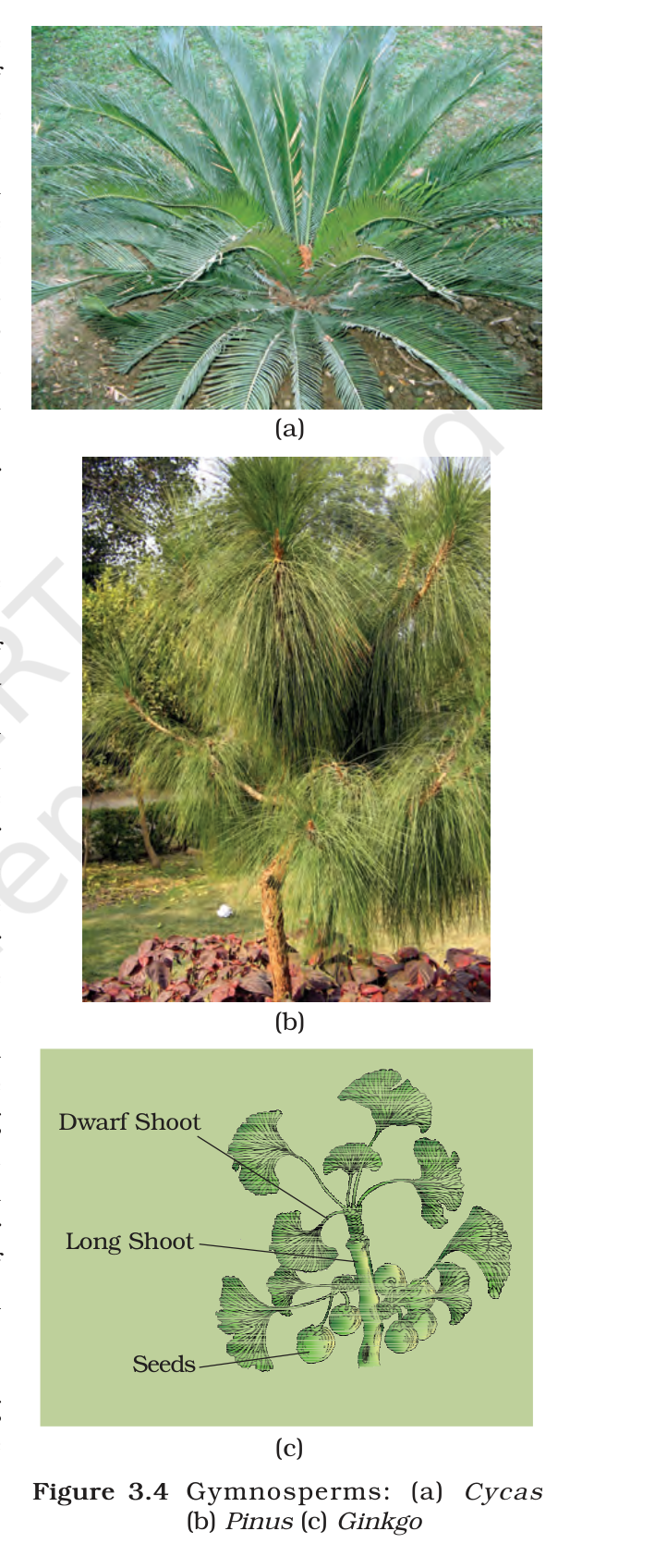
The name gymnosperm comes from the Greek words for naked and seed. In these plants the ovules are not enclosed by an ovary wall, and they stay exposed before and after fertilisation, so the seeds that form are naked. Gymnosperms include medium-sized trees, tall trees and shrubs. Sequoia, the giant redwood, is one of the tallest tree species known.
Most gymnosperms have tap roots. In Pinus the roots form mycorrhiza with a fungus, and in Cycas special short roots called coralloid roots live with nitrogen-fixing cyanobacteria. A gymnosperm stem can be unbranched, as in Cycas, or can branch, as in Pinus and Cedrus. Leaves may be simple or compound, and the pinnate leaves of Cycas persist for a few years. The leaves are built to survive hard conditions: conifers have needle-like leaves that reduce surface area, and a thick cuticle with sunken stomata limits water loss.
Gymnosperms are heterosporous and make haploid microspores and megaspores. These form in sporangia borne on sporophylls, and the sporophylls are arranged spirally along an axis into strobili or cones that may be lax or compact. The strobili carrying microsporophylls and microsporangia are male strobili, and their microspores grow into a highly reduced male gametophyte called the pollen grain. The strobili carrying megasporophylls with ovules are female strobili. Pinus may carry male and female cones on the same tree, while Cycas bears male cones and megasporophylls on different trees.
The megaspore mother cell sits in the nucellus, which is protected by envelopes; the whole structure is the ovule. The mother cell divides meiotically into four megaspores, and one of them grows into a many-celled female gametophyte carrying two or more archegonia. The female gametophyte stays inside the megasporangium. Unlike bryophytes and pteridophytes, the gymnosperm gametophytes have no free-living existence; both remain inside the sporangia that the sporophyte carries. The pollen grain leaves the microsporangium, is carried by air currents to the opening of an ovule, and sends a pollen tube towards the archegonia. Fertilisation gives a zygote that develops into an embryo, and the ovule becomes a naked seed.
4.2 Angiosperms: seeds inside fruits
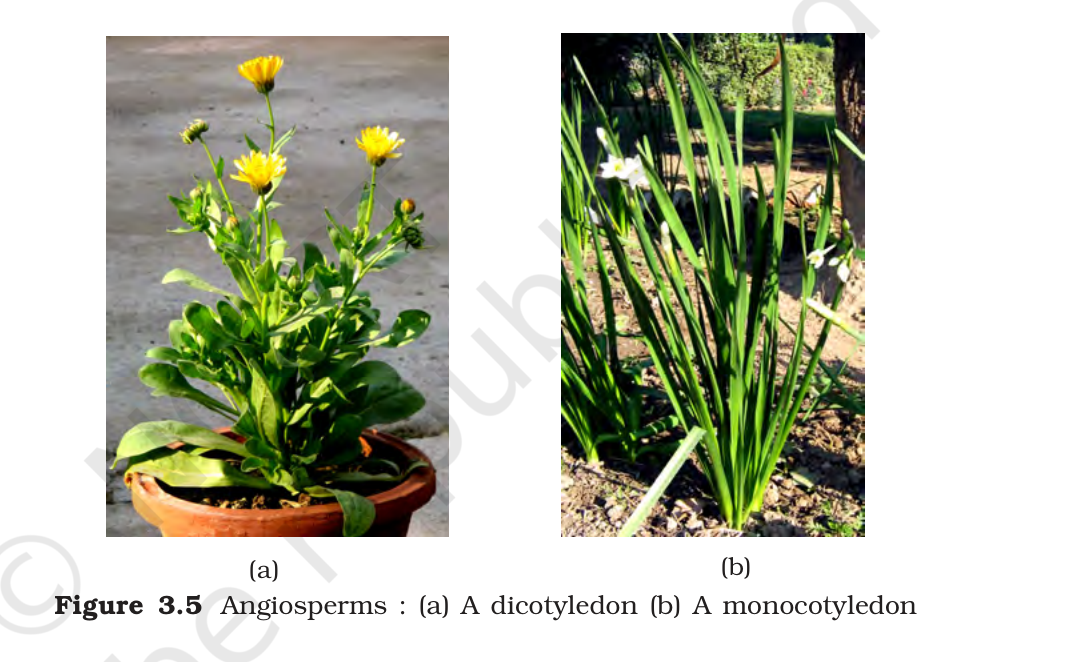
In angiosperms the ovules and pollen grains develop inside flowers, and the seeds sit inside fruits. This is a very large group, spread over many habitats, and its size runs from the tiny Wolffia to Eucalyptus trees over a hundred metres tall. Angiosperms supply food, fodder, fuel, medicines and many commercial products. Two classes divide the group: dicotyledons and monocotyledons.
4.3 The three life cycle patterns
A plant life cycle alternates a diploid sporophyte with a haploid gametophyte, and the two phases differ in length and in independence between groups. In a haplontic cycle the haploid gametophyte dominates and the only diploid stage is the zygote, which divides meiotically at once; most algae follow this pattern. In a diplontic cycle the diploid sporophyte dominates and the gametophyte is a small, short-lived stage; gymnosperms and angiosperms follow this pattern. In a haplo-diplontic cycle both phases are many-celled and free-living, and this is the pattern of many bryophytes and pteridophytes, although the two phases are not equally large. These patterns explain the exercise questions on ploidy.
4.3.1 Practice from the NCERT exercises, questions 2, 4, 6, 9, 10 and 11
Exercise 2. Reduction division happens in the sporophyte stage that makes spores. In a liverwort it happens in the capsule of the sporophyte. In a moss it happens in the capsule too. In a fern it happens in the sporangia on the sporophyte. In a gymnosperm it happens in the microsporangia and megasporangia, first in the spore mother cells and again in the gametophyte before gametes form. In an angiosperm it happens in the anther and the ovule.
Exercise 4. The protonemal cell of a moss is haploid and so is the leaf cell of a moss, the prothallus cell of a fern, the gemma cell of Marchantia and the ovum of a liverwort. The zygote of a fern is diploid, and so is the meristem cell of a monocot. The primary endosperm nucleus in a dicot is triploid.
Exercise 6. Gymnosperms and angiosperms both bear seeds, but the gymnosperm ovules are exposed on megasporophylls and the seeds stay naked, while the angiosperm ovules sit inside an ovary that ripens into a fruit. The angiosperm seed is enclosed, and the angiosperm reproductive organs are gathered into a flower. That is why the two groups are kept in separate classes.
Exercise 10. Chlamydomonas is an alga, Cycas a gymnosperm, Selaginella a pteridophyte, and Sphagnum a moss.
Exercise 11. Gymnosperms have naked ovules and naked seeds, well-developed roots, stems and leaves with vascular tissue, a heterosporous life cycle with male and female cones, and reduced gametophytes that stay inside the sporangia. Their leaves are adapted to dry and cold conditions, and their seeds are not enclosed in a fruit.
Exercise 9, part one. Brown algae are mostly marine, with a cellulose wall covered on the outside by algin, food stored as mannitol or laminarin, fucoxanthin alongside chlorophyll a and c, and two unequal lateral flagella. Red algae are mostly marine, with a wall of cellulose and pectin along with polysulphate esters, food stored as floridean starch, phycoerythrin alongside chlorophyll a and d, and no flagella at any stage.
Exercise 9, part two. Liverworts have a thalloid dorsiventral body, sex organs on the flat thallus, a simple sporophyte and gemma cups for asexual reproduction. Mosses have a protonema followed by an upright leafy stage, multicellular branched rhizoids, sex organs at the tips of the leafy shoots, a sporophyte with a foot, a seta and a capsule, and an elaborate mechanism for dispersing spores.
Slideshow, slide 1 of 3. Use the left and right arrow keys to change slides and the space bar to play or pause.
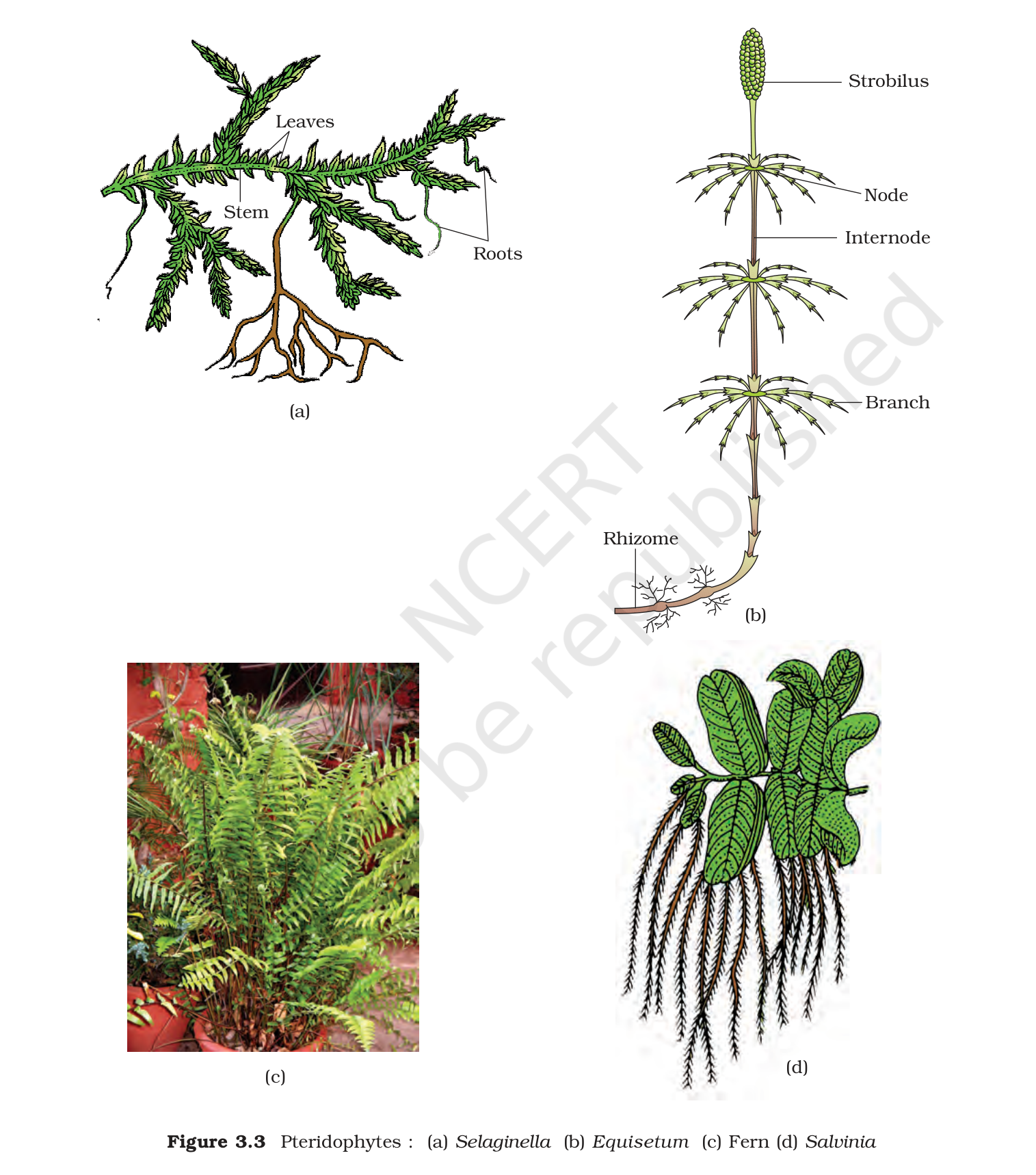
Pteridophytes in the NCERT plate: Selaginella, Equisetum with a strobilus, a fern and Salvinia with its rhizome and roots labelled.
Exam
For a gymnosperm question, start from the naked ovule, because that one fact gives the name and the seed position. Then give the cones, the reduced gametophytes that stay inside the sporangia, and the pollen tube. For a ploidy question, work from the cycle instead of memorising: the sporophyte is 2n, the gametophyte is n, gametes are n, zygote is 2n, and the angiosperm endosperm is 3n.
Common mistake
Do not write that gymnosperms have flowers. A cone is a strobilus of sporophylls, and a flower is a different structure. Do not say gymnosperm gametophytes are free-living, because both live inside the sporangia on the parent plant. And do not write that the endosperm in a dicot is diploid: the primary endosperm nucleus is triploid, because one male gamete fuses with two polar nuclei.