

Concepts: Classifying plants and the algae
Plant Kingdom20 min readLesson 1 of 6
1.1 The plant kingdom and its classification
The previous chapter placed all plants in Kingdom Plantae within Whittaker's five kingdoms. This chapter fills in the kingdom from below. The boundary of Plantae has moved over time: fungi and the cell-walled members of Monera and Protista are no longer counted as plants, even though older systems kept them there. That is also why cyanobacteria are not treated as algae any more. What remains in Plantae are the algae, bryophytes, pteridophytes, gymnosperms and angiosperms.
The history of classification is worth a paragraph of its own. The earliest systems used only the characters a person could see from outside: habit, colour, the number and shape of leaves. Linnaeus built his system on vegetative features and on the structure of the androecium. Such systems are called artificial. They separated close relatives because they depended on a handful of characters, and they gave vegetative features the same weight as sexual ones, although vegetative characters are easily changed by the environment.
Natural systems came next. They grouped plants by natural affinity and used internal features along with the visible ones: ultrastructure, anatomy, embryology and phytochemistry. Bentham and Hooker gave such a system for flowering plants. Modern practice accepts phylogenetic systems, which rest on evolutionary relationships and assume that members of a taxon share a common ancestor. Three newer tools help where the older evidence is thin. Numerical taxonomy puts a number and a code on every observable character and processes the data by computer, so hundreds of characters get equal weight. Cytotaxonomy uses chromosome number, structure and behaviour. Chemotaxonomy uses the chemical constituents of the plant.
1.1.1 Algae: the general form
Algae are chlorophyll-bearing, simple, thalloid, autotrophic organisms, and most of them live in water, fresh or marine. They also grow on damp stones, soil and wood, and some live in partnership with fungi as lichens, or on animals. Their size and form vary widely. Volvox makes a colony, Ulothrix and Spirogyra form filaments, and a few marine forms such as the kelps build massive bodies.
Reproduction takes three routes. Vegetative reproduction is by fragmentation, and each piece grows into a new thallus. Asexual reproduction is by spores, the commonest being motile flagellated zoospores. Sexual reproduction fuses two gametes, and the names depend on their form. Isogamy fuses gametes that are similar in size, whether they are motile as in Ulothrix or non-motile as in Spirogyra. Anisogamy fuses gametes similar in form but different in size, as in some Eudorina species. Oogamy fuses a large non-motile female gamete with a small motile male gamete, as in Volvox and Fucus.
1.1.2 Why algae matter
Algae fix at least half of the carbon dioxide fixed on earth through photosynthesis. They add dissolved oxygen to the water around them. They are the primary producers that start the food cycles of aquatic animals. Several marine algae are eaten: Porphyra, Laminaria and Sargassum are among the roughly seventy marine species used as food. Brown and red algae produce hydrocolloids, the water-holding substances, and algin from brown algae and carrageen from red algae are used commercially. Agar comes from Gelidium and Gracilaria and is used to grow microbes and to make ice-cream and jelly. Chlorella, a protein-rich unicellular alga, is used as a food supplement and has been taken by space travellers.
The three classes are separated by pigment, stored food, cell wall and flagella. Chlorophyceae are the green algae: chlorophyll a and b dominate, they store starch, the wall has cellulose inside and pectose outside, and they grow in fresh and brackish water. Phaeophyceae are the brown algae: chlorophyll a and c with fucoxanthin, stored food mannitol or laminarin, a cellulose wall coated with algin, and two unequal lateral flagella; they are mostly marine. Rhodophyceae are the red algae: chlorophyll a and d with phycoerythrin, floridean starch, and no flagella at any stage; most are marine. The class table in the chapter puts these differences side by side, and the figures below show one example of each class.
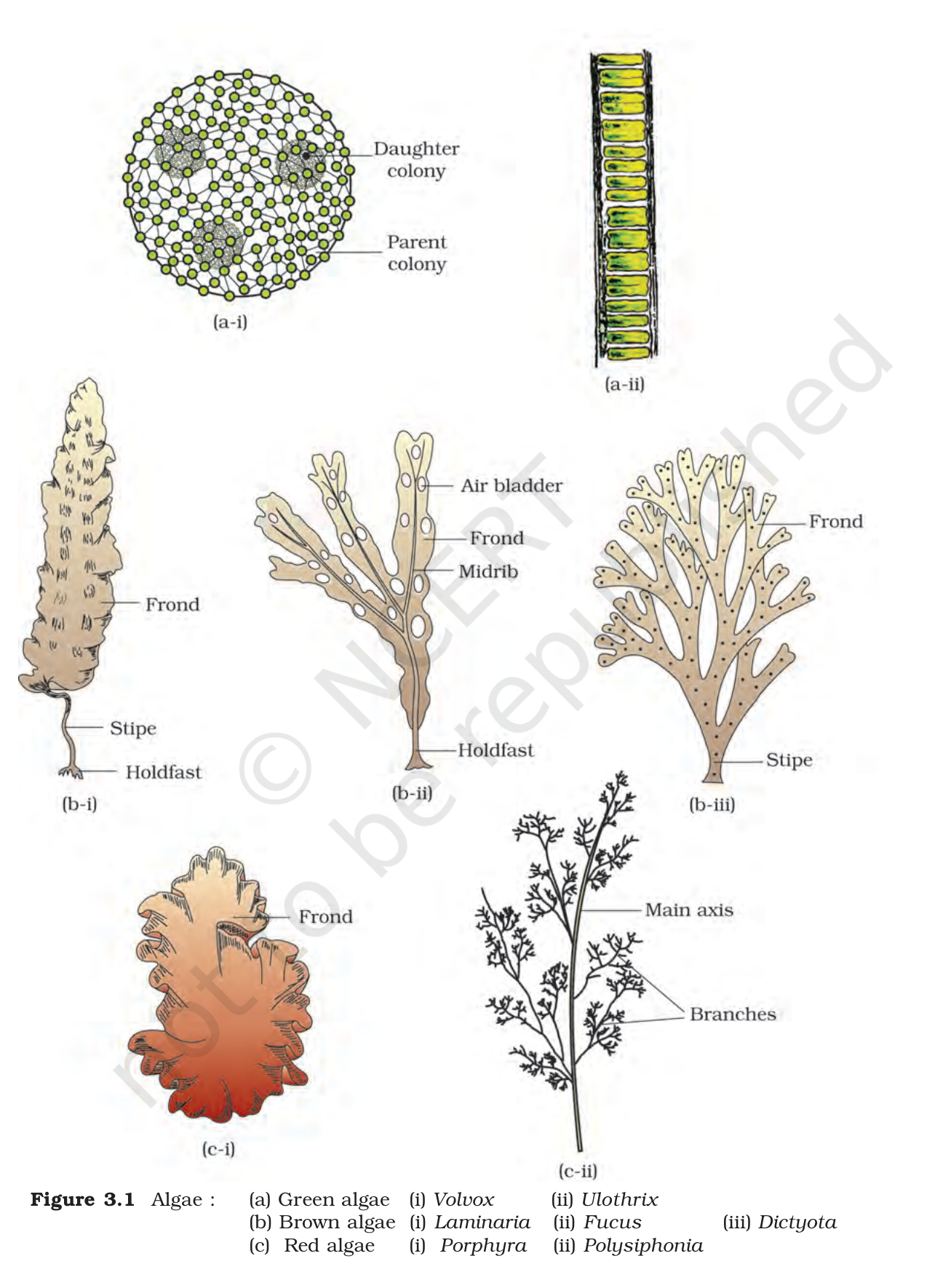
Exam
Algae questions reward a table answer. Keep the three columns ready: class, main pigment, stored food, and one example. Green algae store starch and have a cellulose wall, brown algae store mannitol or laminarin and carry fucoxanthin, and red algae store floridean starch with phycoerythrin in front. For the economic importance question, name algin, carrageen and agar, because the marks sit on those three products rather than on a list of algae.
Common mistake
Do not call cyanobacteria algae, because the chapter has already moved them to Monera. Do not write that all algae are marine, since many live in fresh water. Do not mix the stored food between classes: starch is green, mannitol and laminarin are brown, floridean starch is red. And do not say brown algae lack chlorophyll, because they carry chlorophyll a and c and look brown only because fucoxanthin hides the green.
1.1.3 Practice from the NCERT exercises, questions 1 and 5
Exercise 1. The classification of algae rests on the pigments they carry, the food they store, the chemistry of the cell wall and the number and position of their flagella. These characters are stable in a class and easy to read on a prepared slide, which is why they are used as the basis.
Exercise 5, the algae half. Algae are useful in several ways. They carry out a large share of the carbon dioxide fixation on earth and release oxygen into the water. They are the primary producers of aquatic food chains. Porphyra, Laminaria and Sargassum are used as food, algin and carrageen are hydrocolloids of commercial value, agar from Gelidium and Gracilaria supports microbe culture and food preparations, and Chlorella is a protein-rich food supplement.