

Concepts: Endocrine glands and the human endocrine system
Chemical Coordination and Integration24 min readLesson 1 of 6
1.1 Two kinds of glands
A gland is a cell or a group of cells that makes and releases a secretion. An exocrine gland pours its secretion into a duct, and the secretion reaches the surface or the cavity that the duct opens into; the salivary glands and the sweat glands are familiar examples. An endocrine gland has no duct. Its cells release their secretion directly into the blood, and the blood carries it to the cells that will respond.
The secretion of an endocrine gland is a hormone. A hormone is a chemical messenger made in one place, carried by the blood, and able to act on a specific target cell that carries the matching receptor. Because the hormone travels in the blood, it can reach every part of the body, but only the cells with the right receptor respond. This is why a single hormone can affect one organ strongly and leave the rest of the body almost untouched.
1.2 The human endocrine system
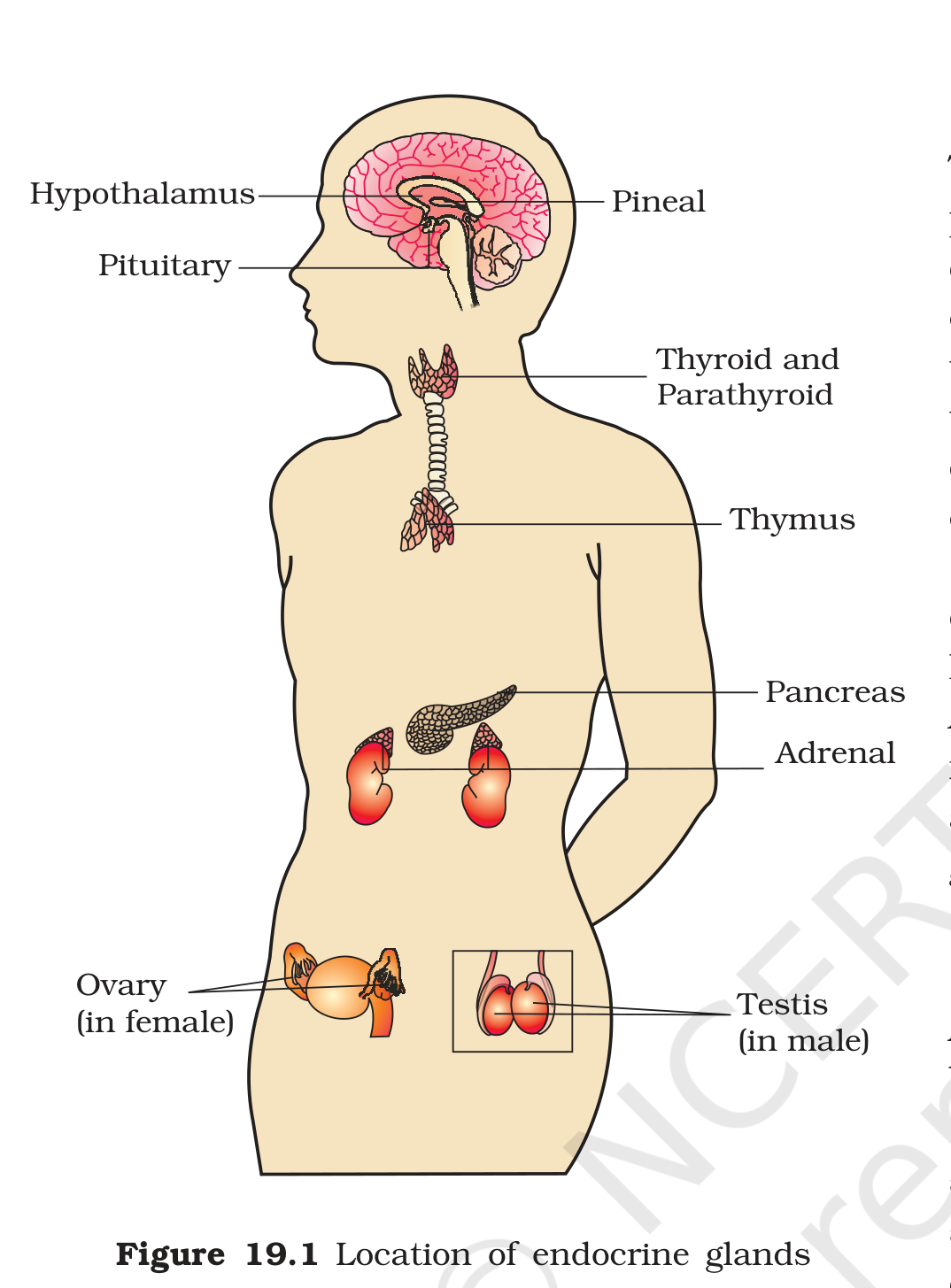
The endocrine system of the body is made of the organised endocrine glands and also of scattered hormone producing cells in other organs. The organised glands are the pituitary, the pineal, the thyroid, the adrenal, the pancreas, the parathyroid, the thymus and the gonads, which are the testis in the male and the ovary in the female. Besides these, the gastrointestinal tract, the liver, the kidney and the heart also produce hormones. The nervous system and the endocrine system work together to coordinate and regulate the body, the nervous system acting quickly through nerves and the endocrine system acting more slowly through the blood.
The hypothalamus is the basal part of the diencephalon of the forebrain, and it is the link between the two systems. It contains groups of neurosecretory cells, called nuclei, whose cells behave like neurons in that they receive signals, and like gland cells in that they release hormones. These hormones regulate the synthesis and release of the hormones of the pituitary gland. There are two kinds of hypothalamic hormones: the releasing hormones, which stimulate the pituitary to release its hormones, and the inhibiting hormones, which stop that release. Gonadotrophin releasing hormone is an example of a releasing hormone, and somatostatin, which stops the release of growth hormone, is an example of an inhibiting hormone.
The hormones made in the hypothalamic neurons travel down their axons and are released from the nerve endings. From there they reach the anterior pituitary through a special portal circulation, a system of blood vessels that links the hypothalamus directly to the pituitary. The posterior pituitary is controlled in a different way: the hormones it releases are made in the hypothalamus and travel down the axons of the hypothalamic neurons to be stored and released from the posterior pituitary. This double arrangement is the reason the pituitary is often called the master gland, even though the hypothalamus sits above it and controls it.
1.2.1 Practice from the NCERT exercises, questions 1 and 2
Exercise 1. An exocrine gland is a gland that releases its secretion through a duct, such as the salivary gland. An endocrine gland is a ductless gland that releases its hormone into the blood, such as the thyroid gland. A hormone is a chemical messenger produced by an endocrine gland or cell, secreted into the blood, and carried to a target cell where it produces a specific effect.
Exercise 2. To show the endocrine glands diagrammatically, draw the outline of the body and mark the hypothalamus and pituitary in the head, the pineal near them, the thyroid and parathyroid in the neck, the thymus in the upper chest, the adrenal on top of the kidneys, the pancreas in the abdomen, the ovaries in the female pelvis and the testes in the male pelvis.
1.2.2 Slow, but far reaching
A nervous impulse can move a muscle within milliseconds, and it acts only on the cells that the axon touches. A hormone is much slower, yet its reach is far greater, because the blood can carry it to every organ in the body. This difference is why the two systems are used for different jobs. Nervous control is used for quick, precise actions such as moving a finger or withdrawing a hand from heat. Hormonal control is used for processes that must run for minutes, hours or years, such as the growth of the body, the level of glucose in the blood and the changes that prepare the body for reproduction. The two systems also meet at the hypothalamus, which is a part of the brain but releases hormones, so the fastest and the slowest control systems of the body are joined at one point.
1.2.3 Why the amount of hormone is controlled
A hormone is powerful even in very small amounts, so its level in the blood must be controlled carefully. The usual control is a feedback loop: the hormone acts on its target and changes the concentration of a substance in the blood, and that change is sensed by the gland, which then adjusts its secretion. When the level of the substance returns towards normal, the secretion of the hormone is reduced. Such loops are the reason a healthy person's blood glucose, blood calcium and water balance stay almost constant even though the body is continuously using and losing these materials.
Exam
For the difference between the two kinds of gland, write duct present against exocrine and duct absent against endocrine, then add one example of each. For a hormone definition, include the four parts: made by endocrine cells, secreted into the blood, carried to a target cell, and acting through a specific receptor. For the hypothalamus, remember that it controls the anterior pituitary through its hormones and the posterior pituitary through the axons that carry oxytocin and vasopressin.
Common mistake
Do not say that a hormone acts on every cell it reaches, because only cells with the matching receptor respond. Do not call the pituitary the master gland without mentioning that the hypothalamus controls it. Do not confuse releasing hormones with the pituitary hormones themselves, since the hypothalamic hormones control the pituitary, not the target organs directly. Also do not call the pancreas only an endocrine gland, because it is a composite gland with both exocrine and endocrine parts.