

Concepts: Exchange and transport of gases
Breathing and Exchange of Gases24 min readLesson 3 of 6
3.1 Diffusion follows a pressure gradient
Each gas in a mixture pushes with its own share of the total pressure, and that share is called the partial pressure; pO2 and pCO2 are the shorthand for oxygen and carbon dioxide. A gas always drifts from a place where its partial pressure is higher towards a place where it is lower. The partial pressures in the atmosphere, in the alveolar air, in the blood entering and leaving the lungs and in the tissues are arranged so that oxygen diffuses from alveolar air into the blood and from the blood into the tissues, while carbon dioxide diffuses in the opposite direction. Table 14.1 in the book and figure 14.3 set out this gradient for both gases. The diffusion membrane has three layers: the thin squamous epithelium of the alveolus, the basement substance, and the endothelium of the blood capillary. Put together, these three layers are still thinner than a millimetre, so the gas has only a very short distance to cross. Carbon dioxide diffuses through this membrane about twenty to twenty-five times faster than oxygen for the same pressure difference, because it is much more soluble in the membrane. Oxygen is therefore the gas that limits the rate of exchange.
3.1.1 Transport of oxygen
About 97 per cent of the oxygen carried by the blood travels attached to haemoglobin inside the red blood cells, and the remaining 3 per cent travels dissolved in the plasma. Haemoglobin binds oxygen reversibly, and the compound formed is oxyhaemoglobin. The amount of oxygen that binds depends on the partial pressure of oxygen, and a plot of percentage saturation of haemoglobin against pO2 gives the oxygen dissociation curve of figure 14.5. The curve is sigmoid: the first oxygen molecule binds slowly, the binding of each subsequent molecule becomes easier, and the curve flattens near the top once the haemoglobin is almost saturated. This shape is why haemoglobin loads oxygen quickly in the lungs and releases it quickly in the tissues. Three factors shift the curve to the right, which means haemoglobin gives up oxygen more readily: a rise in pCO2, a rise in hydrogen ion concentration and therefore a fall in pH, and a rise in temperature. In active tissue all three rise together, so oxygen is released exactly where it is needed. The shift produced by carbon dioxide is called the Bohr effect.
3.1.2 Why the sigmoid shape matters
The sigmoid shape has a practical meaning. In the lungs the pO2 is high and the curve is nearly flat at the top, so a small drop in pO2 does not sharply reduce the amount of oxygen held, and haemoglobin stays almost fully loaded as long as the partial pressure is high. In the tissues the pO2 is low and the curve is steep, so a small drop in pO2 releases a large amount of oxygen. The curve therefore has a loading region in the lungs and an unloading region in the tissues, and that is the real reason for its shape.
3.1.3 Transport of carbon dioxide
Carbon dioxide is carried in three forms. About 70 per cent travels as bicarbonate ions in the plasma, about 20 to 25 per cent travels attached to the globin part of haemoglobin as carbaminohaemoglobin, and about 7 per cent travels dissolved in the plasma. Carbon dioxide entering a red blood cell is quickly converted to bicarbonate by the enzyme carbonic anhydrase, and the bicarbonate then moves out into the plasma while chloride moves in to keep the charge balanced.
3.1.4 Practice from the NCERT exercises, questions 3, 4, 5, 8 and 11
Exercise 3. Diffusion of gases happens only in the alveolar region because the alveolar wall is one cell thick, richly supplied with blood capillaries and covered by a thin film of moisture. The other parts of the respiratory tract have thick walls and little blood supply, so they conduct air but do not exchange gases.
Exercise 4. The major transport mechanisms for CO2 are carriage as bicarbonate ions in the plasma, carriage as carbaminohaemoglobin, and a small amount dissolved in the plasma.
Exercise 5. Compared with atmospheric air, alveolar air has a lower pO2 and a higher pCO2, so the correct choice is the one with pO2 lesser and pCO2 higher.
Exercise 8. A rise in pCO2 shifts the oxygen dissociation curve to the right, so haemoglobin releases oxygen more readily and the tissues receive more oxygen. This helps an active tissue that produces extra CO2.
Exercise 11. The oxygen dissociation curve is the plot of percentage saturation of haemoglobin with oxygen against the partial pressure of oxygen. It is sigmoidal because haemoglobin has four oxygen binding sites and the binding of one molecule changes the shape of the protein and makes the next binding easier, while at very high pO2 the curve flattens as the sites become saturated.
Slideshow, slide 1 of 3. Use the left and right arrow keys to change slides and the space bar to play or pause.
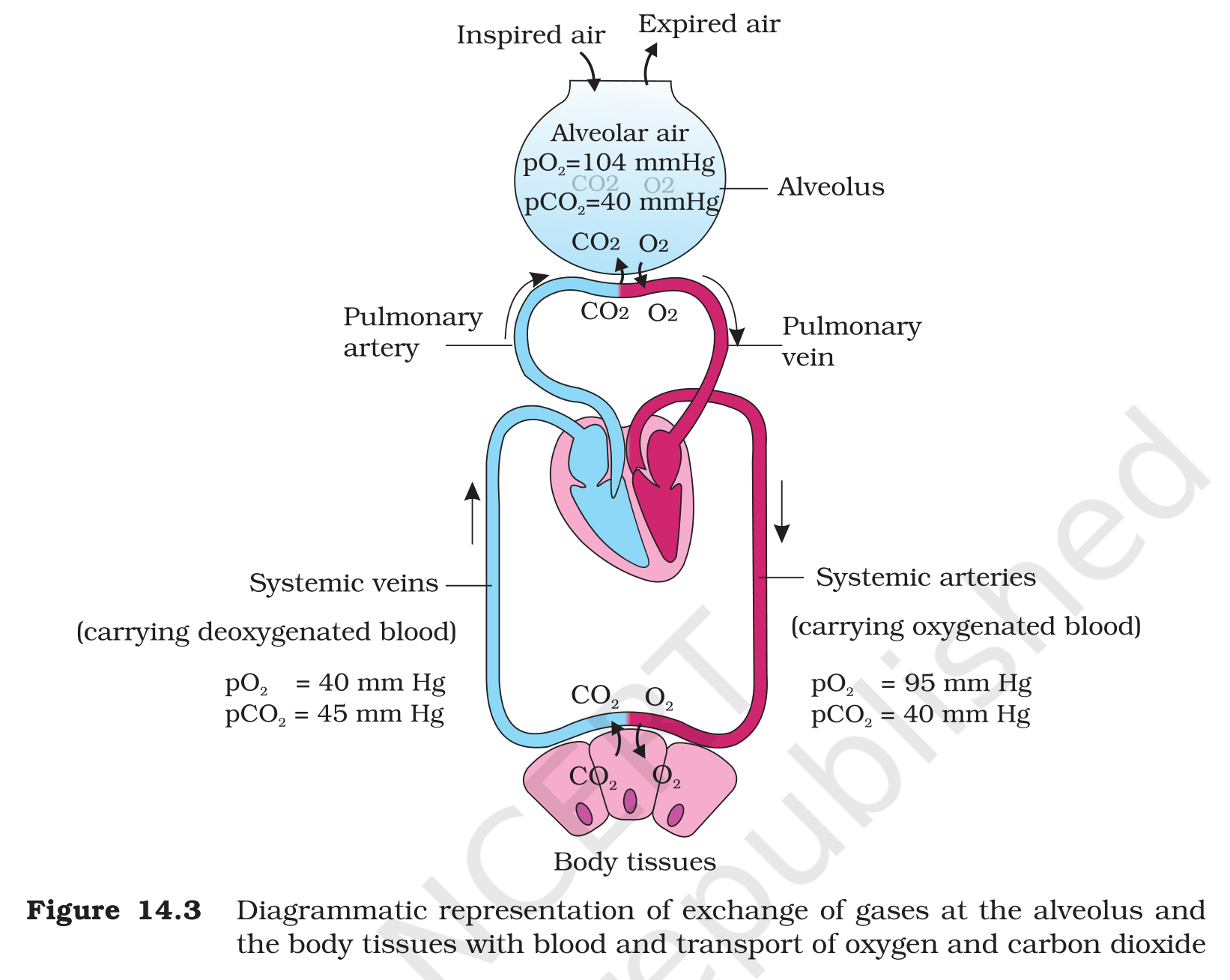
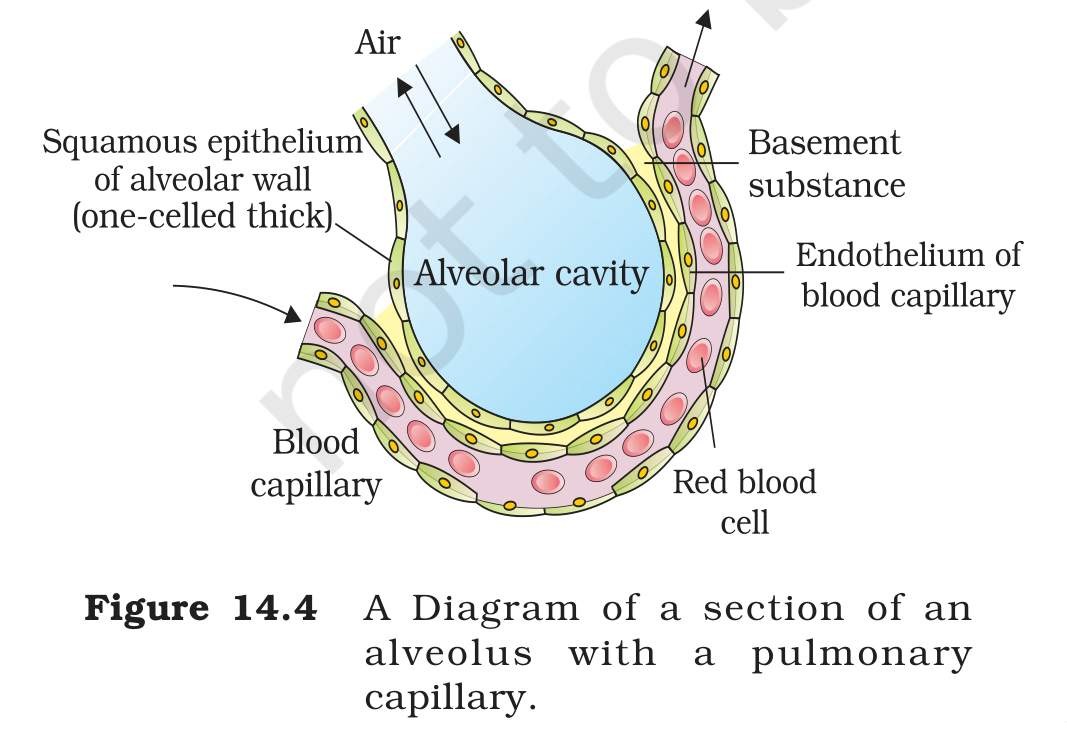
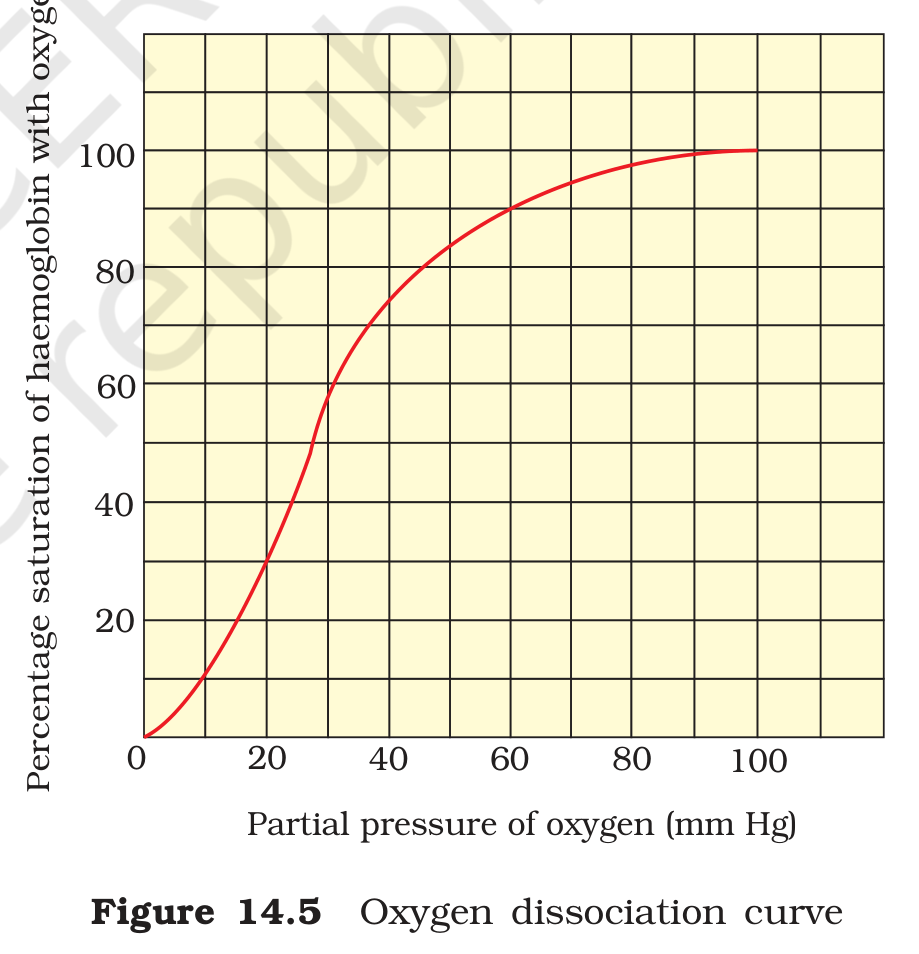
Figure 14.3: exchange of gases at the alveolus and body tissues with the transport of oxygen and carbon dioxide in the blood
Exam
For gas exchange, start from partial pressures and the direction of diffusion, then give the three layers of the diffusion membrane. For oxygen, give the 97 to 3 split, the sigmoid curve and the three right shift factors. For carbon dioxide, give the three routes with their percentages: bicarbonate about 70 per cent, carbaminohaemoglobin 20 to 25 per cent and dissolved about 7 per cent.
Common mistake
Do not say that all the oxygen is carried by haemoglobin, because about 3 per cent travels dissolved in the plasma. Do not draw the dissociation curve as a straight line or as a simple hyperbola, since its sigmoid shape is the point of the question. Do not say that carbon dioxide is carried mainly as carbaminohaemoglobin; the bicarbonate route carries much more. Also do not say that a rise in pCO2 shifts the curve left, because it shifts it right and favours unloading.